date_range
Thursday 20 Aug 2026


 LOCAL EDITION
close
 LOCAL EDITION


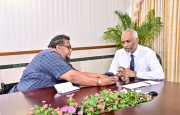
Then-President-Elect Dr. Mohamed Muizzu meets with then-Speaker of Parliament Mohamed Nasheed on October 3, 2023: President Muizzu has rejected Nasheed's invitation for discussion citing it is out of his mandate. (Photo/People's Majlis)
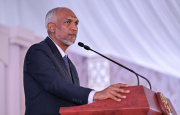
President Dr. Mohamed Muizzu, on Monday, declined to engage in discussions on proposed constitutional and governance reforms put forward by former president Mohamed Nasheed and MDP’s former chairperson Fayyaz Ismail, stating that such negotiations fall outside the mandate granted to him by the public.
At a press conference held on Sunday evening, Nasheed and Fayyaz unveiled a reform framework titled “Bodu Badhalu”, which outlines extensive amendments to the Constitution and the structure of government. The proposals include significant changes to the system of governance, the functioning of the parliament, increased public participation, and measures aimed at strengthening economic self-sufficiency.
During the briefing, Nasheed underscored the urgency of initiating dialogue with the government and invited the ruling People’s National Congress (PNC) to participate in discussions.
“I believe these changes are necessary now. This is not a transformation we should wait until after 2028 to seek. I say to the Maldivian government with all sincerity, we are speaking in good faith; therefore, please come to the table [for discussion],” Nasheed said.
Responding to questions from journalists, President Muizzu stated that his primary responsibility is to deliver on the commitments outlined in the current administration’s five-year manifesto, as tasked by the citizens.
“In my opinion, that is something outside the mandate tasked with me by the people,” he said.
Among the key proposals put forward by Nasheed and Fayyaz is the separation of the roles of Head of State and Head of Government. Under the suggested model, the Head of Government would be directly accountable to Parliament, while the President would serve as Head of State.
Explaining the proposals, Fayyaz said concerns about the governance system in Maldives are frequently raised. He said the President should always be accountable to Parliament.
“We are proposing that there should be someone in charge of peace and politics, such as a head of state and a head of government,” Fayyaz said.
He said the head of state should be politically neutral and able to speak and act on important national issues.
“We think it would be a good change for the head of state to have a role to protect the power of the people and the power of the Constitution,” Fayyaz said.
He said the head of state would be appointed jointly by the councils and Parliament.
The proposals also include establishing an oversight commission to hold independent institutions accountable, removing Supreme Court judges through public vote, and allowing councils and Parliament to jointly make major decisions.
Fayyaz said the Constitution lacks clarity in some areas, creating opportunities for those who do not believe in laws and democracy to undermine people’s rights.
“Therefore, one of our proposals is that all the provisions for the protection of the people, including those related to democracy and people’s empowerment, should be written in the Constitution very clearly and not interpreted in different ways,” he said.
He said the current system is unable to hold the government accountable. When the ruling party holds a parliamentary majority, checks and balances are lost, and the courts can be influenced, he added.
The two also proposed changes to the composition of Parliament, increasing opportunities for women, and giving the public the power to remove members.
Other proposals include increasing public opinion votes, giving people the direct power to remove the supreme head of state, curbing the state’s wasteful exploitation of natural resources, and ensuring the state honors its agreements with businesses.