date_range
Thursday 15 Oct 2026


 LOCAL EDITION
close
 LOCAL EDITION


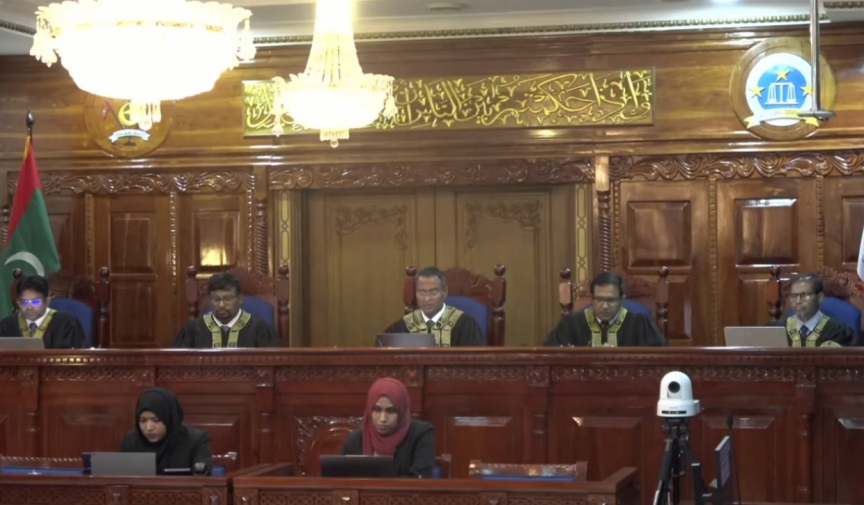
The Supreme Court bench, led by Chief Justice Abdul Ghani Mohamed, delivers its ruling on March 31, 2026.
The referendum question proposed in President Dr. Mohamed Muizzu is not unconstitutional, ruled the Supreme Court on Tuesday, in response to a constitutional case seeking to halt the upcoming referendum on synchronizing the presidential and parliamentary elections.
On February 10, the ruling People’s National Congress (PNC) used its supermajority in the Parliament to pass constitutional amendments proposed by the government to hold future presidential elections and parliamentary elections on the same day.
These constitutional amendments propose merging the two elections, and bringing forward the start of the parliamentary term from May to December 1 to get this done.
This change will shorten the five-year term of the current parliamentary assembly, sworn in on May 28, 2024, by around six months.
On February 16, President Dr. Mohamed Muizzu decreed that a public referendum on this – as required by law on such matters – would be held on Saturday – the same day as the local council elections.
President Muizzu decreed for the following question to be asked of the public:
“Do you approve the ratification of the Eighth Amendment to the Constitution, which provides for the Presidential and People’s Majlis elections to be held concurrently and for a change to the term of the People’s Majlis?”
The Supreme Court received two constitutional cases, challenging the referendum, one of which was rejected.
On Tuesday afternoon, the Supreme Court delivered its judgement on the second case, filed by attorneys Ibrahim Shiyam and Aik Ahmed Easa against the President’s Office, the Attorney General’s Office, and the Elections Commission.

A five-member bench - composed of Chief Justice Abdul Ghani Mohamed, Justice Ali Rasheed Hussain, Justice Dr. Mohamed Ibrahim, Justice Hussain Shaheed, and Justice Abdulla Hameed – had heard the arguments from the two sides during a one-day hearing held on Thursday. At this hearing, the petitioners said that the reason why the referendum is being held is because the Constitution calls for one when making decisions regarding making changes to the term of the current parliamentary assembly, and that voters should therefore be asked whether they agree with changing the term.
They also argued that things that lie within the President’s discretionary powers must also be carried out in line with the spirit of the Constitution.
The state responded that the Constitution does not state how a question being asked in a referendum should be phrased, and that is left to the discretion of the President. The state also argued that the procedures for this is set down in the Referendum Act, which only states that the President must have the question framed in his decree.
The judgement in the case was delivered on Tuesday afternoon by Chief Justice Abdul Ghani, who decided that the referendum question does not violate the Constitution. The rest of the bench concurred.
Key highlights from the judgement:
The upcoming referendum has sparked multiple legal challenges, including at least two filed with the Supreme Court, one with the High Court, and one with the Civil Court.
However, the one the Supreme Court issued the judgement on, on Tuesday is the only one to be heard, with the other cases either rejected or pending a decision on registration.