date_range
Friday 23 Oct 2026


 LOCAL EDITION
close
 LOCAL EDITION


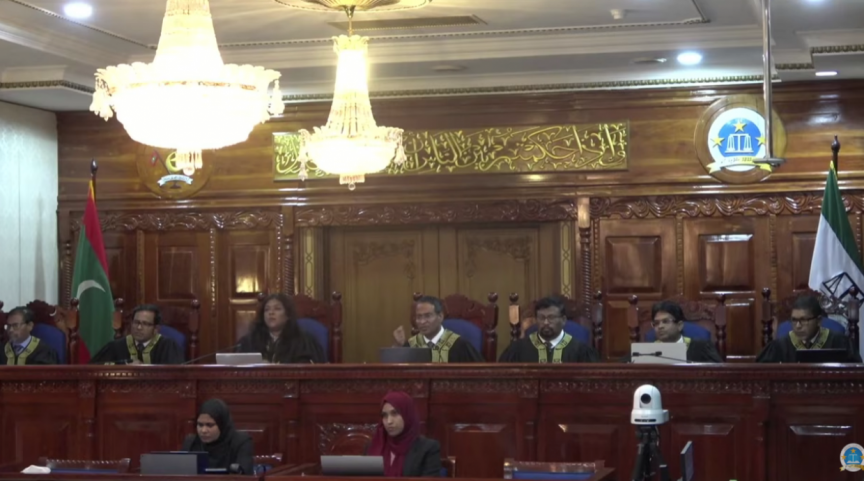
The case is being heard by a full bench.
The Supreme Court is scheduled to deliver its verdict on Wednesday on a constitutional case challenging the anti-defection clauses written into the Constitution in 2024 that empower political parties to unseat parliamentarians.
The top court has scheduled a hearing for 10:15 am Wednesday to deliver its verdict.
The constitutional amendment in question was submitted, passed and ratified in quick succession on November 20, 2024. It added three more circumstances where parliamentarians will lose their seat. They are:
Former Kendhoo MP Ali Hussain, an attorney-at-law, filed a constitutional case with the top court on November 24, 2024, seeking to have the provisions annulled. The main opposition Maldivian Democratic Party (MDP) also intervened in the case.
The first hearing in the case was held on February 17, 2025, and the second hearing was held over a year later, on April 9.
Hearings in the case had remained stalled after the Judicial Service Commission (JSC) suspended three of the judges in the original bench, citing an ongoing criminal investigation against them by the Anti-Corruption Commission (ACC) – the details of which remain unclear.
Husnu Ali Suood resigned in March 2025 after accusing President Muizzu of intimidating the Supreme Court’s judges and subverting judicial independence, while the JSC later opened misconduct investigations against the other two judges, Mahaz Ali Zahir and Dr. Azmiralda Zahir. Despite claiming that the allegations against them were baseless and that the investigations by the JSC were tainted by the denial of due process to them, the two were dismissed by the Parliament in May 2025.
The state argues that all procedures were followed when making the constitutional amendment – an assertion that is rejected by Ali, who argues that the amendment was made in violation of the procedures set down under Article 12 of the Constitution and in violation of the principle of discussion that parliamentarians are required to uphold.
Ali filed the case based on the argument that the amendment violates five specific articles of the Constitution. They are:
All the powers of the State of the Maldives are derived from, and remain with, the citizens.
The powers of the State shall be exercised in accordance with this Constitution.
Unless otherwise provided in this Constitution, every citizen of the Maldives eighteen years of age or older has the right:
a. to vote in elections, and in public referendums, which shall be held by secret ballot;
b. to run for public office;
c. to take part in the conduct of public affairs, directly or through freely chosen representatives.
Members of the People's Majlis should be guided in their actions by considerations of national interest and public welfare foremost, and should not exploit their official positions in any way for their own benefit or for the benefit of those with whom they have special relations. They shall represent not only their constituencies but the country as a whole.
a. No member or other person shall be liable to any proceedings in any court, and no person shall be subject to any inquiry, arrest, detention or prosecution, with respect to anything said in, produced before, or submitted to the People's Majlis or any of its committees, or with respect to any vote given if the same is not contrary to any tenet of Islam.
b. No person or newspaper or journal shall be liable in respect of any report or proceedings made or published under the authority of the People's Majlis, or in respect of any fair and accurate report of the proceedings of the People's Majlis or any of its committees, where this is done in accordance with principles specified by the People's Majlis.
MDP said at the time that they weren’t opposed to anti-defection provisions in principle. But they do not believe it should apply to parliamentarians who are expelled – a move that they say severely undermines the independence of parliamentarians.
They also objected to the lack of extensive consultation and debate before making constitutional amendments.