date_range
Monday 24 Aug 2026


 LOCAL EDITION
close
 LOCAL EDITION


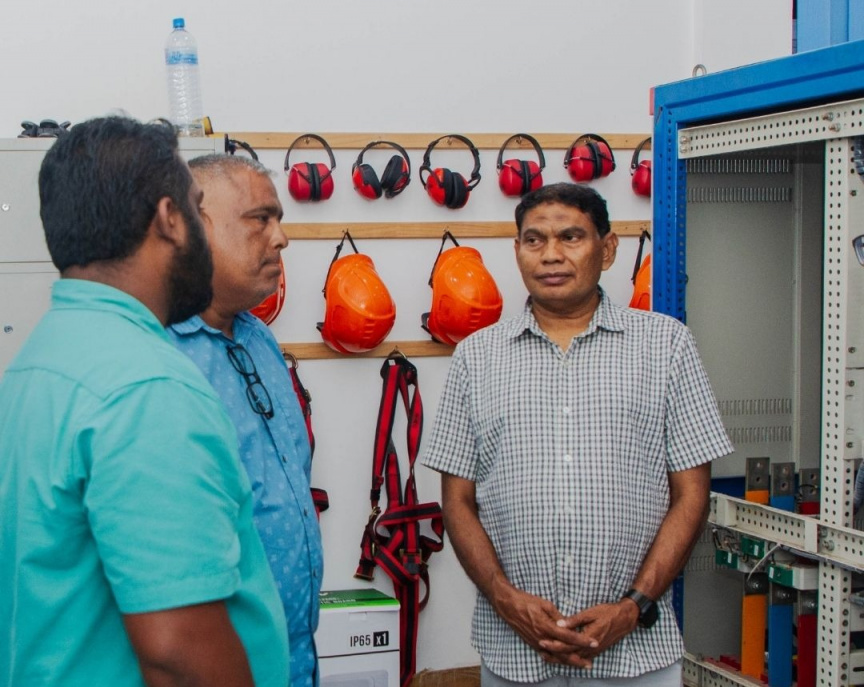
Ahmed Afeef Hussain, managing director of Fenaka Corporation: Afeef says the voluntary redundancy scheme was introduced as there are many staff without work. (Photo/Fenaka)
Fenaka Corporation’s Managing Director Mohamed Afeef says the company introduced a voluntary redundancy scheme offering employees a severance package equivalent to four months’ salary in a strategic effort to reduce its workforce, as there is a substantial number of employees without actual work.
Fenaka, which currently employs around 8,000 people, began accepting applications for voluntary redundancy on Tuesday. According to a memo signed by Chief Corporate Officer Usaid Hassan, which was circulated across all departments, interested employees have until 15:00pm on June 14 to submit their applications.
Speaking with Sun regarding the decision, Afeef described the initiative as a key measure aimed at improving operational efficiency and enhancing the quality of services delivered to the public. He stressed that reducing the workforce is necessary to secure the company’s long-term sustainability.
"These measures will provide the company with the financial flexibility needed to procure essential goods and services required for operations. Furthermore, it will resolve administrative challenges related to payroll and career progression, thereby strengthening the company's internal management," Afif explained.
Afeef noted that the shortage of material required for certain projects has resulted in stalled works on several islands, leaving many employees without active responsibilities. He expressed confidence that the restructuring efforts would improve productivity and elevate service standards.
Employees who opt to resign under the scheme will receive an incentive equivalent to four months’ salary and are required to submit their applications to the Human Resources Department. Afeef said the initiative represents the first phase of a broader policy designed to reform the corporation.
Fenaka has long operated at a loss and has faced repeated allegations of corruption. Concerns have also been raised over the years regarding excessive recruitment by various administration, particularly in conjunction with elections.
As the government continues to bear significant costs associated with state-owned enterprises (SOEs), Finance Ministry in April instructed the Privatization and Corporatization Board (PCB) to begin implementing workforce reduction measures across state-owned companies. The Ministry has since confirmed that several SOEs have already initiated downsizing efforts.
According to the latest statistics, the Maldives, with a population of approximately 400,000, employs 30,312 civil servants. When employees of state-owned enterprises are included, the total number of individuals working for the state rises to 72,312.