date_range
Thursday 20 Aug 2026


 LOCAL EDITION
close
 LOCAL EDITION


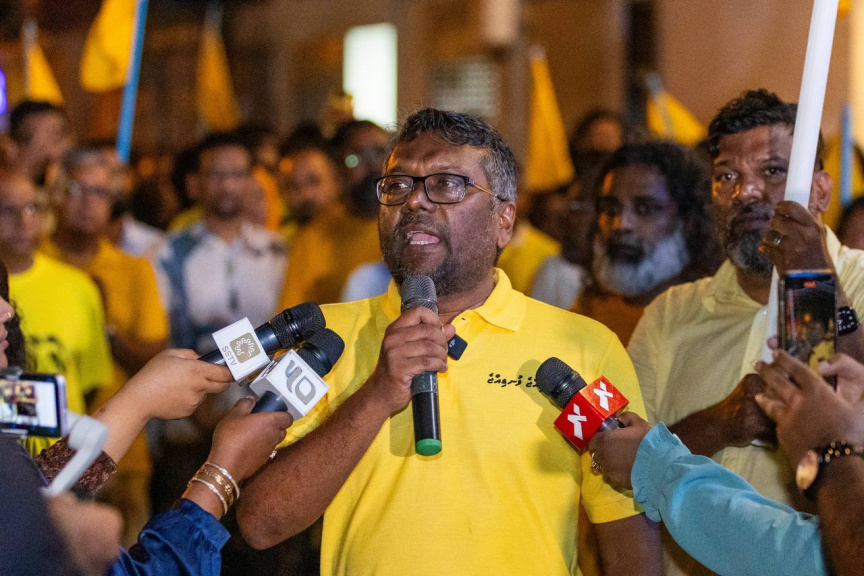
Former MDP chairperson Fayyaz Ismail addressed: Fayyaz has accused the government of pushing to merge two elections as a strategy to secure re-election through the 'backdoor'. (Photo/MDP)
Main opposition Maldivian Democratic Party (MDP)’s former chairperson Fayyaz Ismail has attributed the government’s efforts to amend the constitution to merge the main two elections in the Maldives – the presidential and the parliamentary – as a backhanded strategy to secure a second term through the “backdoor”.
Under the current system, voters go to polls twice within around six months every five years, electing the president in September and members of Parliament in April.
But the amendments, sponsored by PNC’s parliamentary group leader Ibrahim Falah, proposes merging the two elections, and bringing forward the start of the parliamentary term from May to December 1 to get this done.
This change will shorten the five-year term of the current parliamentary assembly, sworn in on May 28, 2024, by around six months.
The first combined poll would take place in 2028.
The bill, which was approved as is in a brief five-minute meeting on Monday with a majority vote of the Independent Institutions Committee, was put to a floor vote on Tuesday morning which was passed a majority vote of 72-1.
During the debate on the bill, three parliamentarians from MDP were kicked out of the chambers or protesting against the bill; Kendhoo MP Mauroof Zakir, Vaikaradhoo MP Hussain Ziyad (Fittey), South Galolhu MP Meekail Ahmed Naseem and Keyodhoo MP Mohamed Niushad.
Other MDP lawmakers were also admonished for disrupting the sitting with their protests, but weren’t told to leave the chamber.
The remaining MDP lawmakers refused to join the vote.
Fayyaz, via a post on X, said the constitutional amendment is not meant to strengthen the system nor to reduce cost but rather serves as a mean for a “deeply unpopular” incumbent administration for re-election through the “backdoor”.
The amendment to the Constitution which will be passed today by the government is not meant to strengthen the system nor to reduce cost. It is a means to consolidate the chances of re-election for a deeply unpopular incumbent government. While the current setup has fallen short…
— Fayyaz Ismail (@faya_i) February 10, 2026
“While the current setup has fallen short of achieving the aspirations of the democratic movement and safeguarding of the people from despotic leaders, the proposed changes will only make it easier for tyrants to stay in power,” he added.
He underscored that what is needed at present, is stronger means by which the people can hold the government and entire state accountable instead of piecemeal changes designed to entrench the powers of the ruling party.
In this regard, Fayyaz said we must work to limit the powers of the presidency, develop stronger means of ensuring the independence of the judiciary and independent institutions, and establish mechanisms for the people to directly intervene and hold their elected leaders accountable.
He called onto reject the ”fraudulent” amendment proposed by the government, and seek real reform that transfers power closer to the people.
“We must recognize the urgency of our situation, and think beyond politics and party in this matter,” he stressed.
Merging the two elections will still require a public referendum.
PNC is pushing to have the referendum held on the same day as the Local Council Election – which is scheduled for April 4.
Elections Commission (EC)’s chairman Mohamed Zahid said the constitutional amendments must be in force by February 18 in order for that to be possible.
President Dr. Mohamed Muizzu first announced plans introduce constitutional amendments to combine the two major elections back in 2024. He promoted it as a cost-cutting measure that will save around MVR 120 million in expenses.
However, the opposition is largely opposed to such a move. While former President Mohamed Nasheed has said he is in favor of combining the two elections, others within the main opposition MDP, including former chairperson Fayyaz Ismail and former Maldivian Vice President Faisal Naseem, as well as former President Abdulla Yameen Abdul Gayoom, who leads the People’s National Front (PNF), have publicly expressed opposition to the move.