date_range
Friday 14 Aug 2026


 LOCAL EDITION
close
 LOCAL EDITION


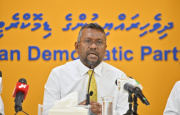
MDP's former chairperson Fayyaz Ismail. (Sun Photo/Moosa Nadheem)
Maldivian Democratic Party (MDP)’s former chairperson Fayyaz Ismail has criticized the public release of surveillance footage by Home Minister Ali Ihusan, stating that even if allegations against former state minister for housing Akram Kamaludeen and MDP's deputy chairperson Ibrahim Waheed were valid, the matter should have been addressed through legal channels rather than social media.
The dispute arose after Minister Ihusan posted a short CCTV clip early Friday morning, alleging that Akram and Waheed had filmed his wife and ten-year-old daughter while they were walking on the street.
In a post on X, Fayyaz accused the current administration of pushing the country toward authoritarianism, describing it as incompetent and lacking respect for ethical and legal standards. He argued that it is inappropriate for a Home Minister to monitor citizens while, in his view, failing to adequately address serious concerns such as injustice and corruption. He also voiced alarm over what he suggested could be the misuse of state resources.
This fascist, hypocritical sanctimonious government is rapidly forcing this state into a dictatorship, and a deeply incompetent one at that, without values or laws. The Home Minister’s use of state resources to spy on citizens —and declaring this publicly— without even… https://t.co/0zUyWlvWnu
— Fayyaz Ismail (@faya_i) February 27, 2026
Fayyaz further warned against the emergence of a “Big Brother” state, where surveillance cameras and personal data might be used to control citizens or influence electoral outcomes. Calling for unity across political lines, he urged the public to stand together against what he characterized as corrupt and irrational governance.
Responding to the criticism, Ihusan stated that individuals who portray themselves as champions of democracy were responsible for recording his wife and daughter outside their home. He clarified that the footage he shared came from a private CCTV system monitoring his residence and did not involve state assets.
Dear Mr. Fayyaz Ismail,
— Minister of Homeland Security & Technology (@min_mohst) February 27, 2026
I would like to clarify the matter for you.
The individuals you hail as “Democratic Champion” leaders were, in fact, recording my wife and young daughter as they walked on the public street directly in front of our family home — an area clearly covered by… https://t.co/nQdM3Bn65L
The Minister also described it as troubling that Fayyaz would defend what he termed unacceptable conduct by MDP members without full knowledge of the facts, adding that such reactions reflected the standards upheld within the party.
In turn, Fayyaz argued that the Minister’s actions undermined the professionalism of the police and reiterated that if sufficient evidence existed, formal legal proceedings should be initiated. He maintained that publicly sharing footage of suspects online was unjustifiable and suggested that the Minister’s decision to do so could indicate a lack of confidence in law enforcement—an irony, he said, given ongoing allegations of personal data misuse under the Minister’s oversight.
Dear Minister
— Fayyaz Ismail (@faya_i) February 27, 2026
Your immaturity is beyond ridiculous and to have you as our home minister is an affront to the very idea of policing. If you have a valid basis agaisnt these individuals then by all means take legal action agaisnt them. As far as the status quo you ARE the Law… https://t.co/ICLEzBhDNN
The video posted by Ihusan shows Waheed recording on his phone while Akram stands nearby, accompanied by another individual on a motorbike. According to the Minister, the footage captured was later circulated through an anonymous account. The shared clip depicts a woman and two young children walking along a street in Malé, with one child riding a bicycle and a man, described in the video as a bodyguard, accompanying them.
Ihusan condemned Akram and Waheed, accusing self-proclaimed advocates of democracy and rights of resorting to undignified tactics, and claimed the incident exemplified what he described as divisive political practices associated with the MDP.