date_range
Sunday 29 Nov 2026


 LOCAL EDITION
close
 LOCAL EDITION


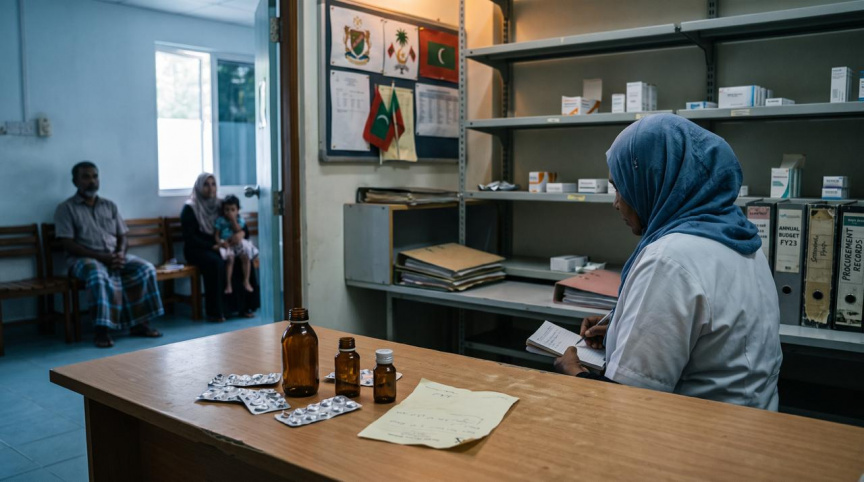
Poster depicts patients waiting in queue at a clinic.
Why have medicine shortages and difficulties seeing doctors not ended for ordinary citizens, even though the state budget allocated a record amount of money with top priority given to the health sector? President Dr.Mohamed Muizzu has announced that the biggest goal of this year's budget is developing the health sector.
Statistics from the Finance Ministry show that a total of 8.8 billion rufiyaa (8,819.6 million rufiyaa) was allocated to the health sector this year. Of this, out of the 2,769.7 million rufiyaa budget allocated to the Health Ministry,2,377.7 million rufiyaa was spent through the 12th of this month. Compared to the 1,816.5 million rufiyaa spent during the same period last year, spending on the health sector this year has increased substantially.
Although total spending from the budget has risen, only a relatively small portion has been spent from the funds allocated for infrastructure development to improve the quality of the health system. According to Finance Ministry figures, 814.7 million rufiyaa was allocated for this year for health sector infrastructure development under the Public Sector Investment Program (PSIP). However, through August 13, only 232.0 million rufiyaa of that amount had been utilized. That means more than 70 percent of the budget allocated to establish health resources remained unused by that point.
The biggest proof that the benefits of this large expenditure are not reaching the public is the growing number of complaints about not getting essential medicines and having to bring medicines from abroad. Many members of the public say it has now been days since they have been unable to get necessary medications.Some say that although medicine used to be issued for one month previously, the situation has worsened further since State Pharma was established, and now medicine is issued for only two weeks.

"My father cannot get the medication he takes for high blood pressure. This is a big deal relative to a country," a 36-year-old young man said while sharing his complaint.
This is not the complaint of just one or two people. A young man recently expressed concern saying that because an essential medicine urgently needed for the chemotherapy of his mother, who is undergoing treatment for late-stage cancer, could not be obtained in the Maldives, the situation became life-threatening. In addition, the Ministry of Social and Family Development said that during visits to households across 17 atolls under its Haalu Kihineth? ("How Are You?") program, members of the public repeatedly submitted complaints about difficulties bringing medicines from abroad and obtaining financial assistance for medical treatment.
Clarifying the main reasons behind the medicine shortages, State Pharma Managing Director Dr. Shah Mahir said that while private parties control 70 percent of the Maldivian pharmaceutical market, STO's share is only 30 percent. He also noted that because the Maldives has a small population, pharmaceutical manufacturers have less interest, creating challenges in sourcing required quantities of medicine and identifying medicine stock in pharmacies in real time.
A parliamentary committee revealed that although officials can see the stock of medicines in the company's pharmacies, doctors and hospitals do not have access to that information, causing major difficulties. Health Ministry State Minister Geela Ali said State Pharma, established to resolve this issue, has imported more than 300 batches of essential medicines. Furthermore, State Pharma said that starting April 1, it established a 24-hour call center and portal and began importing large quantities of 54 types of medicine.

A World Health Organization (WHO) study report shows that out of 535 medicines on the Maldives' essential medicines list, only 243 medicines—or 45 percent—meet the organization's standards. A report by the People's Majlis Public Accounts Committee also states that the absence of a system requiring doctors to prescribe only essential medicines, and the lack of a robust mechanism to control medicine prices and manage stock, are major reasons why health welfare system expenses are high.
In addition to medicine shortages, having to wait a long time to see doctors and get tests done is also a major problem in the health system. Malé City Council member Ahmed Ghalib said that because people have to wait in queues for months to see doctors and get tests done at IGMH and Hulhumalé Hospital, citizens are forced to seek treatment at private facilities at high cost. This is a longstanding hardship that the public has been enduring.
"Because doctors here suspected my wife had cancer, I went to India since getting the test done to check for cancer was delayed after registering at Hulhumalé Hospital. After staying in India for three months, confirming nothing like that was there, returning to the Maldives, and staying on my island caring for my children, the hospital called giving a queue number to do the test. That is the state this country is in," a young man said sharing his experience.
Such delays increase the need to travel abroad for treatment, placing a heavy burden on out-of-pocket expenses and the Aasandha budget. Although the number of patients sent abroad under Aasandha decreased somewhat between 2023 and 2025 as specialized treatments expanded in the Maldives, the Health Ministry said overall spending has not dropped because more people are going abroad for cancer treatment. The biggest evidence of this is that out of the two billion rufiyaa allocated to Aasandha for this year, 1.7 billion rufiyaa was spent through September 24. That represents an increase of 330 million rufiyaa over the same period the previous year, leaving only 300 million rufiyaa in the budget for the remainder of the year.

In addition, long delays by the state in paying money owed to domestic and foreign healthcare providers also disrupt services. According to statistics released by the People's Majlis Public Accounts Committee, the amount of money Aasandha owes to local and foreign hospitals, clinics, and pharmacies has reached 1.15 billion rufiyaa. The committee also revealed that unpaid medical assistance owed to various facilities through the National Social Protection Agency (NSPA) has reached 662 million rufiyaa.
Maldivians who have to travel to countries such as India and Sri Lanka because they cannot get adequate treatment in the Maldives face major hardships not only with travel and accommodation costs, but also in obtaining foreign currency. Although it was decided to issue $2,000 through Bank of Maldives (BML) to those traveling for medical treatment under Aasandha and NSPA and $1,000 to those traveling at their own expense,those traveling at their own expense receive dollars only after submitting an appointment letter from a foreign hospital.
Velidhoo constituency MP Mohamed Abbas said out-of-pocket spending for healthcare and seeking treatment abroad has risen, increasing how often people must beg for public help and pushing citizens to the point of desperation. At the same time, Keyodhoo constituency MP Mohamed Niushad also expressed concern in the People's Majlis, saying the system has fallen to a state where citizens must beg for medical treatment.

The root of all these problems is that the Maldives' health system is congested in Malé. A World Bank report states that because there has not been adequate investment in health services in the atolls, people are forced to travel from the atolls to Malé—and then abroad—to seek higher-quality treatment. As a result, hospitals in Malé are overburdened and queues for OPD visits and diagnostic tests have grown long; therefore, key performance indicators (KPIs) such as service delivery times and appointment wait times have been included in IGMH's framework to find solutions.
Furthermore, inconsistencies in measures to prevent diseases in advance have also become a major challenge for the health system. WHO statistics show that 84 percent of deaths in the Maldives are from non-communicable diseases such as cancer and heart disease. Additionally, 26 percent of the Maldives' population (113,414 people) use tobacco. Although the government raised the duty on a cigarette from 3.30 rufiyaa to eight rufiyaa to address this issue, the result was a decline in legal cigarette imports and an increase in cigarette smuggling. Of the import duty revenue projected from raising the duty, only 61 percent was collected.Following this, the government changed that policy and decided to lower the cigarette duty back to four rufiyaa,and the People's Majlis passed and ratified the bill. The government said the decision to halve the duty was made on WHO advice.
The World Bank's Public Expenditure Review states that although the Maldives spends heavily on the health sector compared to other middle-income countries, the outcomes are below what is expected. The main reason for this is a shortage of trained Maldivian healthcare professionals. Health Ministry statistics show that 64 percent of doctors and 41 percent of nurses working in the Maldives are foreign nationals. The WHO has stated that short retention periods for foreign staff, low spending on disease prevention and primary healthcare, and the lack of a strong referral system force patients from the atolls to come directly to tertiary hospitals in Malé.