date_range
Wednesday 14 Oct 2026


 LOCAL EDITION
close
 LOCAL EDITION


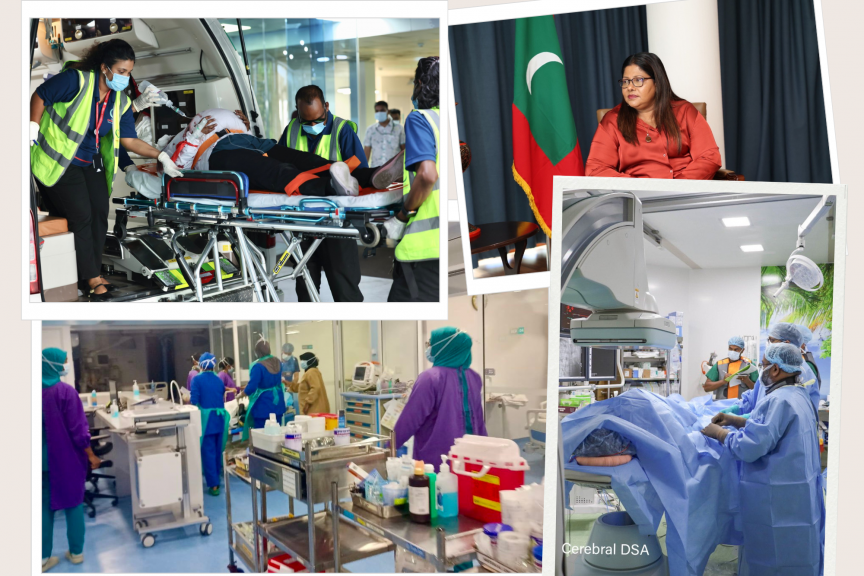
I recently returned from a sudden trip to a country where Maldivians commonly go for medical treatment. Hundreds of Maldivians are there seeking care. Among the hospitals and clinics of this neighboring country, it is rare to find a place where Maldivians are not seen. It would not be a lie to say that hospitals in cities like Trivandrum, Cochin, and Bangalore in India, and Colombo in Sri Lanka, are a second home for Maldivians. Even in hotel lobbies and restaurants, you meet only Maldivians. This is not a new sight.
Even though agents who help Maldivians see doctors joke that the sudden increase in people is an effect of the results of the recent elections, behind this lies a long-standing, unresolved major issue. That is the fact that many people do not trust the Maldivian health system.
Many believe that the Maldivian health system is too weak to provide adequate treatment to patients. The biggest complaint from most Maldivians spoken to is the mistakes made in diagnosis and giving medicine without conducting adequate tests. They say that when they go to a doctor due to difficulties, it is common to start treatment based on a guess rather than finding the actual cause of the illness. The result is that the illness does not get better and they have to face additional health problems. Many patients say that what is actually happening in the body is not clear until they go abroad, conduct tests, and show themselves to experienced doctors. This is a very large burden to bear financially and mentally for the patient and the family.

"In the Maldives, most of the time, tests are not done. They just prescribe some medicine and send us away. Or they say something scary without even looking properly. These places [abroad] are not like that. Tests can be done the next day. They will not give a medicine until after the tests are done," said an 84-year-old Maldivian man, sharing his experience while abroad for treatment.
This is not just the complaint of one person. Many people, for whom Maldivian doctors decided that major operations for heart problems, kidney diseases, and cysts were necessary, found out after testing abroad that no such danger existed. Because of such incidents, the trust held in the entire system has been lost.
Another Maldivian, who has been to a neighboring country about 30 times for medical treatment, noted that unlike the Maldives, tests can be done easily and quickly in those countries.
"While doing tests in these hospitals at our own expense, a full body [checkup] can be done much cheaper than in the Maldives. Again, tests can be done any day you want. You can see the doctor on that same day. And look, it's not just any ordinary doctors. We are able to immediately consult doctors who have gained many years of experience. This is the reason why this trip is necessary," he said.
What is clear from these stories of many people spoken to is that, even if money has to be spent, the citizens want a system where they can get quick and trustworthy treatment.

In addition to the problems of diagnosing illness, the quality of medicine and the amount available is also a major concern for the Maldivian citizens. They say that the medicines in the Maldivian market are not of the highest quality, and the problem of lack of access to essential medicine has become common. Although an essential medicine list is compiled in accordance with World Health Organization (WHO) standards, an arrangement for those medicines to be available without disruption has not been established. And the failure to properly implement policies to encourage the use of generic medicine when issuing prescriptions is also an issue. This is also one of the main reasons patients are forced to depend on foreign countries.
According to statistics from the Maldives Monetary Authority (MMA), the main purpose for 51 percent of Maldivians traveling abroad is to seek medical treatment.
No result for this spending?
The existence of these problems is surprising, given the high state spending on the health sector. Looking at statistics, MVR 7.46 billion was spent on the health sector in 2024. Last year, this amount increased to MVR 8.3 billion. And in the budget passed for this year, has an allocation of MVR 8.8 billion. Additionally, MVR 3.38 billion was spent through the Aasandha scheme in 2024 alone, with people seeking more than one million times. However, because of the poor quality of service, Maldivians spend hundreds of thousands of dollars from their own pockets annually on Indian hospitals alone. This is a very large burden on the country's economy.
When compared with the health systems of other countries, what is most lacking in the Maldives is a strong system of primary health care or basic health treatment. In developed countries, a patient will first see a family doctor. That doctor identifies the patient's entire health history, and after conducting necessary tests, refers them to a specialist doctor if they need to see one. However, in the Maldives, many people go directly to specialists. Because of this, hospitals become overcrowded, the time a doctor has to give to each patient decreases, and the chance of making errors in diagnosing illness increases.
Additionally, the lack of a strong auditing system to ensure the quality of places providing health services is also a reason for the loss of trust. The main reason hospitals in countries like Thailand and Malaysia can provide high-quality services is the strict quality control system that exists in those places.

Radical changes are needed to regain the trust lost in the health system. Firstly, an independent quality assurance system must be established to ensure the accuracy of the results of tests conducted in hospitals and clinics. Secondly, a way to monitor the standard of doctors and provide continuous training must be established. And it is important to have a strong system where patients' complaints are heard, investigated, and action is taken. At the same time, the spending on schemes like Aasandha, instead of just being given for medical treatment, must be targeted towards preventive healthcare and developing the resources available in the Maldives. Establishing a health management information system that can connect the entire Maldives is also an important solution for this.
Even though the spending the Maldives makes on the health system is increasing year by year, there is no end to the complaint that of lack of access to adequate treatment and medicine. The trust is low, despite the billions in spending. Maldivians are forced to spend heavily on hospitals in foreign countries. If the funds we have available cannot be invested in strengthening Maldivian laboratories and diagnostic resources and ensuring the quality of medicine, the trips Maldivians make to foreign countries to seek treatment will not end. It is already late to implement these changes.