date_range
Monday 12 Oct 2026


 LOCAL EDITION
close
 LOCAL EDITION


Ameenee Magu has long been a topic of ridicule among Maldivians. Looking back several years, even a small amount of rainfall would turn the road into what resembled a flowing river. As a result, people frequently shared edited photos on social media depicting ferries and launches travelling along Ameenee Magu, in widespread mockery.
Efforts to permanently address this issue were finally initiated during the last MDP administration. The project was fully completed under the current administration. However, the completed work must now be redone. This project has become yet another example that offers important lessons for the Maldives.
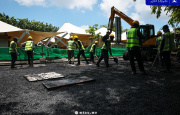
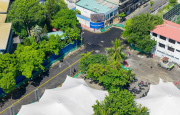
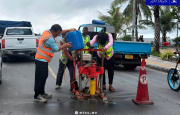
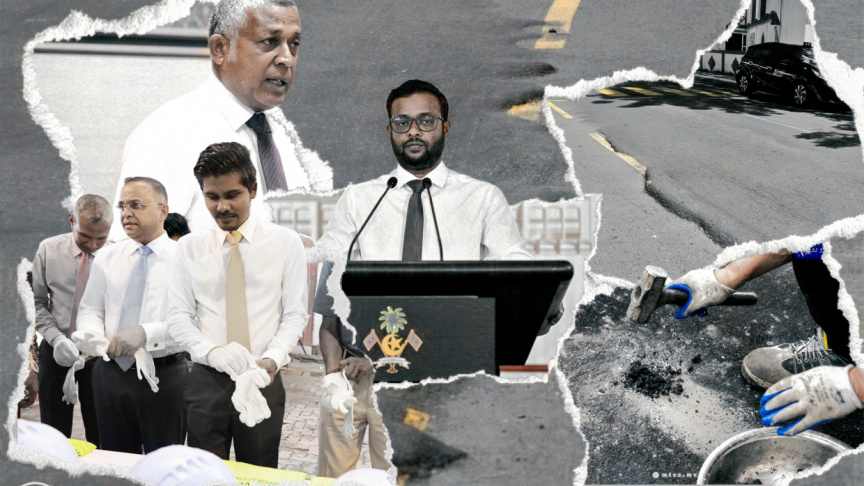
Less than two years after the redevelopment of Malé's Ameenee Magu, which was completed at a cost of MVR 84.4 million from the state budget, work commenced this week to excavate the road once again and repair it using heavy machinery. The Infrastructure Ministry has contracted the Maldives Transport and Contracting Company (MTCC) to reconstruct the western end of Ameenee Magu. The work was officially awarded to MTCC on June 15, 2026, after the asphalt surface in this critical section—including the Dharumavantha Hospital and Harbour Food Court area—severely deteriorated, with numerous bumps and potholes developing.

The project was launched in July 2022 under the administration of former president Ibrahim Mohamed Solih, when it was awarded to the Road Development Corporation (RDC). A significant portion of the work was completed before the 2023 presidential election. Following the inauguration of President Dr. Mohamed Muizzu's administration, the remaining two segments of the road were completed within just 36 days. However, defects later emerged in sections constructed under both administrations. The asphalt surface began to deteriorate. As large potholes developed, conditions deteriorated to the point where travelling along the road became increasingly difficult.
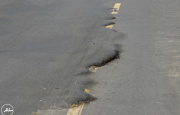
In the section constructed under Solih's administration, these issues were particularly severe in the Iskandhar Koshi area, where the asphalt surface eventually warped into waves and ridges. In the section completed by the current administration, the final two segments are in particularly poor condition. The need to reconstruct a newly completed road within such a short period highlights significant shortcomings in the execution of infrastructure development projects.
Why did this happen? The high cost of damage
Relevant authorities state that the rapid deterioration of the asphalt on Ameenee Magu resulted from engineering deficiencies and the use of unsuitable machinery. According to recent core-cutting tests conducted by MTCC, the sub-base beneath the asphalt had not been properly compacted. Because the sub-base lacked sufficient strength, the movement of heavy vehicles caused the asphalt to shift and crack.
Speaking in the Parliament, Infrastructure Minister Dr. Abdulla Muththalib, stated that RDC had initially carried out the asphalt paving using manual equipment operated by inexperienced workers. Consequently, the asphalt thickness was inconsistent, allowing water to penetrate the surface. Furthermore, although the western end of Ameenee Magu serves as a primary route for large public transport buses, the road's design failed to account for the axle loads imposed by these vehicles. The force generated when buses stopped and accelerated caused the asphalt surface to deteriorate completely.
The need to reconstruct a major road in less than two years represents a substantial loss to both the state budget and local businesses. After completing the project at a cost of MVR 84.4 million, the government must now incur additional expenses to remobilize contractors, lay new asphalt, and operate heavy machinery. These are funds that could otherwise have been allocated to sectors such as healthcare or housing. Instead, they must now be spent repeating the same work.
Furthermore, as Ameenee Magu is home to a large number of shops and cafés, the road closure will once again reduce business income. In addition, the poor condition of the road caused damage to citizens' motorbikes and taxis, including broken shock absorbers and burst tyres, forcing many people to spend significant amounts on vehicle repairs. This is the cost of negligence.
Following the closure of Ameenee Magu from Izzudheen Magu to Dharumavantha Hospital until August 28th, major changes have once again been made to traffic flow within Malé. The greatest concern is the difficulty faced by ambulances transporting emergency patients to IGMH and Dharumavantha Hospital. Having to navigate ambulances through narrow streets because of road closures poses a serious risk to lives.
Moreover, the public transport system has also been disrupted. Access to the Villingili Ferry Terminal, which is relied upon by thousands of residents, has once again become more difficult.

According to MTCC, buses operating on RTL Route 10 (Orchid Route) will no longer stop at the Social Centre, IGMH, and Dharumavantha Hospital. Services on Route 11 have been temporarily suspended. Meanwhile, Routes 1, 3, 7, and 15 will now conclude at the Maafannu Bus Terminal. As a result, travel times for schoolchildren and employees have increased, creating significant inconvenience. Media outlets, citing eyewitness accounts, also reported that even before the road was closed, raised sections of asphalt had caused motorbikes to skid at night, resulting in dangerous accidents.
What is the solution?
The situation on Ameenee Magu reflects the consequences of placing political priorities above sound engineering standards. Rushing infrastructure projects ahead of elections has become a common practice in the Maldives. While the previous administration hurried to complete the initial sections of the road before the last presidential election, the current administration completed the remaining two segments in just 36 days at "Muizzu Speed." Political leaders have prioritised cutting ribbons quickly rather than ensuring long-term quality.
This project has imposed significant financial losses and hardship on both the state and the public. Rather than holding the contractor accountable for the project's failure, political leaders have instead engaged in assigning blame to one another. While the current administration argues that the previous government's planning was flawed, critics point out that the sections suffering the greatest damage are those constructed under the present administration.

Strong measures must be introduced to prevent the continued waste of public funds and to ensure the quality of infrastructure projects. First, it should be mandatory for independent third-party engineering consultants to inspect and certify both the density of the sub-base and the quality of the asphalt before any road is opened to the public. Second, strict regulations should require contractors to provide a three- or five-year Defect Liability Period, ensuring that any road failure during that period is repaired at the contractor's own expense. Furthermore, road designs for bus routes should adequately account for dynamic loads through the use of polymer-modified bitumen or concrete.
Most importantly, project timelines should be determined by engineering requirements rather than electoral schedules. Unless such changes are implemented, millions of rufiyaa in public funds are likely to continue being wasted repeatedly, as demonstrated by the case of Ameenee Magu. This illustrates one of the fundamental reasons why the Maldives has not progressed as much as it should: carrying out projects without proper planning or strong guiding principles. Ameenee Magu stands as clear evidence of that.