date_range
Monday 19 Oct 2026


 LOCAL EDITION
close
 LOCAL EDITION


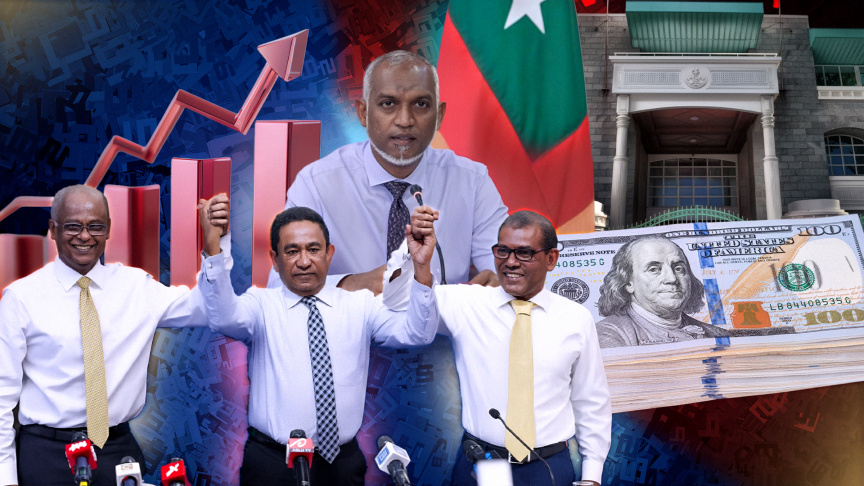
The four Maldivian presidents linked to the dollar-scandal timeline and the government actions that fueled it. (Sun Graphics/Salim)
Did something go wrong? Not my doing. Did something go right? Me, that was my achievement.
This is the political reality of the Maldives, yesterday and today. The "blame game"—or one leader pointing fingers at another—is the most common practice. In the political arena, responsibility for problems is always pinned on the governments that came before the incumbent one. However, as the price of the dollar rises on the black market, political debate alone will not change foreign exchange rates. While the official rate remains pegged at MVR 15.42, by mid-year, the black market rate for the dollar has surged to between MVR 21.60 and MVR 22.10. This is approximately 40 percent higher than the official rate.
Looking at the economic history of the Maldives, every administration from 2008 to the present day has implemented policies that exacerbated structural flaws in the economy. These include bloated state spending, money printing, high-interest borrowing, and the weakening of institutional governance. Together, these factors have dealt major shocks to the Maldivian financial system. Statistics clearly demonstrate that the dollar shortage is not a sudden development, but the cumulative result of flouting core economic principles over many years.

The roots of this issue trace back to the changes introduced under President Mohamed Nasheed’s administration in 2011. In April 2011, the exchange rate—which had been pegged at MVR 12.85—was allowed to float within a 20 percent horizontal band ranging from MVR 10.28 to MVR 15.42. Following this decision, the market rate immediately hit the ceiling of the band at MVR 15.42.
As reported by the International Monetary Fund (IMF), although this policy was intended to absorb external shocks following the 2008 global financial crisis, implementing it without accompanying expenditure cuts led to inflation and eroded public purchasing power. Devaluing the currency without fiscal consolidation created market anxiety, birth-marking the parallel black market seen today. Since then, the gap between the official dollar rate and actual market availability has never truly narrowed. While the government framed the policy as an economic remedy, its practical outcome was severe hardship for citizens and local businesses.
Subsequently, President Abdulla Yameen’s administration launched massive infrastructure projects. Major developments—including the Sinamalé Bridge, the reclamation of Hulhumalé Phase II, and the expansion of Velana International Airport—were primarily financed through external commercial loans and sovereign bonds. The Sinamalé Bridge, built with Chinese assistance, cost approximately millions of dollars, while airport development incurred a USD 374 million loan burden.
While these projects delivered physical modernization, the high-interest debt imposed a heavy future repayment burden on the state. Taking on large commercial loans without diversifying foreign exchange inflows forced the state to draw heavily on its reserves for debt servicing. The administration was even hesitant to levy bridge tolls. Although infrastructure development is vital for growth, the commercial terms of these borrowings multiplied pressure on foreign reserves. Crucially, because most of these projects generated no direct USD revenue—with the exception of the airport—debt servicing had to be subsidized by foreign exchange earned elsewhere. In short, massive loans were taken to finance non-revenue-generating projects.

Under President Ibrahim Mohamed Solih’s administration, the Fiscal Responsibility Act was suspended in response to the COVID-19 pandemic, leading the government to monetize its deficit by printing money through the Maldives Monetary Authority (MMA). Reports indicate that between 2020 and 2023 alone, over MVR 8 billion was injected into the economy.
For a small, import-dependent economy, introducing this volume of liquidity flooded the market with local currency and sent USD demand soaring. Consequently, the rufiyaa lost value, reserve depletion accelerated, and black market rates spiked sharply. While money printing offered a short-term cash flow fix for government operations, its broader macroeconomic cost was severe. Businesses struggled to convert excess rufiyaa into the dollars needed for imports. Economically, this unbacked expansion served as a primary driver of currency depreciation. Even after the economy reopened post-pandemic, the structural imbalances created by monetary expansion remain unresolved.
The current administration of President Dr. Mohamed Muizzu inherited a heavy debt burden, prioritizing debt service above all. However, critical fiscal consolidation measures—such as downsizing non-essential public employment, transitioning from universal subsidies to targeted social assistance, and restructuring state-owned enterprises (SOEs)—have faced implementation delays, maintaining high pressure on public finances.
Even though direct deficit monetization via the MMA has ceased, slow expenditure reduction has kept the budget deficit wide, posing severe challenges to usable reserves. The government continues to fund infrastructure projects, while delayed payments to contractors have strained private sector cash flows. Consequently, pressure on the foreign exchange market remains unabated. Although the administration has announced cost-cutting measures, international financial institutions continue to voice concern over delays in execution.
Corruption across successive administrations has further compounded the dollar shortage. Chronic weaknesses in public financial management, procurement irregularities, and SOE inefficiencies have repeatedly drained state resources. The massive MMPRC embezzlement scheme stands as a prime example.

When foreign currency revenues and state assets are misappropriated rather than directed toward reserves or productive investments, the financial system loses its foreign exchange buffer. Millions in lost USD revenue ending up in offshore accounts inflicts direct structural damage on the domestic economy. Such scandals erode foreign investor confidence, further constricting capital inflows to the Maldives.
"Looking at President Yameen, President Solih, and President Muizzu, I see no fundamental difference in their underlying economic approaches," noted a financial expert and former managing director of a state-owned enterprise, speaking on condition of anonymity. "All three expanded SOEs, handed out political appointments, and relied on debt to finance low-return projects. The economy is now living through the bitter consequences."
The dollar crisis is not merely a product of political decision-making; it is deeply tied to structural economic vulnerabilities and global headwinds. A major immediate challenge is the heavy debt service schedule due this year. Repaying the USD 500 million sovereign Sukuk alongside other external obligations requires drawing nearly USD 1 billion from state reserves and the Sovereign Development Fund (SDF).
This heavy debt servicing restricts the amount of foreign currency the central bank can supply to commercial banks. As the state competes for scarce dollars to avoid default, private businesses are squeezed out, driving trade further into the black market. Given that this year marks the highest debt service obligation in Maldivian history, the strains across the economy are acutely felt.

The Maldives remains almost 100 percent reliant on imports for food, fuel, and construction materials. Annual import bills reach billions of dollars; in 2019 alone, imports totaled USD 2.8 billion. Rising global commodity prices and geopolitical disruptions raise import costs, requiring significantly more USD to import the same volume of goods. Post-pandemic supply chain shifts and global inflation have only expanded this outflow, while limited domestic production leaves little room to reduce import reliance.
Economists also point out that a portion of tourism receipts remains outside the domestic banking system, though tourism still provides the vast majority of foreign exchange entering the country. Additionally, outward remittances from foreign workers and expenditure on overseas healthcare and education continually draw dollars out of domestic circulation, further driving up market rates.

Assigning blame to previous administrations will not solve the foreign exchange crisis. Addressing it requires structural economic reform. Looking to international precedents, Seychelles successfully navigated its 2008 economic crisis through decisive structural adjustment: floating its currency, eliminating universal subsidies, and transitioning to direct, targeted cash transfers for vulnerable households.
The Maldives must similarly move away from universal subsidies on fuel, food, and healthcare (Aasandha), shifting to a targeted safety net for low-income households. This would reduce fiscal waste and mop up excess MVR liquidity. While reducing subsidies is politically difficult, it is essential for macroeconomic stability. The Seychelles experience shows that while harsh adjustments cause short-term pain, they restore long-term equilibrium and stabilize the currency.
Following East Asian models, establishing regulations that require foreign currency earnings to flow through the domestic banking system is equally crucial. The MMA recently introduced rules requiring tourism establishments to convert 20 percent of their USD revenues through local banks. Given that tourism is the primary generator of foreign exchange, future policy design must engage industry experts to ensure revenue goals are met without undermining sector competitiveness.
As demonstrated by Sri Lanka and several Pacific island nations, approaching creditors early to negotiate debt restructuring and extend maturities can provide critical breathing room. The Maldives must actively engage key international creditors to reschedule debt service payments. Extending repayment windows reduces annual debt service costs, preserving foreign reserves for essential imports. While some fear restructuring risks credit rating downgrades, it remains a far safer path than reserve exhaustion and sovereign default. Sri Lanka, after defaulting, initiated IMF-backed restructuring to stabilize its economy and rebuild reserves.

Finally, tightening monetary policy and reforming SOEs are imperative. The IMF has consistently advised the Maldives to cease deficit monetization and enforce fiscal discipline. Permanently halting money printing, restructuring loss-making SOEs, and strictly prioritizing high-return capital projects are fundamental to stabilizing the exchange rate over the long term. Because SOEs represent one of the largest drains on the national budget, privatization or operational overhauls must form the core of fiscal reform. Ensuring central bank independence from political influence remains another critical benchmark emphasized by international financial institutions.
Resolving the dollar crisis requires decisive implementation rather than political rhetoric. Containing public spending, targeting social subsidies, and enforcing foreign exchange conversion rules are immediate necessities.
The timeline and political will with which the government implements these announced reforms will determine the trajectory of the Maldivian economy. The implementation date of the proposed subsidy reforms will serve as the first real test of structural adjustment. Unless political debate gives way to national interest and tangible policy execution, the dollar shortage will deepen, and the burden on ordinary citizens will continue to grow. The reality is clear: every past administration contributed to this crisis through repeated missteps. What remains to be seen is whether current leaders have the resolve to fix it.