date_range
Wednesday 14 Oct 2026


 LOCAL EDITION
close
 LOCAL EDITION


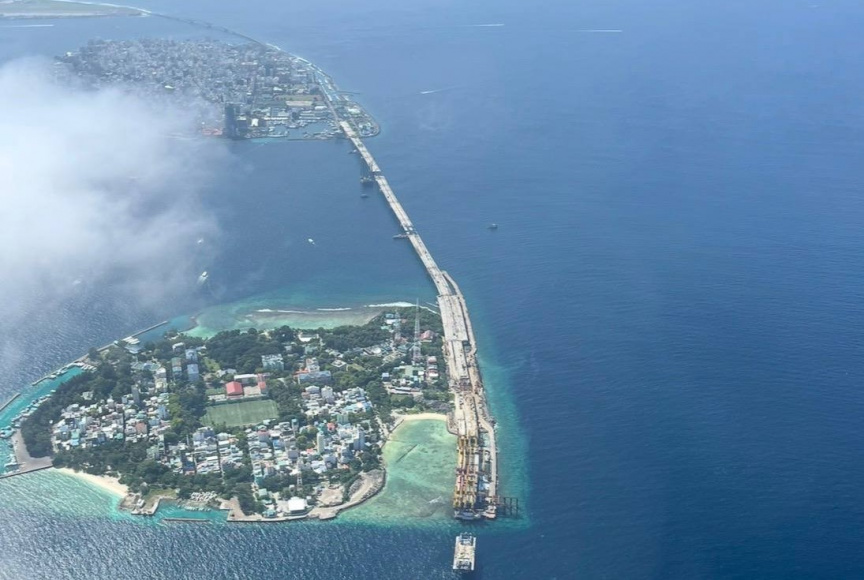
An aerial shot of the Thilamale' Bridge under development between Male' and Vilimale'. (Sun Photo)
The following is an op-ed by Rishi Suri, is editor and director of The Daily Milap.
___
For years, discussions surrounding India-Maldives relations have been dominated by geopolitics. Analysts have often framed the relationship through the lens of strategic competition in the Indian Ocean, external influence, military cooperation, or the growing presence of major powers in the region.
Yet the future of India-Maldives ties may ultimately be defined by something far more tangible: infrastructure.
The single most important symbol of that reality is the Greater Malé Connectivity Project (GMCP), the largest infrastructure project in Maldivian history and the biggest development initiative India has ever undertaken in the island nation. Funded through a package of US$500 million comprising a US$100 million grant and a US$400 million Line of Credit from India, the project represents far more than a bridge. It is a long-term investment in the economic future of the Maldives.
The GMCP will create a 6.74-kilometre network of bridges and causeways linking Malé with Villingili, Gulhifalhu and Thilafushi. Once completed, it will become the backbone of the Greater Malé urban region.
To understand its significance, one must first understand the unique geography of the Maldives.
The country consists of nearly 1,200 islands scattered across the Indian Ocean, with fewer than 200 permanently inhabited. Economic activity, government administration and employment opportunities remain heavily concentrated in the capital region. Malé is one of the most densely populated urban areas in the world, facing chronic pressures related to housing, transport and limited land availability.
For decades, these constraints have limited the Maldives’ economic potential.
The GMCP seeks to change that equation by physically integrating key economic zones around the capital. Thilafushi is being developed as the country’s primary industrial and logistics hub. Gulhifalhu is expected to emerge as an important residential and port development zone. Improved connectivity between these islands could significantly reduce transport costs, ease congestion in Malé and create new opportunities for businesses and residents alike.
Infrastructure has always been the hidden foundation of economic transformation. Roads, bridges, ports and transport corridors rarely generate headlines after construction, but they shape investment flows, labour mobility and long-term productivity for decades.
For the Maldives, whose economy remains heavily dependent on tourism, such diversification is becoming increasingly important.
Tourism directly contributes around one-fifth of the country’s GDP and remains the principal source of foreign exchange earnings. More than 1.5 million tourists visit the Maldives annually, making tourism the lifeblood of the national economy.
However, the vulnerabilities of overdependence became evident during the Covid-19 pandemic, when tourism arrivals collapsed and government revenues came under severe strain. The experience highlighted the need for stronger logistics networks, expanded urban infrastructure and new economic sectors capable of generating employment beyond the tourism industry.
This is where the GMCP assumes strategic importance.
Unlike many geopolitical debates that fluctuate with electoral cycles, infrastructure projects have enduring effects. A bridge that reduces travel times, improves cargo movement and connects workers to jobs creates measurable economic value irrespective of which political party is in power.
In fact, the real test of foreign partnerships in the Maldives is increasingly shifting from rhetoric to delivery.
Ordinary Maldivians are less interested in abstract geopolitical narratives than in practical outcomes: affordable housing, reduced congestion, employment opportunities, reliable transport and economic growth. Any external partner that contributes meaningfully to these goals is likely to earn long-term goodwill.
This is precisely why the GMCP matters.
For India, the project represents a model of development-focused engagement. Rather than viewing the Maldives solely through a security lens, New Delhi has increasingly emphasised connectivity, capacity building and infrastructure development. The project demonstrates an understanding that influence in the twenty-first century is often built through economic relevance rather than political messaging.
The significance of the project also extends beyond bilateral relations.
The Indian Ocean is witnessing growing competition over ports, logistics corridors and maritime infrastructure. Small island states are increasingly seeking partnerships that provide economic benefits while preserving national autonomy. In such an environment, successful infrastructure projects become powerful instruments of trust and credibility.
Of course, the GMCP has faced challenges. Construction delays have pushed expected completion timelines beyond initial projections, with revised schedules extending toward 2026.
Yet infrastructure projects of this scale are rarely judged solely by construction timelines. They are ultimately judged by their long-term economic impact.
If the project succeeds in unlocking new industrial zones, expanding residential development and reducing the concentration pressures facing Malé, its economic dividends could be felt for generations.
That is why the future of India-Maldives relations may not be decided in strategic seminars or political slogans. It may instead be determined by whether bridges are completed, ports become operational, businesses expand and citizens experience tangible improvements in their daily lives.
In the end, geopolitics may shape headlines. Infrastructure shapes history.
And in the Maldives, history is increasingly being built one bridge at a time.
____
Rishi Suri is editor and director of The Daily Milap, India’s oldest and largest Urdu newspaper. He writes on geopolitics, strategic affairs, and regional diplomacy, with articles published in leading international publications.