date_range
Wednesday 14 Oct 2026


 LOCAL EDITION
close
 LOCAL EDITION


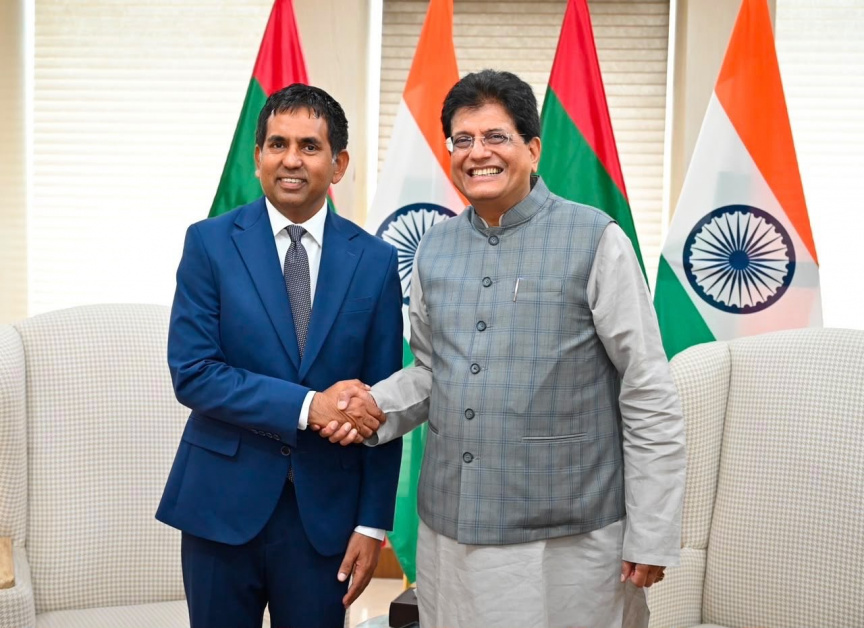
Maldivian Economic Minister Mohamed Saeed (L) with Indian Commerce Minister Piyush Goyal (R). (Photo/X/Mohamed Saeed)
When Maldives Economic Minister Mohamed Saeed travelled to New Delhi last week, it made headlines and rightly so. A senior Maldivian minister sitting across the table from one of India's most powerful cabinet members, with trade bodies and business leaders in the room, is not an everyday moment. It is the kind of engagement that, if followed through properly, can change things for ordinary Maldivians.
Minister Saeed met Indian Commerce and Industry Minister Piyush Goyal. He also sat down with the leadership of two of India's biggest private sector organizations — the Confederation of Indian Industry and FICCI. These are not just networking meetings. These organizations speak for thousands of Indian businesses that have the money, the expertise and the appetite to invest. Getting in the room with them matters.
The main topic on the table was the India-Maldives Free Trade Agreement — a deal that was launched when President Dr. Mohamed Muizzu visited India in 2024. A free trade agreement, in simple terms, means that goods and services can move between the two countries with fewer taxes and fewer barriers. For a country like the Maldives that imports so much of what it needs, and that is always looking for new ways to earn income, this kind of agreement can make a real difference to the cost of doing business and to the everyday price of goods.
India and the Maldives have always had a close relationship. We share history, geography and culture. India is one of our closest and most important trading partners, and a major source of the essential goods our islands depend on every day. But the economic relationship between our two countries has not always had the formal structure it needs — the proper agreements and investment channels that turn goodwill into actual projects on the ground.
That is what makes this visit meaningful. It is not just about keeping good relations warm. It is about building the machinery that makes those relations work for people — for the fisherman who wants a better price for catch, for the young Maldivian who wants a job, for the entrepreneur who wants access to a bigger market.
Minister Saeed himself said he is looking forward to translating the discussions into "tangible opportunities" and "lasting mutual prosperity." Those are the right words. But words need to be followed by results. The Maldivian public will be watching for the projects, the investments and the agreements that come next.
We are a small country. We cannot afford to let good momentum go to waste. When a door is open, we must walk through it.
The visit to New Delhi shows that both sides are serious. India has the scale, the investment capacity and the private sector energy to be a genuinely transformative partner for the Maldives. The Maldives has the location, the goodwill and the political will at the top to make this work.
Now we need to see it in action. We need impactful projects. We need deals that create jobs, reduce costs, and open new doors for our economy.