date_range
Monday 26 Oct 2026


 LOCAL EDITION
close
 LOCAL EDITION


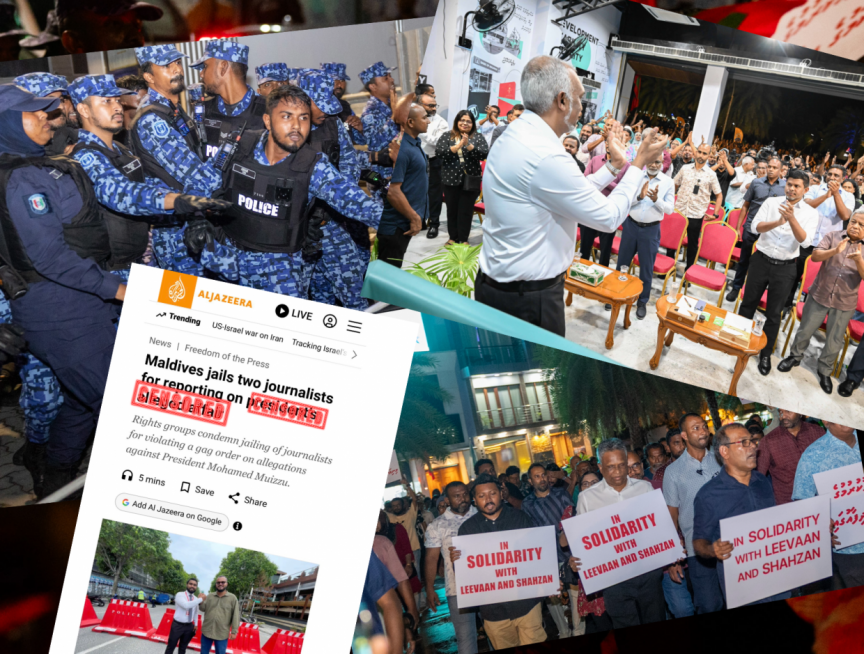
Yesterday, while browsing Al Jazeera, a close friend noticed a headline reporting the imprisonment of two journalists for allegedly violating a court order. He immediately remarked, “What a disgraceful display this country is putting on before the eyes of the world. At last, these issues have reached the international press.”
Even ordinary citizens today feel a sense of embarrassment. This is a natural consequence when a nation’s most unfortunate incidents begin attracting global attention. Earlier this month, Maldivian journalists were already concerned about the country’s significant drop in the World Press Freedom Index. Roughly two weeks later, the reality behind that decline is becoming increasingly visible.
Press freedom is being systematically constrained through the use of state mechanisms. Journalists are working under growing pressure, both direct and indirect, in an atmosphere marked by fear and uncertainty over potential consequences following publication or questioning.

The world’s attention is now fixed on developments in the Maldives. International media outlets have reported on the imprisonment of Maldivian journalists, while civil society organizations and press freedom advocates continue to raise concerns and call for government action. Questions are also being raised about how foreign diplomats in the country are viewing these developments, and what impact they may have on the Maldives’ reputation.
Is it not the reputation of the Maldives that is being tarnished before the entire world?
Democracy Advocated on the International Stage, Silenced Voices at Home
In international forums such as the United Nations, government leaders maintain that the Maldives guarantees full rights and freedoms. While these are clearly stated in the Constitution, questions remain about how fully they are being applied in practice.
As the Maldives continues to present itself as a leading voice among Small Island Developing States (SIDS), its domestic democratic space appears increasingly fragile, with growing limits on open expression and discussion.
Amid this situation, President Dr. Mohamed Muizzu said at a PNC gathering last night:
“We are now a nation recognized and accepted by the international community. We have established ourselves as a partner whose voice carries weight globally.”
These statements contrast with growing concerns about the country’s democratic direction and international image.
Undoubtedly, these developments are being closely watched by the international community.

What Will Be the Impact on Global Confidence in the Maldives?
Foreign diplomats and international organizations in the Maldives are closely monitoring the situation, particularly concerns within the journalistic community. Reports are being sent to their respective governments and headquarters, and this is expected to affect the Maldives’ foreign relations and global image.
According to a foreign policy expert, while a single incident may not cause lasting damage, repeated cases involving pressure on media and journalists can have serious consequences. International partners are likely to question the state of democracy in the Maldives. The key issue is whether the government is acting in line with national laws and democratic principles; if not, criticism from international organizations and press freedom groups is likely to continue, weakening global trust.
This is the situation unfolding today.

What is clear is that these developments are not isolated. The world is watching closely. Rather than being seen as a stable democracy, the Maldives risks being viewed with growing skepticism. As allegations of corruption and attempts to suppress reporting circulate online, the country’s diplomatic image faces further strain.
Ultimately, what is at stake is trust in the nation. For a small country dependent on international cooperation in areas such as tourism, foreign relations, and climate action, any erosion of that trust could have long-term consequences.