date_range
Wednesday 14 Oct 2026


 LOCAL EDITION
close
 LOCAL EDITION


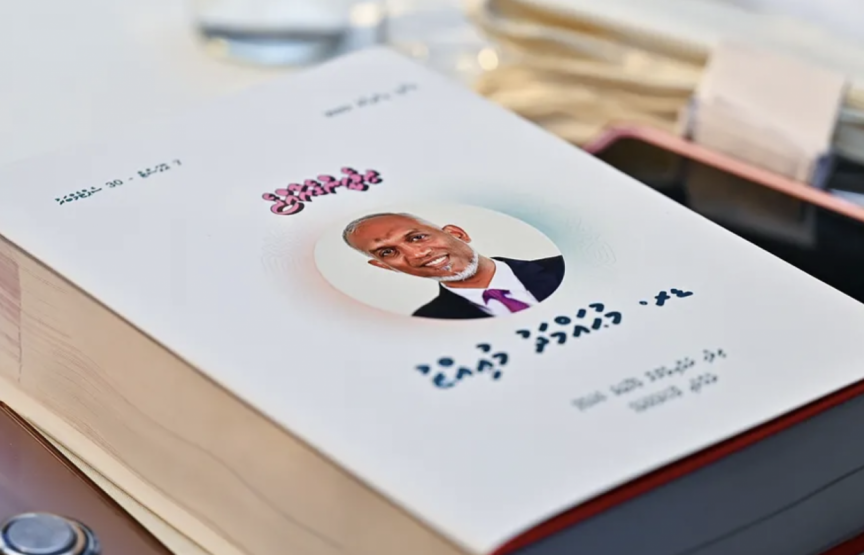
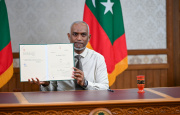
A book containing President Dr. Mohamed Muizzu's electoral pledges. (Photo/Mihaaru)
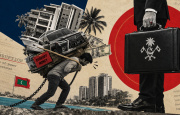
President Dr. Mohamed Muizzu has now completed 895 days in office, with 932 days remaining in his current term. As the administration reaches this midpoint, a prominent observation is that, rather than focusing on productive governance, it has remained consistently entangled in major controversies. This has contributed to a noticeable decline in overall performance.
President Muizzu’s journey to the head of state is on a trajectory often compared to the step-by-step advancement model seen in countries such as China. Having served seven years as Housing Minister and later as Mayor of Malé, he was widely viewed to possess a deep understanding of the system and the ability to deliver results. However, as the term approaches its halfway mark, he is frequently perceived as being preoccupied with "off-field" political maneuvering.
The President secured his mandate on the basis of an extensive set of pledges outlined in a 1,024-page manifesto, to which further pledges have since been added. Public expectations are, therefore, considerably high. Among the most significant pledges is the gaurantee that, by the end of the five-year term, no citizen would remain without housing. Given that he would have accumulated twelve years of combined experience—seven as Minister and five as President—by the end of the term, this pledge is expected to be fulfilled. Yet, as the administration passes its midpoint, there has been little meaningful progress in this sector. Despite announcements of large-scale housing projects and loan schemes, tangible outcomes remain limited, and it currently appears unlikely that the pledge will be delivered to the extent originally envisioned.

Additionally, the administration pledged to improving the healthcare system, increasing Maldivian’s self-reliance, and expanding agriculture to strengthen food security. Pledges also extended to major infrastructure initiatives, including an underwater tunnel linking Rasmalé and Malé. Despite commanding a full parliamentary majority and exercising significant authority, the government’s performance to date remains concerningly weak.
Public dissatisfaction is most clearly reflected in the results of this month’s local council elections and the public referendum. With a voter turnout of 73%, the ruling PNC suffered a huge defeat. The opposition MDP secured the mayorships of all five cities—Malé, Addu, Fuvahmulah, Kulhudhuffushi, and Thinadhoo. Furthermore, in the referendum on merging presidential and parliamentary elections, 68% of voters rejected the government’s proposal. These outcomes send a clear signal regarding public sentiment on the administration’s performance.
Instability and constant turmoil
The administration encountered challenges almost immediately, as relations deteriorated with former president Abdulla Yameen—the very figure whose political backing contributed to President Muizzu’s election. A prolonged political conflict emerged between the government and Yameen, which continues to this day. Early in its term, the administration also had soured relations with India, the Maldives’ closest neighbor. Controversial remarks by senior officials and a confrontational policy stance escalated into a significant diplomatic strain. Although the government later sought India’s assistance, the initial tensions which attracted international attention, have yet to fully stabilize.
After consolidating parliamentary control, the government turned its attention to the judiciary. In particular, the handling of the Supreme Court bench as it heard a case directly linked to the interests of the government has been viewed as a setback for a system based on the separation of powers.
Then came the “war” to exert control over the media, with the question of press freedom intensifying. Most recently, after a documentary by the news outlet "Adhadhu," police conducted a court-authorized raid of its office. The raid, carried out as the media commission already reviewed the matter, drew international scrutiny.
The government has also faced intense criticism over the creation political positions beyond what was pledged, withholding information regarding these posts, as well as over allegations of various political deals and corruption.
As a result of repeatedly navigating such self-induced turmoil, the administration has struggled to produce sufficient results. While it is true that it inherited a delicate fiscal situation due to debts accumulated by previous governments, its productivity has declined further due to its own missteps.
The need for action over reaction
Sources within the government indicate that fulfilling its promises will require a shift in approach—specifically, prioritizing action over rhetoric. This includes reducing reactive responses to emerging issues and limiting time spent on political maneuvering in favor of results-driven governance.
"The biggest mistake the President makes is micro-management. He wants to direct and oversee everything personally. That is not how things should be done at a presidential level," said an official working closely with President Muizzu, speaking on condition of anonymity.

From the outset, the administration has been characterized by a strong emphasis on public relations (PR). However, experts suggest that these efforts have often been counterproductive, largely due to overreaction and excessive rhetoric.
Examples cited include the use of police intervention in matters that could be addressed by independent institutions. The recent handling of "Adhadhu" situation was highlighted as a case in point.
"The government actually gave more attention to the 'Adhadhu' situation after it had already died down. By sending the police in, they created a spectacle that resulted in major international headlines. This could have been managed much more easily. If it had been handled through the media commission, it would have been settled," a senior journalist observed.
The secret behind successful governments
Observing successful governments globally shows that effective leadership does not rely on micro-management. Rather, it involves delegating responsibilities to capable officials while maintaining oversight of key policy implementation.
Experiences from countries such as Singapore establishes that leaders should focus on long-term development strategies instead of becoming preoccupied with routine or minor issues. Proactive governance, rather than reactive decision-making, is often identified as a key factor in success. Moreover, within democratic systems, responding constructively to criticism and pursuing reform is generally more effective than engaging in confrontations with the media.
The principal challenge facing the current administration is therefore to recalibrate its approach to governance. To achieve the objectives outlined in the 1,024-page manifesto, it will be necessary to reduce political infighting and ease tensions with the media, while shifting focus toward practical implementation. With 932 days remaining, the government must demonstrate tangible progress. Failing this, the outcomes observed in the recent local council elections may well be repeated. The administration now faces a critical decision: whether to adjust its course and prioritize effective governance, or continue on its current trajectory.