date_range
Friday 28 Aug 2026


 LOCAL EDITION
close
 LOCAL EDITION


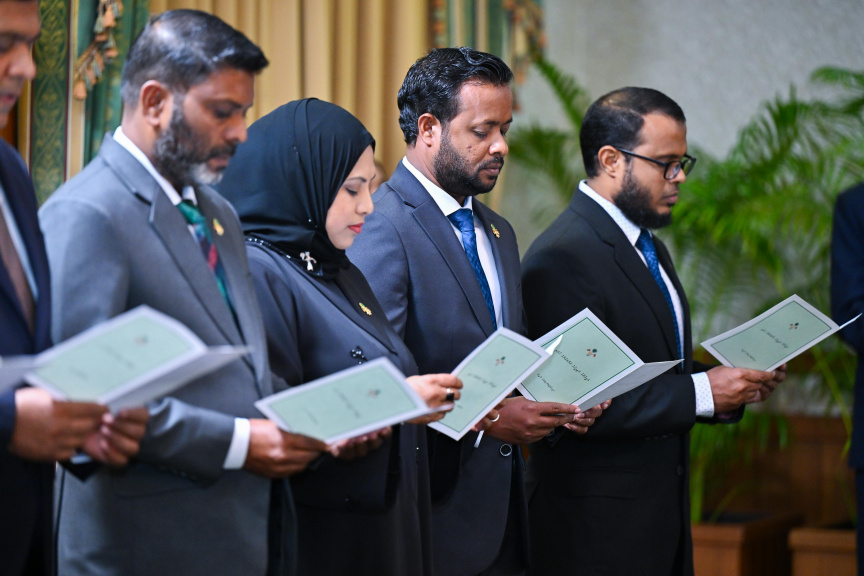
Ministers of President Mohamed Muizzu's Cabinet take oath after major reshuffle, April 14, 2026. (Photo/President's Office)
President Dr. Mohamed Muizzu on Tuesday carried out the most extensive reshuffle of his administration to date, merging several ministries and reducing the cabinet from 20 ministries to 15.
When the President took office on November 17, 2023, he appointed the largest cabinet in Maldivian history, with 22 ministers. Over the past two years, portfolios have been repeatedly restructured, and Tuesday’s reshuffle marks another major reorganisation.
A total of 10 ministers resigned suddenly on Tuesday:
Mohamed Ghassan Maumoon – Minister of Defence
Dr. Abdulla Khaleel – Minister of Foreign Affairs
Abdulla Nazim Ibrahim – Minister of Health
Thoriq Ibrahim – Minister of Tourism and Environment
Dr. Aishath Shiham – Minister of Social and Family Development
Adam Naseer Ibrahim – Minister of Culture and Language
Maryam Mariya – Minister of Agriculture
Ibrahim Waheed – Minister of Youth
Adam Shareef Umar – Minister of Cities and Local Government
Dr. Ali Haidar Ahmed – Minister of Higher Education

Following the resignations, the President appointed new ministers and reassigned portfolios. The ministers sworn in on Tuesday evening are:
Moosa Zameer – Minister of Finance and Public Enterprises
Ali Ihusaan – Minister of Homeland Security, Labour and Technology
Dr. Iruthisham Adam – Minister of Foreign Affairs
Ismail Shafeeu – Minister of Education, Higher Education and Skills Development
Geela Ali – Minister of Health, Family and Welfare
Mohamed Saeed – Minister of Economic Development, Transport and Trade
Dr. Mohamed Shaheem Ali Saeed – Minister of Islamic Affairs and Endowments
Mohamed Ameen – Minister of Tourism and Civil Aviation
Abdulla Rafiu – Minister of Youth Empowerment, Sports and Fitness
Heena Waleed – Minister of Arts, Culture and Heritage
Dr. Abdulla Muthalib – Minister of Infrastructure, Housing and Urban Development
Ali Shareef – Minister of Climate Change, Environment and Energy
President Dr @MMuizzu appoints Cabinet Ministers at a ceremony held at the President’s Office today. pic.twitter.com/Ke6CBC4TeR
— The President's Office (@presidencymv) April 14, 2026
The President’s Office said the cabinet will continue to include Attorney General Ahmed Usham and two other ministers who were not part of Tuesday’s reshuffle.
The reshuffle brought significant structural changes across the government. The Ministry of Education and the Ministry of Higher Education were merged to form a single portfolio responsible for education, higher education and skills development. Labour, which had previously been housed under Higher Education, was transferred to the newly expanded Ministry of Homeland Security, Labour and Technology.
The former Ministry of Transport and Civil Aviation was also split, with transport functions moved to the Ministry of Economic Development, Transport and Trade, while civil aviation was paired with tourism under the Ministry of Tourism and Civil Aviation. In addition, the Ministry of Social and Family Development was dissolved entirely, with its responsibilities redistributed among other ministries.
Despite the wide-ranging changes, no new appointments were made to the Local Government Ministry or the Defence Ministry, leaving both portfolios temporarily without ministers.
The sweeping changes came just days after the April 4 local council elections, which were widely expected to strengthen the government but instead resulted in a major defeat. The outcome intensified public and political pressure for a cabinet overhaul.
The President’s Office said the restructuring aims to “streamline government functions” and “improve service delivery,” while critics and analysts have linked the reshuffle to the election results and internal demands for accountability.