date_range
Wednesday 28 Oct 2026


 LOCAL EDITION
close
 LOCAL EDITION


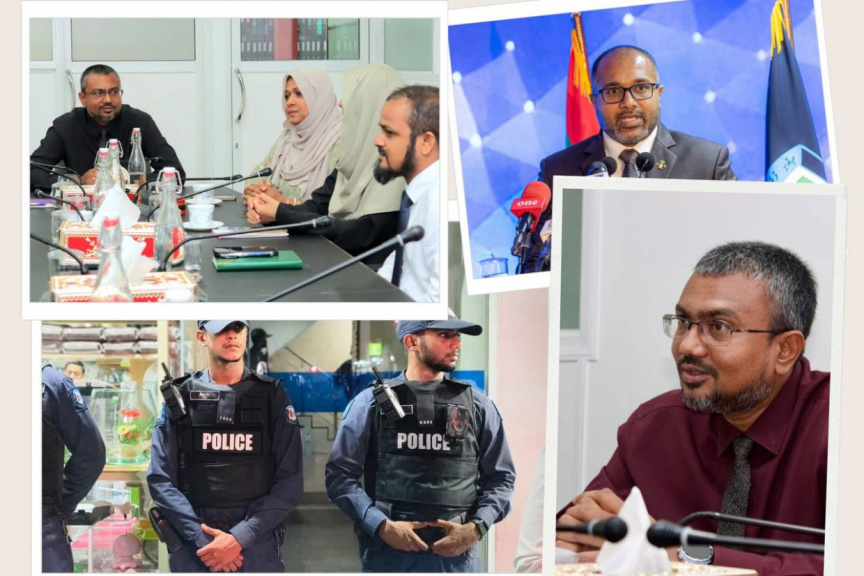
The year is 2026. The Maldives is a democratic society. No matter how much the government and its supporters attempt to defend certain actions, there are things that simply cannot be justified. In a democracy, freedom of the press is one of the most fundamental rights. However, the police entering a media office, seizing equipment, and using their power to effectively halt the operations of a news outlet is unacceptable by any standard.
I do not support defamation or the spreading of lies. Those who committed such acts yesterday are the same ones condemning them today. If journalists or anyone else engages in such behavior, it must be investigated. However, this must be done within a specific framework—not through a display of brute force or intimidation. Issues involving media outlets should be handled by the institutions legally mandated to oversee them.
Police raid on 'Adhadhu' and the commission's silence
Following a documentary released by the news outlet "Adhadhu" last March, police entered and searched their office last night. A large amount of electronic equipment was taken into police custody, obstructing the outlet's work. Furthermore, travel bans have been imposed on the outlet's CEO, Hussain Fiyaz Moosa, and Managing Editor, Hassan Mohamed, citing an “ongoing investigation.”
In response to this incident, the Maldives Journalists Association (MJA) stated that the government has crossed a "red line" and called for an end to the intimidation of journalists. Conversely, some government ministers have spoken out in defense of the police's actions.
While matters have escalated to this point, the Maldives Media and Broadcasting Commission (MMBC), which is funded by taxpayer money, remains silent. Not only did they fail to lead the defense of journalists, but the commission's President also failed to respond to calls and messages from reporters seeking comment. This is a deeply disappointing and concerning development.
If a media outlet or a journalist commits an error, it should be investigated. However, simultaneously, if an injustice is committed against journalists or media outlets, the Media Commission must raise its voice and work to provide them with protection.
Millions spent with no results
A massive commission has been established to regulate media in the Maldives. Previously, the Broadcasting Commission and the Media Council operated separately. However, those two institutions have now been merged to form the new Maldives Media and Broadcasting Commission. Every year, millions of Rufiyaa from the state budget—taxpayer money—is spent to run this commission.

The heads of these institutions receive exorbitantly high salaries and benefits. Yet, we do not see these places functioning as they should. No results are produced. When the police stormed the ‘Adhadhu’ office, there was no effort from the commission to stop it or to investigate the circumstances to ensure justice for the journalists.
Institutions are not created, nor are large budgets passed, simply to display a nameplate. Yet, what we see today is a commission costing millions that is failing to function—whether due to being under influence or for other reasons.
Not just penalties, but the responsibility to develop the field
The law mandates that the Media Commission does more than just penalize media outlets; it is also required to work toward the development of media and journalists. Both in the past and present, some media outlets and journalists make mistakes. There are times when ethical standards for broadcasting news are breached. But the question is: what adequate work has the media's "guardian” done to rectify these errors?
Journalists are not provided with sufficient training or experience. When an issue arises, most things are brushed aside with a press release. Or, as in the case of ‘Adhadhu’, they remain silent, not saying a single word.
This is not what it means for the commission to fulfil its responsibility.
To raise the standard of journalism and cultivate responsible reporting, continuous training programs must be conducted. However, as of 2026, the Commission has not conducted high-quality programs to develop the skills of journalists. Beyond the administrative task of distributing state funds to media outlets, no practical work is seen to improve the quality of journalism.
Contravention of international standards
In the world's advanced democratic nations, media is regulated in a completely different manner. In those countries, media commissions are independent institutions free from government influence. If a media outlet makes a mistake, instead of sending the police to intimidate and seize equipment, the matter is handled through a Media Council or Commission.
Measures such as issuing fines, ordering apologies, or mandating news corrections are taken through a judicial or regulatory system. Looking at how Ofcom operates in countries like the UK, they prioritize ensuring media freedom alongside accountability. In the US, the Federal Communications Commission (FCC) also operates under similar transparent principles.
The Maldives has the same system, at least on paper. Violations by media outlets are supposed to be investigated by the Media Commission, and not the police.
However, we see power being exerted over media directly through the police while a Media Commission stands by. This is an authoritarian trait that is completely alien to both international standards and local standards.
Stopping media via police power is a grave error
It is a definitive wrong for police to enter a media outlet and halt its operations. This is not acceptable under any circumstances. The Media Commission is the entity that should oversee the conduct of media outlets; it is the institution legally tasked with that responsibility. However, today, that Commission has failed.
Due to the failure of the Commission, journalists and the entire community are suffering. The safety and security of journalists have been lost, and they are forced to work in an atmosphere of fear. As long as the Commission does not stand up against this, condemn the police's actions, and advocate for the rights of journalists, the state budget spent on it is a waste.
The Commission must clarify what action it will take regarding the ‘Adhadhu’ case. It is wrong to simply collect a salary and remain in the good graces of whichever government is in power. One should only hold a position and take a salary if they can fulfill their responsibilities. Otherwise, it will be confirmed that the Media Commission is nothing more than a political tool.