date_range
Friday 23 Oct 2026


 LOCAL EDITION
close
 LOCAL EDITION


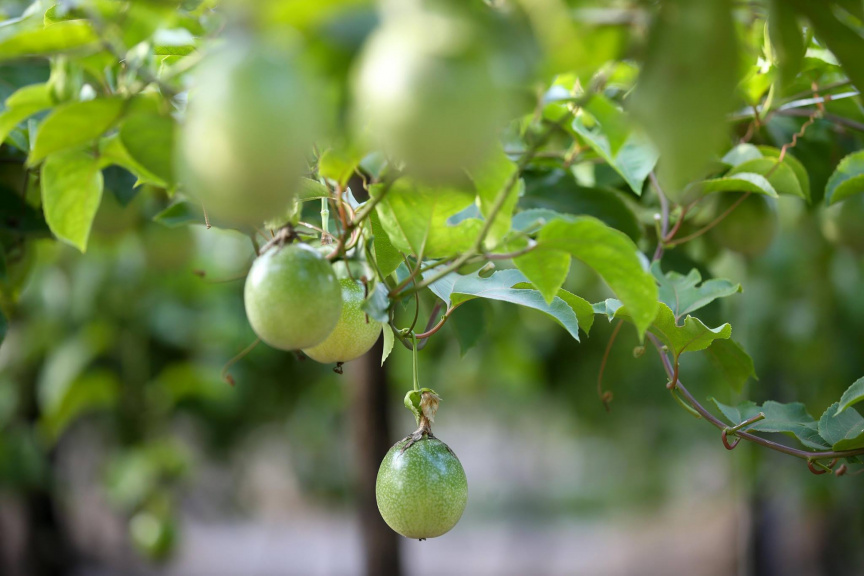
Passion fruits grow in a farm in AA. Thoddoo. (File Photo/Sun/Mohamed Afrah)
Did you know that the peels of fruits and vegetables often have more nutrients than the flesh? Sadly many of us don’t dare eat them anymore.
Pumpkin skins go straight into the bin. Apples get stripped bare. Even guavas, once eaten whole in Maldives without a second thought, are now peeled out of caution. It’s not about taste anymore; it’s about trust. And increasingly, people simply don’t trust what might be sitting on the surface, or inside, the produce we bring home.
A recent report by The Small Island Conservancy (SILC) has brought the issue into sharp focus, documenting alarming levels of pesticide residues in Thoddoo’s produce and the growing strain on its soil.
The new Thoddoo agrochemical study is the kind of document that makes you put your watermelon down mid‑bite.
The report literally says:
“Carbaryl and Diafenthiuron… were detected in various samples… their presence at any detectable level is considered illegal and highly alarming.”
These aren’t mild‑mannered garden sprays. These are banned pesticides, found in:
watermelon
cucumber
papaya
red spinach
luffa
snake gourd
And then there are the legal pesticides used in creative quantities:
Dimethoate in watermelon: 0.52 mg/kg vs 0.01 mg/kg allowed
Permethrin in watermelon: 0.95 mg/kg vs 0.05 mg/kg allowed
Carbendazim in papaya: 0.61 mg/kg vs 0.2 mg/kg allowed
The report warns:
“These findings emphasize the pressing need for stringent monitoring and regulation of pesticide use in the region.”
Translation: We’re flying blind.

Here’s the part nobody talks about:
Salty coral islands + heavy agrochemical use = soil death.
Our islands don’t have deep, nutrient‑rich soil; instead, they sit on thin, sandy ground with high salinity, shallow freshwater lenses, and almost no capacity to hold nutrients or buffer chemicals.
So when farmers apply synthetic fertilizers year after year, the soil doesn’t “hold” nutrients, it leaches them straight into groundwater. The study notes that Maldivian soils are:
“highly prone to nutrient leaching… particularly nitrogen.”
Once the soil collapses, farmers compensate with even more fertilizer.
It’s a vicious loop. And yes, GMO fertilizers (the high‑efficiency, fast‑release types) can accelerate this collapse because they dump nutrients faster than the soil can absorb, leaving behind salt buildup and chemical residues that make the land less productive over time.
On these tiny islands, that’s not just an agricultural problem, it’s an existential one.
Because the system gives them no choice.
Pests wipe out crops overnight
Labels are in foreign languages
Sellers act as “advisors”
Training is minimal
Demand spikes during Ramadan
Land is overworked
No national body tests residues
Farmers are trying to survive, consumers are trying to survive, but in reality the only thing thriving is the chemical industry.

1. Wash with running water
Removes dust + some residues.
2. Soak in baking soda (best method)
1 tsp baking soda in 1 litre water, 12–15 minutes.
3. Salt‑water soak for waxy fruits
Helps loosen wax coatings.
4. Peel when necessary, but don’t rely on peeling
Residues can be inside the flesh too.
5. Buy from trusted sources
Ask farmers/sellers about their practices and sources.
6. Don’t eat produce immediately
Some residues degrade over 24 hours.
We are a nation that:
imports most of its food
depends on a few islands for fresh produce
has no routine testing of local crops
is seeing rising non‑communicable diseases
is slowly poisoning its own soil
If we don’t fix this now, the consequences will be far‑reaching. We’re looking at dying farmlands, contaminated groundwater, crops that can only survive with increasing chemical inputs, and a population consuming residues it cannot see. And over time, this pattern of exposure raises the risk of serious health issues, including cancers linked globally to long‑term pesticide contact.
No amount of peeling will save us then.