date_range
Saturday 17 Oct 2026


 LOCAL EDITION
close
 LOCAL EDITION


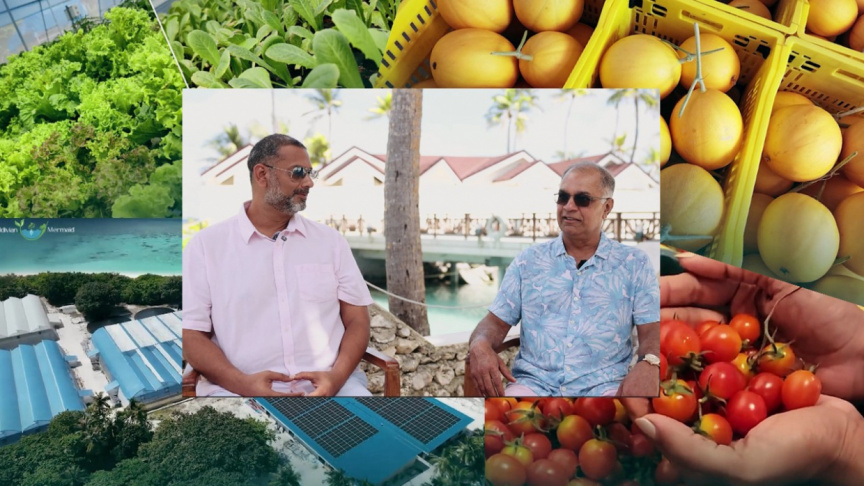
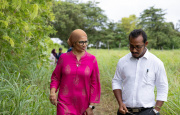
Maldivian Mermaid’s CEO, Japjit Sobti (L) and chairman Parth Amin (R).
To many Maldivians, the idea of generating millions in revenue from local agriculture might seem far-fetched. In an economy deeply anchored in its identity as a luxury global tourism brand, one might question the necessity of looking beyond the lucrative hospitality sector. From local inhabited islands to uninhabited islets, the focus has remained steadfastly on tourism development.
However, the investors behind "Maldivian Mermaid" perceive the Maldivian agricultural sector through a different lens—as a burgeoning industry capable of generating hundreds of millions in the long term.
Their vision is to establish a sustainable agricultural model and a premium brand that also competes with the prestige of the country’s luxury tourism sector – thereby creating self-reliance and sustainability within the economy, and helping retain foreign currency.

Parth Amin, Chairman of Maldivian Mermaid, possesses a profound understanding of the Maldives' economic landscape. The heavy financial burden of food imports was a primary catalyst for his vision to establish a robust domestic food production industry.
Reflecting on the inception of this idea two years ago with a Maldivian partner, Parth noted that their efforts to secure an island for investment are now progressing successfully.
One of the main drivers behind this large-scale sustainable project is the alarming outflow of foreign currency due to the importation of produce that could otherwise be grown locally.
Furthermore, from an environmental perspective, Parth highlighted the negative impact of carbon emissions associated with the logistical chain of food imports.

"The food that comes into the Maldives; I have seen that it has tons of packing. Cardboard, plastic, Styrofoam," Parth added.
Eco-Friendly Farming by Maldivian Mermaid
The company’s CEO, Japjit Sobti, further emphasized that despite the limited land area, their operations have proven that a variety of fruits and vegetables can be successfully cultivated in the Maldives. Parth noted that through hydroponics, they have identified effective methods for growing diverse produce. They are now committed to sharing this technical expertise with local farmers across various islands.

“So yes, we have now figured out how to grow vegetables here . We are more than happy to put it on the different islands, different communities across the whole country. And it’s not an impossible thing anymore. And I think that’s how it can help the local community in Maldives,” he said.
According to Japjit, sustainability is at the core of Maldivian Mermaid’s operations. The farms utilize solar energy for 50 percent of their electricity needs, while 80 percent of the water used is harvested rainwater, enriched with essential nutrients before being distributed to the plants.
Additionally, the company employs reusable crates for transporting produce. These containers are retrieved from customers, sanitized, and reused, ensuring a circular system.
"In reality, we are adding nothing to the plastic waste problem," Japjit remarked.

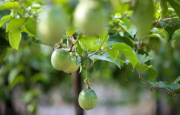
Currently, their farm in Baa Atoll cultivates 40 varieties of vegetables, fruits, and herbs. This includes 18 types of leafy greens suitable for salads, such as lettuce, coriander, kale, and mint. The farm also produces various types of melons, watermelons, tomatoes, capsicums, and papayas. The company is also exploring value-addition opportunities to maximize the market potential of these products.
Empowering Maldivian Farmers: The Need for Support
Japjit acknowledged that establishing a hydroponic setup is a capital-intensive endeavor. And to develop such a setup and to attract more farmers he says that he sees a two-way solution.
“One it has to be a public private partnership. There are investors like us who are willing to partner with local farmers. But I also feel the government has to create subsidies, has to create loan plans and has to allow other technical partners to come in and work with everyone,” said Japjit.

He argued that agriculture should receive support similar to the subsidies provided to the fisheries sector. To foster growth, he suggested that the government should consider waiving taxes and import duties on agricultural equipment and inputs.
Both Parth and Japjit pointed out that while opportunities exist, they are not as prominently highlighted or incentivized as those in the tourism sector. They believe it is essential for the government to offer concessions for agricultural investments comparable to those granted to the hospitality industry.
“Any economy, any country that wants to promote any types of industry, whether its agriculture, whether its software, well, I come from the software industry, and in India we got lots of subsidies right in the form of tax. That itself if the Maldivian government would do, would ease it for everybody,” Parth added.

Japjit also raised an important question regarding the workforce: as many Maldivians lean toward careers in tourism, how can agriculture be rebranded as a high-income profession? He emphasized that the government plays a vital role in shifting this perception.
These investors remain highly optimistic. They believe that with the right opportunities, modern Maldivian agriculture can flourish. Success hinges on the interest and courage of the Maldivian people, supported by conducive government policies. If these elements align, there is no reason why this sector cannot evolve into a billion-rufiyaa industry in the years to come.