date_range
Thursday 27 Aug 2026


 LOCAL EDITION
close
 LOCAL EDITION


Then-President-Elect Dr. Mohamed Muizzu meets with then-Speaker of Parliament Mohamed Nasheed on October 3, 2023: Nasheed has retracted support to merging two main elections. (Photo/People's Majlis)
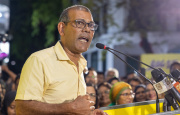
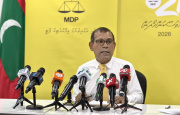
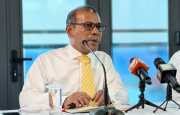
Former president Mohamed Nasheed, on Wednesday night, states that despite his initial support for the government's proposal to hold presidential and parliamentary elections simultaneously, he is now prepared to vote against it.
On February 10, the ruling People’s National Congress (PNC) used its supermajority in the Parliament to pass constitutional amendments proposed by the government to hold future presidential elections and parliamentary elections on the same day.
On February 16, President Dr. Mohamed Muizzu decreed that a public referendum on this – as required by law on such matters – would be held on April 4 – the same day as the local council elections.
At first, Nasheed was the sole prominent opposition leader to endorse the constitutional amendment. In contrast, Maldivian Democratic Party (MDP) lawmakers in the Parliament, along with MDP’s leader Abdulla Shahid, former chairperson Fayyaz Ismail, and former president Abdulla Yameen Abdul Gayoom, have all publicly opposed it.
In a message shared on the MDP National Council’s WhatsApp group, Nasheed confirmed that he would respect the party’s collective decision in the forthcoming referendum, stating, “I am ready to say ‘No’ to that vote.”

The government has argued that the main goal of merging the elections is to cut state spending. However, yesterday, Nasheed challenged this view, contending that the costs of sustaining democracy in the Maldives are not burdensome. He pointed out that one of the major advantages of a multi-party system has been the creation of a strong tax framework, which has substantially boosted state revenue.
Highlighting that tax income now surpasses MVR 30 billion, Nasheed stressed that regular elections and active public participation are essential for national development. He further warned that any attempt to reduce citizen involvement is unlikely to receive popular support.
Notably, MDP, on Wednesday, filed a judicial review petition with the Civil Court seeking to halt the upcoming referendum.
MDP argues that President Muizzu failed to attach an information sheet as required by the Referendum Act with his decree and failed to share any relevant details even after, infringing on MDP’s campaign rights enshrined under Article 26 of the Act.
MDP also argues the party is being denied the chance to properly do what it needs to ensure people have room to make informed and independent decisions.
The MDP claims it could cause significant political damage to the party, and irrevocable financial losses if the court were to overturn the decree after the party already spends on the campaign.
The MDP cited several other reasons why they believe the referendum to be unlawful. This includes:
While the MDP seeks to half the referendum, the Elections Commission (EC) is rushing to make preparations to hold it on the same day as the local council elections.
Under the current system, voters go to polls twice within around six months every five years, electing the president in September and members of Parliament in April.
But the constitutional amendments passed by the Parliament proposes merging the two elections, and bringing forward the start of the parliamentary term from May to December 1 to get this done.
This change will shorten the five-year term of the current parliamentary assembly, sworn in on May 28, 2024, by around six months.
The first combined poll would take place in 2028.
President Muizzu first announced plans introduce constitutional amendments to combine the two major elections back in 2024. He promoted it as a cost-cutting measure that will save around MVR 120 million in expenses.
However, the opposition is largely opposed to such a move, describing it as an attempt by the PNC to hold on to power