date_range
Saturday 24 Oct 2026


 LOCAL EDITION
close
 LOCAL EDITION


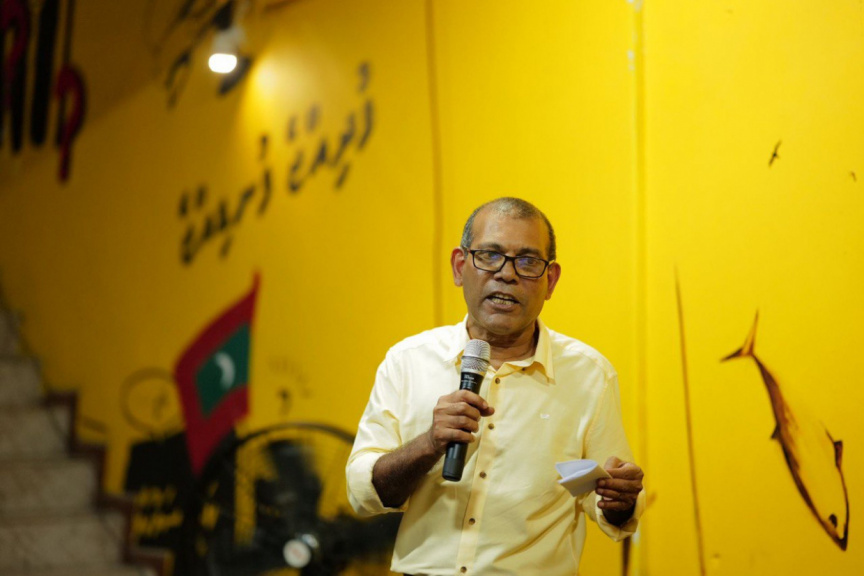
Former president Mohamed Nasheed at a campaign event of Ali Azim: Nasheed has spoken out in support of handing over the operations of Hanimaadhoo International Airport to an Indian company. (Photo/Ali Azim campaign team)
Former President Mohamed Nasheed has warned that the Maldives could face a severe fuel shortage as global oil prices surge, urging the government to prepare for power cuts, reduced traffic, and shorter operating hours for public services.
Oil prices have climbed sharply in recent days following the escalation of the US–Israel conflict with Iran. More than 85 countries have reported price spikes as global supply routes come under pressure.
On May 5, FSM, the fuel subsidiary of state‑owned STO, raised diesel and petrol prices by between 18 and 26 percent.
In a post on X, Nasheed said the Maldives’ combined fuel storage capacity, including STO and private sector reserves, amounts to around 70 million litres of diesel and 25 million litres of petrol, which he described as “a 20‑day stock.”
Alhugandu hadhaanvaa gothugai Raajjeygai rahkaa kurevenee, STO adhi private sector himeneyhen 70 million litre ge diesel. Adhi 25 million litre ge petrol. Mi ee 20 dhuvahuge stock eh. Raajje thelah jehumuge furusathu bodu. Mi vaguthu alhaan fenna baeh fiyavalhu.
— Mohamed Nasheed (@MohamedNasheed) March 14, 2026
1. Raajjeyge…
“There is a high chance Maldives will hit oil shortage badly,” he wrote.
Nasheed outlined several measures he believes the country should take immediately to conserve fuel and manage the risk of supply disruption. These include identifying private‑sector fuel reserves, scheduling power cuts to reduce consumption, and imposing limits on land transport.

He also recommended reducing the operating hours of government offices and schools, cutting back on social events, and prioritising fuel for essential sectors such as fisheries, resorts, and aviation.
Nasheed further suggested rerouting air and sea transport to avoid West Asian corridors and exploring alternative supply lines.
Four days after the conflict began, Economic Minister Ahmed Saeed said on March 3 that the Maldives would continue to receive essential goods without interruption and would not face shortages of oil or gas.
Since then, global oil prices have continued to rise. The government has decided to hold domestic fuel prices steady by using STO’s expected profits in addition to existing subsidies, and has sought assistance from India to secure fuel imports.
Several countries, including developed economies and Asian nations, have already introduced cost‑cutting measures in response to rising oil prices. These include reducing government working hours, closing schools, limiting vehicle use, and even cutting salaries of senior officials.