date_range
Saturday 10 Oct 2026


 LOCAL EDITION
close
 LOCAL EDITION


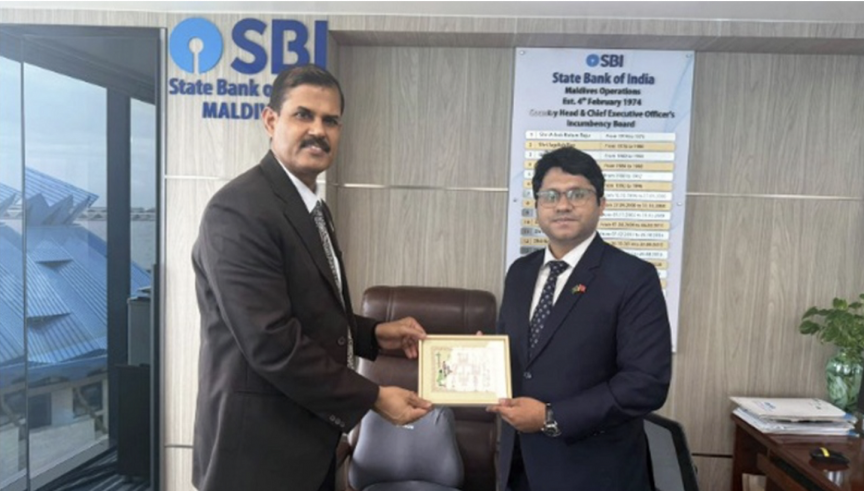
Bangladeshi High Commissioner to the Maldives meets senior management representatives of the State Bank of India (SBI) to seek easier remittance arrangements for workers in Maldives.
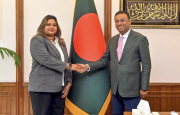
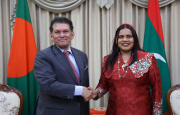
The High Commissioner of Bangladesh to the Maldives, Dr. MD Nazmul Islam, has held discussions with senior representatives of three foreign banks operating in the Maldives.
According to the Bangladesh High Commission, the discussions focused on establishing a formal, secure, and accessible mechanism through which Bangladeshi workers in the Maldives can remit their earnings.
There are more than 100,000 Bangladeshi workers in the Maldives, including individuals who are residing and working in the country without valid documentation.
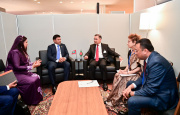
The High Commissioner met with senior management representatives of the State Bank of India (SBI), Sri Lanka’s Bank of Ceylon (BOC), and Pakistan’s Habib Bank Limited (HBL). According to the High Commission, the meetings primarily addressed the prevailing foreign exchange shortage in the Maldives, existing remittance mechanisms, available banking channels, and the difficulties encountered by expatriate workers from other countries when transferring funds abroad.
While the World Bank has identified foreign exchange liquidity as a challenge in the Maldives, the Maldives Monetary Authority (MMA) is implementing measures to increase the availability of US Dollars for commercial banks.
Based on information provided by SBI management, the High Commission said the remittance limit for Indian nationals, which previously stood at USD 700, has been progressively reduced amid the shortage of US Dollars and currently stands at approximately USD 150. Similarly, Habib Bank reported that the remittance limit for Pakistani nationals has been reduced from USD 1,000 to USD 300, with further reductions potentially being introduced. Citing the Bank of Ceylon, the High Commission also reported difficulties in opening new accounts to facilitate the conversion of Maldivian Rufiyaa into Sri Lankan Rupees for remittance due to the limited availability of US Dollars.
The High Commission noted that, unlike workers from several other countries, the main challenge facing Bangladeshi workers is linked to the nature of their employment. Many professionals from India, Sri Lanka, and Pakistan are employed in positions where salaries are paid in US Dollars. By contrast, the majority of the approximately 100,000 Bangladeshi workers in the Maldives are employed in unskilled positions and receive their wages in Maldivian Rufiyaa. As a result, Bangladeshi workers face substantially greater demand for converting Rufiyaa into US Dollars before sending their earnings abroad.
Against this backdrop, High Commissioner Nazmul Islam proposed a specific arrangement to the bank executives. Rather than seeking exclusive privileges, he asked whether a mechanism could be developed within the existing banking framework to facilitate the formal remittance of smaller amounts, ranging from USD 50 to USD 100. The High Commissioner stressed that even relatively small amounts are crucial to the families of low-income workers whose salaries are paid in Rufiyaa.
"Bangladeshi workers, through hard labor in the Maldives, send their income to support their families. Our responsibility is to identify the difficulties they face and facilitate secure, legal channels for their remittances," the High Commissioner stated.
He further observed that the foreign exchange shortage in the Maldives affects nationals of multiple countries and is not limited to the Bangladeshi community. Accordingly, he said the primary objective is to work with banks to identify practical solutions that can be implemented within the existing regulatory framework.
The meetings also addressed opportunities to strengthen trade and financial relations among South Asian countries. The Bangladesh High Commission stated that it will continue consultations with relevant Maldivian authorities and financial institutions in an effort to establish an efficient remittance mechanism for expatriate workers.
The Maldivian government is currently enforcing stringent measures to address the foreign exchange crisis, including a crackdown on the illegal US Dollar black market. Authorities have reported that a significant number of individuals apprehended during such operations are Bangladeshi nationals.