date_range
Monday 26 Oct 2026


 LOCAL EDITION
close
 LOCAL EDITION


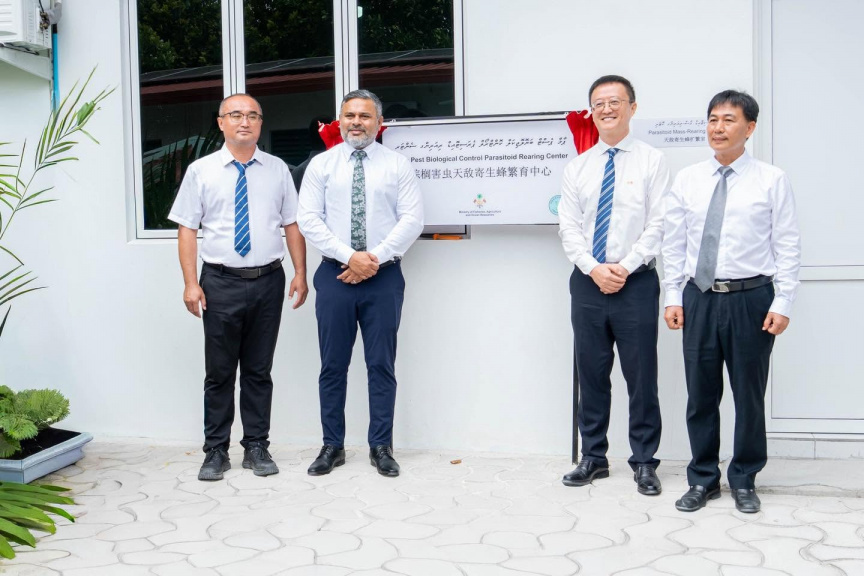
From the inauguration of ‘Palm Pest Biological Control Parasitoid Rearing Center,’ established breed environmentally beneficial insects that naturally combat pests affecting coconut palms. (Photo/Agriculture Ministry)
What was opened in Hanimaadhoo on the 6th of August may matter more to the everyday Maldivian landscape than many projects that receive far greater attention.
The Palm Pest Biological Control Parasitoid Rearing Center, established under a collaborative initiative between the Maldivian Ministry of Agriculture and the Chinese government, officially opened its doors at the Hanimaadhoo Agriculture Center. Agriculture Minister Ahmed Shiyam and Chinese Ambassador Kong XianHua presided over the occasion — two countries, one shared mission, and one very Maldivian problem that has been quietly worsening for years.
Our coconut palm is not simply a tree. It is our national symbol, printed on our flag, woven into our identity, embedded in our history and our daily lives. For generations, it has provided food, shade, timber and cultural meaning to communities across every atoll. It belongs to this country the way the ocean does.

And in recent years, it has been under attack.
Pests have been spreading through coconut palms across the Maldives with little effective resistance. The damage has been visible to anyone who looks — discoloured fronds, weakened trunks, trees that once stood tall now struggling. The problem has not been a secret, but a lasting, sustainable solution has been slow to arrive.
This center is that solution beginning to take shape.
The facility has the capacity to breed up to 100,000 parasitoids daily — beneficial insects that are natural enemies of the pests destroying our palms. Rather than relying on chemical pesticides that carry their own risks to soil, water and surrounding ecosystems, this approach works with nature. Breed the right insects, release them into affected areas, and let biological balance do what chemicals cannot do sustainably over the long term. It is science in service of the environment, and it is exactly the kind of thinking that a small island nation dependent on healthy ecosystems should be embracing.
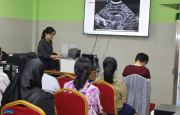
Alongside the center's opening, a training programme was conducted for 50 participants — farmers, local council representatives and agricultural company staff — by technical experts from the Chinese Academy of Tropical Agricultural Sciences. Theory and practice, delivered by specialists, to the very people who will carry this work forward on the ground across the islands. That transfer of knowledge is as valuable as the facility itself, and more Maldivians must express interest as well.

The project agreement was signed between the Maldivian Ministry of Agriculture and China's Ministry of Commerce in July last year. Its delivery within a year — a functioning center, trained personnel, and a clear operational plan — reflects genuine commitment from both sides.
For Maldives-China relations, this is the kind of bilateral cooperation that speaks directly to people's lives. Not geopolitics on paper, but practical help for a real and growing problem. China's assistance here is tangible, targeted and timely.
Our national tree has been struggling in silence for too long. With this center, it finally has defenders.