date_range
Saturday 31 Oct 2026


 LOCAL EDITION
close
 LOCAL EDITION


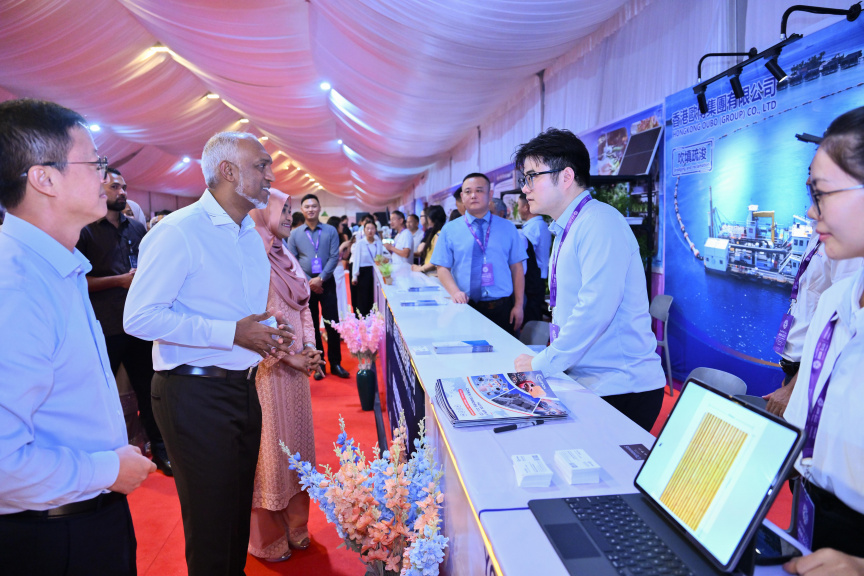
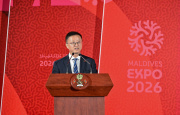
President Dr. Mohamed Muizzu at a stall by a Chinese business in the Maldives Expo 2026. (Photo/President's Office)
The following is an op-ed by Maya Majueran.
___
The presence of twelve Chinese enterprises at Maldives Expo 2026 in Malé is more than a diplomatic photo opportunity. It is a practical test of whether international technology cooperation can be translated into everyday gains for Maldivian small and medium-sized enterprises. The early signs are encouraging - but the real work begins after the exhibition closes.
The exhibitors brought technologies that speak directly to the Maldives’ structural realities: floating solar systems and seawater desalination address energy and water constraints; 3D printers and new-energy vehicles point to cheaper maintenance and cleaner transport; coffee-making robots and vertical take-off and landing aircraft show how automation and new mobility could support tourism and inter-island connectivity. For SMEs, these are not abstract novelties. They are potential answers to high operating costs, limited skilled labour, and expensive imports.

The timing matters. The expo coincided with the First China-Maldives Investment Cooperation Forum, which drew over 250 participants and 41 Chinese enterprises, and produced five MoUs. Maldivian Minister of Economic Development and Trade Mohamed Saeed rightly framed the Chinese technologies as a way to help local SMEs increase the added value of their products and services. That is the correct benchmark. The question is not how many exhibits were displayed, but how many local firms can actually adopt, afford, and maintain them.
Here, a note of caution is warranted. Technology transfer is rarely automatic. A floating solar system or a desalination unit is only useful to an SME if financing is available, spare parts are accessible, and local technicians can service it. A coffee robot may impress visitors, but a guesthouse owner needs to know the payback period. A 3D printer can reduce waiting times for spare parts - if the right materials and training are in place. Without after-sales support and skills development, even the most relevant innovation can remain a showpiece.
The China-Maldives Free Trade Agreement and the new investment forum provide a framework, but SMEs need more than frameworks. They need pilot projects, concessional financing, and clear regulatory pathways. Chinese firms, for their part, should treat the Maldives not as a showroom but as a testbed for island-appropriate, affordable, and climate-resilient solutions. Joint ventures and local assembly - not just imports - would deepen the benefit.

Overall, the 12 enterprises at Maldives Expo 2026 have opened a credible door. If both sides move from MoUs to maintenance contracts, from demonstrations to pilot installations, and from exhibition halls to island workshops, this could become a genuine win-win. The opportunity is real. The responsibility now is to make it operational.
Editor's Note:
Maya Majueran is the Founding Director of the Belt and Road Initiative Sri Lanka (BRISL), a pioneering organization dedicated to research, dialogue, and engagement on China’s Belt and Road Initiative (BRI). Alongside his leadership role, Maya is a researcher and commentator on international relations, economics, and geopolitics, with a particular focus on Asia and the Global South’s evolving role in world affairs. He is a committed advocate for a multi-polar world order and for strengthening the Global South’s voice in shaping international systems and advancing economic integration.