date_range
Monday 26 Oct 2026


 LOCAL EDITION
close
 LOCAL EDITION


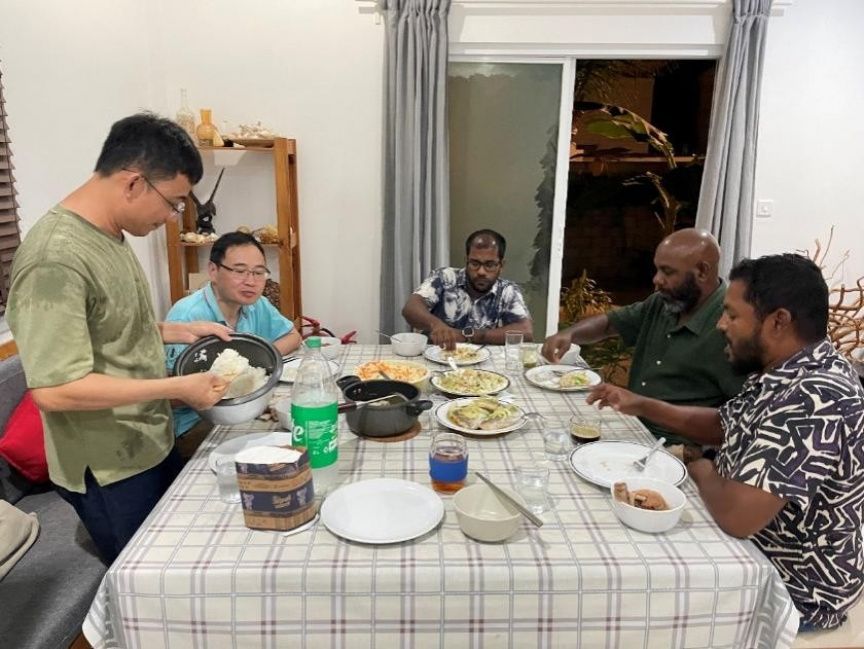
(Photo/Ambassador Kong Xianhua)
The following is an op-ed written by Kong Xianhua, the Chinese Ambassador to the Maldives.
__
The wind in the Maldives seems stronger on the inhabited islands.
During our two-day visit to Hanimaadhoo, the sea breeze never let up. Coconut palms swayed in the wind, whitecaps kept rising and breaking across the sea, and the air was heavy with moisture. Located at the northern tip of the Maldives, far from the capital Malé, Hanimaadhoo is a tranquil island. It is not quite the resort side of the Maldives that many tourists imagine, but rather a home where generations of local people have lived. And on this inhabited island, far from the capital, two Chinese have been living and working here for quite some time. Unlike tourists, they are agricultural experts ——Dr. Wang Jianyun and Dr. Zhong Yihai, resident experts with the Chinese Assistance Project on Coconut Tree Pest Control in the Maldives, from CATAS, Chinese Academy of Tropical Agricultural Sciences, Hainan Province,an island province of China.
As Chinese Ambassador to the Maldives, I was invited, together with my colleagues, to attend the Closing Ceremony of the Training Course on the Coconut Tree Pest Control and the Opening Ceremony of the Palm Pest Biological Control Parasitoid Rearing Center. On our way to the Agricultural Center, we traveled in its only pickup truck. The vehicle normally serves as the center’s work transport. With several short-term experts joining us during those 2 days, there were more people than could fit in the front seats. So some experts simply crouched together in the truck bed. As the vehicle moved along the island road, the sea breeze came straight toward us. From time to time, those of us in the front could hear laughter coming from behind. A few people crouched together in the truck bed, talking about their research work, talking about island life, their laughter carried away on the sea breeze. At that moment, the island, the coconut palms and this group of Chinese experts seemed, all at once, together form a vivid and living picture.

At the Agricultural Center, the two resident experts soon got down to discussing about their research work. How to control coconut palm pests and diseases, how far the project had progressed, what they had encountered in their experiments—the discussion went on and on. Many of these questions had lingered with them for a long time, and they spoke of the details with the ease that comes from having studied something over and over again. What impressed me most was that, whenever they spoke about their work, there was a light in both of their eyes. Their enthusiasm is so remarkable that one can hardly overlook it.
Coconut palms are almost everywhere in the Maldives. Walking along the island roads, the sea breeze sweeps through, great stretches of coconut fronds, yellow and green from pest damage, rise and fall with the wind. The coconut palm is the national tree of the Maldives. For centuries, islanders have relied on its fruit for food, used its trunk to build homes, and its roots to hold the sand in place. It has long been regarded as a “tree of life.” It is precisely around such an issue of profound importance that the Chinese Assistance Project on Coconut Tree Pest Control in the Maldives has been carried out.
The two experts have remained here for two years, conducting surveys and research, carrying out experiments, and exploring pest-control methods suited to local conditions. What does the coconut hispine beetle feed on? How long does it take a parasitoid wasp to complete one generation? Can Chinese experience be directly applied in the Maldives? Much of the work is painstaking and highly specific. This process necessitates persistent observation, ongoing fine-tuning, and, most crucially, ample patience and time.

Yet they rarely describe any of this as hardship. What they speak of most often is their gratitude for the help they have received from their local Maldivian friends. Their landlord, local residents, colleagues at the Maldivian Ministry of Agriculture, as well as the kids from a neighboring family who once brought them a grouper as a welcoming gift... Through these sincere connections and the experience of sharing daily life, they have gradually gone from being guests from distant China to becoming part of Hanimaadhoo.
Outside of work, they cook for themselves and find their own ways to adapt to this island life. Dr. Wang comes from northern China and prefers noodles, while Dr. Zhong is from the south and is more accustomed to rice. In Hanimaadhoo, the two have gradually found their own rhythm of life. When the laboratory lacks suitable tools, they look for materials and make what they need themselves. In his spare time, Dr. Wang has learned to fish from local residents, and often heads down to the shore with a handmade fish spear to catch fish himself. They raise chickens, quails, rabbits and goldfish at home. Their little dwelling, too, has gradually taken on the warmth and bustle of everyday life.

They soon became friends with the local people. Working and spending time together, they would talk about coconut palm pests and diseases, then about everyday life, and eventually about each other’s countries. They worked together at the center and sat around the table together, sharing Roshi and mas huni.
They also shared stories from China with their local friends. The Old Man Who Removed the Mountains and Jingwei Filling the Sea were among the stories they liked to tell. And so, one story after another from the distant East found its way to the island in the Indian Ocean. China’s tradition of keeping faith and honoring commitments; love for their homeland; the determination to overcome difficulties; the willingness to work quietly and give without seeking recognition... Between the storytellers and their listeners, the sense of unfamiliarity gradually faded away. What remained was the natural warmth and easy familiarity that comes with truly getting to understand one another.
Dr. Wang’s family also made a special trip to Hanimaadhoo to visit him. As we were returning, we happened to meet them at the airport. We talked about life on the island and about Dr. Wang’s work there. They could see that Dr. Wang was tanner and thinner than before. There was concern on the faces of his parents, wife and child, but also a deep sense of pride. To contribute something, however small, for the people of the Maldives; to make their own contribution to China–Maldives friendship; to bring their scientific research into the shade of the coconut palms of the Maldives and use it to benefit the Maldivian people—this is their biggest wish.

After spending time with the two experts, I have increasingly come to feel that foreign assistance can take many forms. It can be a technical solution, a laboratory, or a pickup truck. It can be the laughter of several people squeezed into the truck bed because there are not enough seats. It can be a meal after a day’s work, or the silhouettes of people walking through the coconut palms on an evening when the sea wind is roaring. These seemingly ordinary moments together make up the real and fulfilling life they have built in Hanimaadhoo.
Behind these daily routines, however, lies a great deal of solid, painstaking work. Coconut palm pest control may not be a subject that readily draws wide public attention, yet it is closely tied to the daily lives of local residents. The surveys they conduct, the experiments they carry out one after another, and the observations they record step by step are gradually bringing Chinese technology and experience into closer alignment with local circumstances, while also ensuring that this assistance truly takes root on the island. More than 50 agricultural workers from over 20 Maldivian islands participated in the training, and they will carry the coconut palm pest-control techniques they learned from Chinese experts back to their respective islands.

I think this was perhaps my greatest impression from my visit to Hanimaadhoo. On an inhabited island thousands of miles away from China, there is such a project, and there are two such Chinese experts. Their work may not sound dramatic or spectacular, and few people see what they do each day. But their dedication to their work is real. Their friendships with local people are real. And every day they spend moving between the coconut groves and the laboratory is real.
When we left Hanimaadhoo, the sea breeze was still blowing strongly. As the plane gradually climbed higher, the island grew smaller and smaller outside the window, while its roads and houses slowly melted into the meeting place of sea and sky. The pickup truck that had carried the experts along the island was no longer visible, and the Agricultural Center gradually disappeared into the coconut palms.
But I knew that the work on the island would carry on. The sea breeze would continue to sweep through the coconut groves of Hanimaadhoo. And the vivid story of China–Maldives friendship would continue to be written.