date_range
Wednesday 28 Oct 2026


 LOCAL EDITION
close
 LOCAL EDITION


Give just 10 minutes to reflect on the country. This is 2026. The Maldivian population has still not reached four hundred thousand. The country generates an annual income of MVR 40 billion. This is the “paradise” where the world’s wealthiest come to unwind. Tourism brings in immense wealth for Maldivians, and the country also holds significant untapped resources capable of generating even more revenue. Yet we must question what condition is the country truly in?
Despite such a small population, a significant number of people still lack adequate housing. There is little sign that this will be resolved anytime soon. Hospitals exist, and billions are spent on healthcare, yet proper treatment remains out of reach for many. Schools, colleges, and universities are widespread, and graduates are in large numbers. Still, truly exceptional minds emerge only rarely.
For an ordinary poor person, justice is difficult to obtain. Finding employment without influence is almost impossible. Those in power are rarely held accountable, even when state resources are drained. Those in power can punish or hurt anyone at will. This is the harsh reality of the nation.

Every five years, governments change—but instability remains constant. Instead of fulfilling promises, time is more often consumed by engagement in some political conflict. One president may target judges. Another may be accused of manipulating island leases. Yet another may spend an entire term focused on securing re-election rather than delivering results.
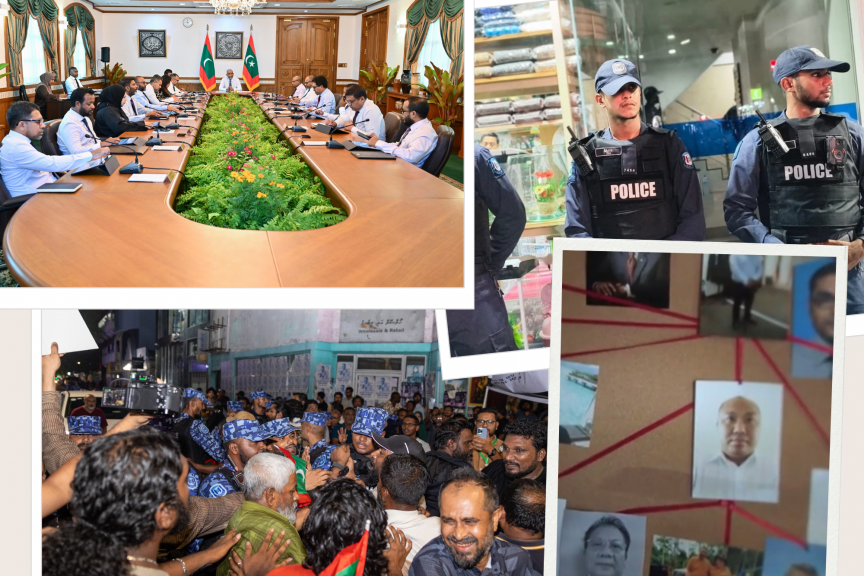
The current administration of President Dr. Mohamed Muizzu is no different in appearance. It came to power on a wave of high expectations, backed by a strong parliamentary majority meant to deliver reform and development. Yet it too has been seen spending significant energy on matters far removed from national priorities. Political temperature remains high.
One day it may be conflict with a neighboring country. The next, clashes with judges. Then disputes with councils or journalists. Energy is repeatedly diverted into confrontation rather than governance. As a result, government’s performance weakens. Although President Muizzu came to power with a nearly thousand-page manifesto, numerous plans, and many signed projects, tangible outcomes remain limited in numerous areas.
Predictably, public support has begun to fall. The government’s poor performance in the last major election reflects this trend. In the referendum, it secured only around 30 percent support—less than even its own party base. This signals a clear decline in confidence.
Afterward, the President announced the administration’s intention to “correct” its course. Yet visible change has been minimal. Instead of focusing on development, effort still appears heavily directed toward political maneuvering. If this continues, there will be nothing to sell by the end of the term—much like previous administrations.
Since the Maldives embraced multi-party democracy, instability and division have become familiar patterns. Each change of government brings a full reset of priorities. Long-term projects are abandoned or restarted from scratch. Rather than steady national progress, political rivalry dominates. Instead of institutions driving development, individuals do.
The five-year cycle has clear consequences. The first two years are spent blaming predecessors. The middle period is spent clinging to power. The final stretch becomes campaign mode. That leaves very little real time for meaningful development.
Within this cycle, development itself becomes a political weapon. Projects are shaped by popularity rather than necessity. They are delayed, renamed, or scrapped for political reasons. Public funds are wasted, and progress slows. Corruption and weak accountability repeatedly surface across administrations. Resources are consumed, losses are rarely recovered, and consequences are almost nonexistent.
In the Transparency International 2025 Corruption Perceptions Index, the Maldives ranked 91st out of 182 countries—an indication that systemic issues remain entrenched.
With each election, changes in senior government officials erode institutional memory. When technical roles are politicized, professional governance weakens. Permanent Secretaries and Ministry Directors are frequently replaced, and experienced administrators are sidelined. As a result, the state repeatedly loses the expertise needed for stable governance.

The economic impact is severe. In a tourism-dependent economy, political instability weakens investor confidence. Credit rating agencies such as Fitch Ratings flag this instability as a risk. Debt has now surpassed 122 percent of GDP, and without structural reform, the outlook remains concerning. International financial institutions continue to warn about rising debt levels, making fiscal discipline increasingly urgent.
Society, too, has become deeply polarized. National debates often devolve into partisan conflict rather than problem-solving. Social media amplifies misinformation and hostility.
At the core of these issues is a deficit in political maturity. Leadership often lacks consistency and long-term responsibility. Rather than strengthening institutions, politics is reduced to confrontation. State bodies are sometimes used as tools in political struggle.
A solution is needed.
The Maldives requires a long-term national development framework—one that survives government changes, ideally lasting 15 to 20 years. Policies on education, healthcare, housing, the economy, and climate resilience must remain consistent regardless of who is in power.
Independent institutions must be strengthened so they serve the state, not political parties. The parliament, judiciary, Anti-Corruption Commission, and Auditor General’s Office must operate free from interference. Cooperation across political lines must become normal, not exceptional. The idea that opponents and journalists are enemies must be abandoned. A professional civil service must be protected from political turnover.
Transparency and accountability must be strengthened. Procurement systems must be reformed, spending must be open, and corruption must be investigated without bias. Governments should focus on governing—not campaigning. Energy must shift from politics to policy execution.
The Maldives is not a difficult country to develop. What is missing is consistent will.
Citizens also carry responsibility. Blind loyalty must give way to accountability. Voters must demand competence, stability, and real policy outcomes—not emotional promises. Political competition is natural in a democracy, but when it overshadows national development, progress stalls, institutions weaken, and trust erodes. The country cannot afford to restart every five years. This is the reality of today: national time is being lost to political turbulence.