date_range
Wednesday 21 Oct 2026


 LOCAL EDITION
close
 LOCAL EDITION


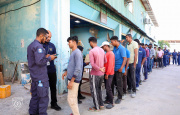
Immigration raids the Rashu Market in Hulhumale' on October 21, 2024. (Photo/Maldives Immigration)
Maldivian authorities plan to soon start monitoring and tracking bank account transactions in order to strengthen efforts to stop illegal business activities by expatriates, according to Economic Minister Mohamed Saeed.
During a press briefing on Tuesday morning, a reporter asked Saeed about the progress made by authorities in efforts to address expat-run illegal business activities.
Saeed said that when the authorities follow-up on reports regarding expat-run businesses, they find that such businesses are often registered to a Maldivian citizen.
“The Maldivian owner rents it out to an expatriate or puts an expatriate at the counter. People in the neighborhood see this, and think it’s an expatriate-run business,” he said.
Saeed said that the authorities still check if they are documented, and take action if they are not.

He said that during talks conducted by the Businesses Council towards resolving the issue, some business owners had suggested tracing the money trail through Maldives Inland Revenue Authority (MIRA) and bank accounts.
“We are working on this. We will be able to find out in a couple of days if the money is circulating through the bank account of an expatriate or the level of linkage there is within the network in such businesses,” he said.
The Economic Ministry had launched a multi-agency crackdown on expat-run illegal businesses in November last year.
Saeed said that the authorities received 409 reports of such business activities, and searched 242 establishments in response. 102 of the establishments were temporarily closed down. He said that this included 57 establishments identified as illegal businesses and 45 establishments that fall within the spa and salon category.
Meanwhile, 62 of the establishments were found to be operating within the law, and were allowed to reopen.