date_range
Wednesday 07 Oct 2026


 LOCAL EDITION
close
 LOCAL EDITION


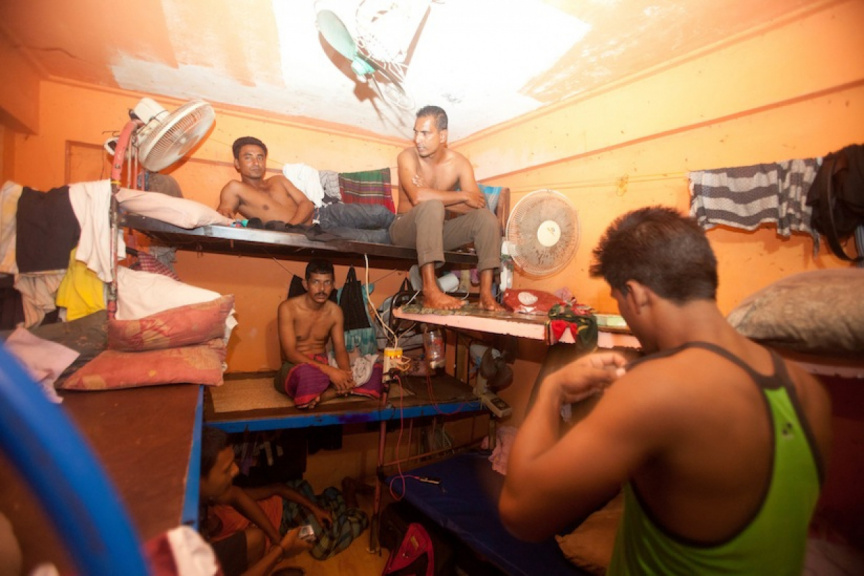
An accommodation block for migrant workers in the Maldives: Many migrants live in conditions deemed unworthy for human habitat. (Photo/Transparency Maldives)
Drawn by the illusion of high wages, many migrants arrive in the Maldives after mortgaging family homes or selling the livestock that once sustained their modest livelihoods. They come with a single aim: to earn enough to support their families back home. Yet from the moment they make the payment to come to this country to the moment they arrive, many encounter relentless and impersonal exploitation.
Compelled into grueling labor, they are frequently denied the wages they were promised. Adequate housing and proper nutrition remain out of reach. Within this cycle of neglect, the news is repeatedly marked by a grim pattern: fires in migrant worker accommodations. In one case, ten lives were lost; in another, five. Families who had sent their loved ones abroad in search of a better future receive only charred remains or ashes in return.

Fire-related deaths in migrant housing have become a recurring tragedy in the Maldives. Beyond fires, lives are regularly lost due to unsafe working conditions. These incidents are not isolated accidents or coincidences; rather, they stem from entrenched discrimination within society and systemic failures among the responsible authorities.
Although the Maldivian economy relies heavily on migrant labor, the attention paid to their safety is negligible. Public discourse often shifts blame onto the migrants themselves, particularly those without documentation, while rarely addressing the exploitative actors who collect large recruitment fees and confine workers to inhumane conditions. Recent fires underscore a stark reality: many migrants live in unsafe, overcrowded environments unfit for human habitation. Despite the repetitive nature of these incidents, meaningful corrective action remains absent.
''Thahugeegu'' kurumugai thihbaa, 10 marah fahu 5 maru: mi faharu?https://t.co/A2mP1Eu0Sg
— sun.mv (@sunbrk) March 18, 2026
Follow us:
Viber: https://t.co/S8n0X7xxc5...
Telegram: https://t.co/plOPl2zYfy#sunonline #seemv #news #sunonlineheadlines #latestnews #dhivehinews #maldivesnews pic.twitter.com/SyqJeq2a05
A History of Tragedy: From Nirufehi to Dhigurah
One of the most devastating incidents occurred on November 10, 2022, at M. Nirufehi in Malé, when a fire originating in a ground-floor vehicle repair garage rapidly spread through the migrant housing above. Ten workers—eight Indians and two Bangladeshis—lost their lives, trapped without escape. Although 28 individuals were rescued, it remains the deadliest fire in the country’s history.
In the immediate aftermath, there was brief public attention on the uninhabitable conditions of migrant housing. However, as is often the case, the concern quickly faded, and the tragedy receded from public memory until the next disaster occurred.

Last Friday night, another fatal incident took place in ADh. Dhigurah, where a fire in a worker accommodation block claimed the lives of five Bangladeshi migrants. The fire is believed to have been caused by a gas leak during the preparation of Suhur. Approximately 30 individuals were residing in a building with only one exit, reportedly located adjacent to the kitchen where the fire began, effectively trapping the occupants. Rescue teams were forced to breach a wall to reach those inside. Of the seven individuals hospitalized, five succumbed to smoke inhalation, while two remain on ventilators at IGMH.
"Death Traps" and Systemic Neglect
Migrant accommodations are often, in effect, death traps. In confined spaces, 20 to 30 individuals may share a single room, sleeping on stacked bunk beds. Due to space constraints, gas cylinders are frequently stored next to sleeping areas, significantly increasing fire risk. When fires occur, these cylinders can ignite in rapid succession, rendering the blaze uncontrollable.
"If you look at the footage from Dhigurah, you can see the intensity of the fire. That happens because so many gas cylinders are kept in such small spaces. If this isn't stopped, it will happen again," said a senior official from a relevant authority, speaking on the condition of anonymity.

As observed in the Nirufeige incident, in addition to fire hazards, these accommodations often lack ventilation and proper windows. Many victims succumb to smoke inhalation before flames even reach them. The use of plywood and timber partitions allows fires to spread rapidly, often engulfing entire structures within minutes.
Regulations Without Enforcement
Regulatory frameworks governing the recruitment and housing of migrant workers formulated by the Ministry of Economic Development years ago. These guidelines specify minimum standards for space, sanitation, and safety. However, their effectiveness is undermined by a near-total lack of monitoring and enforcement.
The COVID-19 pandemic briefly exposed the severity of overcrowded migrant housing in Malé, with authorities identifying over 30 locations unfit for habitation. Temporary shelters were established, and residents were relocated.
Yet once the immediate crisis subsided, conditions largely reverted to their previous state. Across both the capital and islands, authorities often lack even basic records of occupancy until a tragedy occurs.
Investigations Without Results
Following each loss of life, the Maldives Police Service and the Human Rights Commission of the Maldives (HRCM) launch investigations. After the Dhigurah fire, HRCM once again initiated a probe into potential human rights violations.
However, such investigations rarely yield tangible outcomes. In the aftermath of the Nirufehi fire, there is no public record of accountability or penalties imposed for negligence. Official responses are typically limited to statements, briefings, and online communications, while systemic issues remain unaddressed.
"The truth is, even though these institutions exist, they do nothing," said a human rights advocate. "They take their salaries and benefits while migrants live in these conditions. These workers are someone’s children, someone’s family. We are failing to guarantee them their most basic rights."

The pattern is consistent: bodies are repatriated, and the issue fades from public attention. In the absence of accountability, landlords continue to profit from unsafe housing arrangements without consequence.
Migrant workers perform some of the most physically demanding jobs in the country, from construction to cleaning—roles often avoided by locals. Despite their contributions, they are frequently denied basic human dignity. Practices such as unpaid wages, passport confiscation, and unsafe living conditions have become normalized. In death, their families are left not only with grief but also with the financial burdens incurred to send them abroad.
The Dhigurah incident serves as a stark reminder of systemic failure. Regulations that exist only on paper are insufficient without enforcement. It is both a moral and legal imperative to conduct regular inspections of migrant housing and impose strict penalties on those who violate safety standards. Without decisive action, further tragedies are inevitable. If any sense of collective humanity remains, such conditions cannot be allowed to persist.