date_range
Thursday 15 Oct 2026


 LOCAL EDITION
close
 LOCAL EDITION


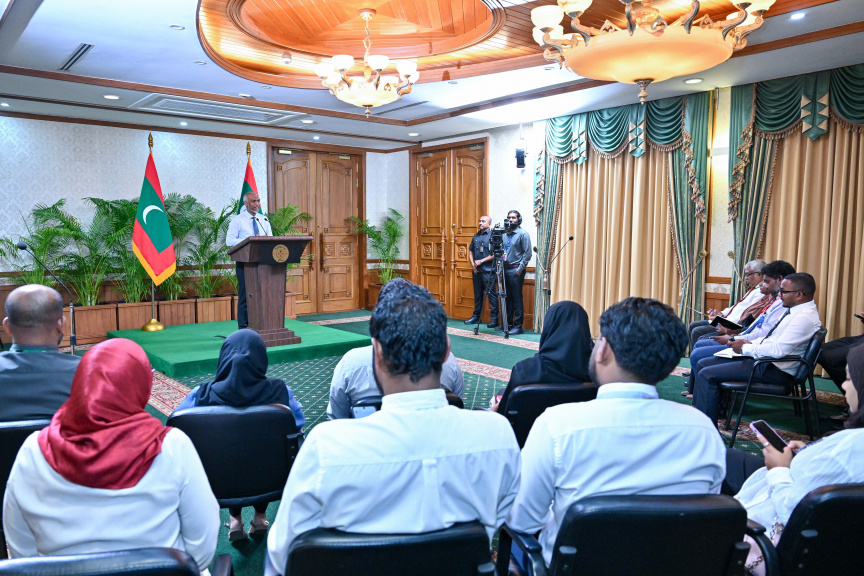
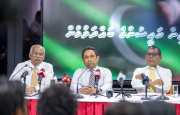
President Dr. Mohamed Muizzu speaks to reporters on April 20, 2026. (Photo/President's Office)
While listening to the concerns of a veteran teacher last week, they remarked, "In truth, journalists are the only ones left with the opportunity to voice what is truly in their hearts regarding the current state of the nation. Government employees, teachers, and even those in the private sector remain silent, paralyzed by the fear of adverse consequences if they dare to speak the truth."
This may indeed be the harsh reality facing the average citizen today. However, this perspective also underscores a glimmer of hope: the belief that there still remains some space for journalists to uncover facts and offer criticism. But looking at the current climate, can we genuinely claim that such freedom still exists for the press?
The essence of journalism lies in its power to act as a watchdog over those in authority—to pose difficult questions and demand accountability, regardless of whether it pleases or displeases the powerful. With the liberties afforded by the 'Green Constitution,' the concept of a free press was formally recognized. Since then, the media has weathered numerous turbulent periods. The Maldivian people have witnessed eras where journalists were summoned for interrogation and media houses were set ablaze. Reflecting on that not-so-distant past and comparing it with the present, one must wonder: are we seeing history repeat itself?

Beyond the Press Freedom Index: A democratic decline
In the latest World Press Freedom Index released by Reporters Without Borders (RSF), the Maldives has plummeted from 104th to 108th place. This is not merely a number; it is a serious warning that the environment for independent journalism is deteriorating rather than improving.
This index is a comprehensive evaluation of the political, economic, social, and legal challenges and opportunities for free media within a country. Any decline in ranking, or the erosion of established progress, is inherently concerning. However, the Chief Spokesperson of the Government, Mohamed Hussain Shareef (Mundhu)—who is expected to work most closely with the media—shared a remarkably different interpretation of this warning last Thursday.
"A country dropping four spots in an index could simply mean that some countries below it have improved by five or ten spots in the statistics, right?" he suggested.

But is a decline not fundamentally negative? If other nations have improved their standards enough to surpass us by several ranks while the Maldives slides backward, does it not signify a failure to progress? A lower ranking indicates a decline in the safety of journalists, an increase in political and economic interference in media, and a weakening of legal protections.
Unanswered questions and withheld Information
Transparency is the cornerstone of any accountable system, and the primary tool for transparency is the disclosure of information. Today, however, obtaining information has become a monumental task. The 'Right to Information' (RTI) framework often appears to exist only in name.
Securing responses from government offices, ministries, and state institutions is a persistent challenge for journalists. Beyond ignored phone calls, even the most mundane matters are guarded as state secrets. As the administration enters its third year, the most frequently asked question remains unanswered: exactly how many individuals are employed in political positions across various agencies, institutions, and state-owned enterprises?
Even the President's Office rarely provides satisfactory responses to RTI requests. The consequence of this is a damaging message echoing through the state’s administrative hierarchy: that withholding information is acceptable. Delaying or obstructing the flow of information is not just an inconvenience to journalists; it is an infringement on the public's right to understand how state resources are utilized and how decisions are made.

Modern democracy or "immature" leadership?
If political leaders or a government view the work of journalists as an obstacle, it is a grave error. It is a clear indication that the seeds of a modern democracy have yet to truly take root. This is the scene currently unfolding in the Maldives.
Tough questions are often dismissed as personal attacks. Investigative reports are characterized as biased or as direct acts of opposition. Instead of responding constructively to criticism, resorting to hostility through the exercise of power raises questions about the competency of those in leadership. When faced with an inquiry, dragging out responses or attempting to discredit a specific outlet based on perceived interests is unbecoming of a public official tasked with providing information.
As World Press Freedom Day arrived, journalists were met with more apprehension than hope. There is a palpable fear that the pens of the press are being seized and broken. Even a glance at the recently established commission to oversee media affairs fails to show a genuine commitment to protecting journalists.
If the Maldives is to progress, it requires an environment where journalists can operate without fear. The only path forward is to widen the space for freedom of the press.