date_range
Tuesday 13 Oct 2026


 LOCAL EDITION
close
 LOCAL EDITION


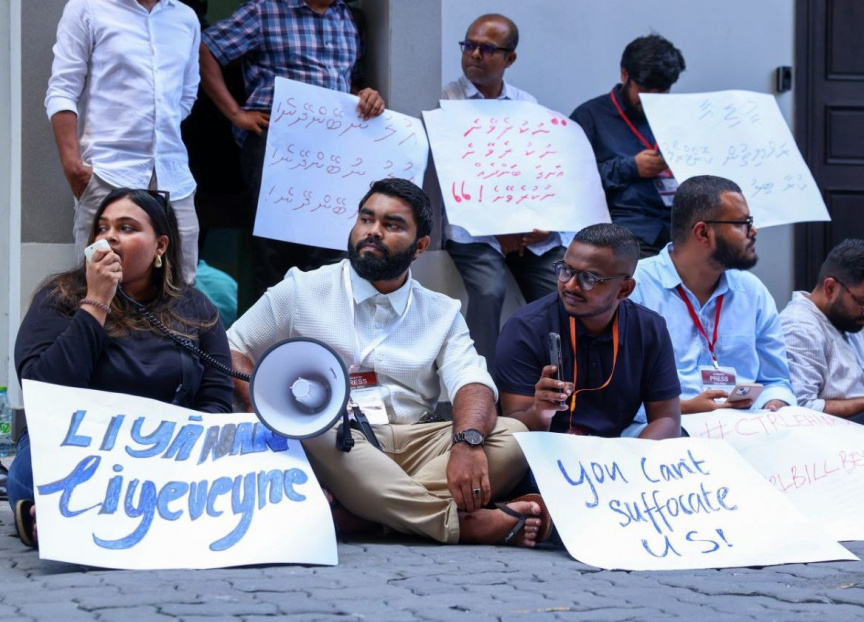
Journalists protest against the media control bill outside the Parliament Building on September 9, 2025. (Sun Photo/Maaniu Mohamed)
The Maldives has fallen four places in the Reporters Without Borders (RSF)’s annual press freedom index.
According to the 2026 world press freedom index, the Maldives is now ranked 108 out of 180 countries – down by four ranks from 104 in 2025.
The Maldives remains categorized a country where press freedom remains “difficult”.
The Maldives had been ranked 87 in 2022, considered “satisfactory.” But the country slipped to 100 in 2023, considered “problematic”, and then by six ranks to 106 in 2024, before rising to 104 in 2025, which is still classified as “difficult.”
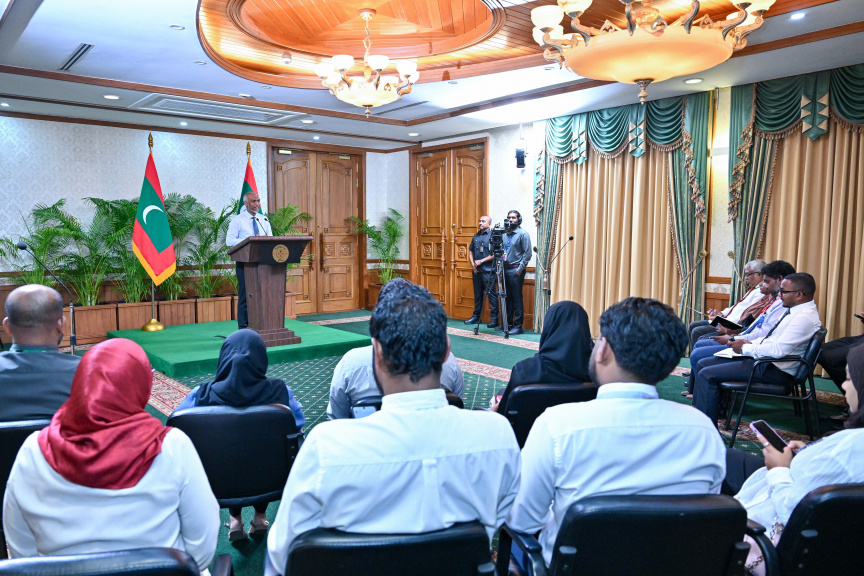
The country has slipped another four places this year.
The RSF assigned Maldives with a score of 49.23 out of 100, citing major challenges to press freedom.
Breakdown of the score:
The only favorable change was in the social indicator, with the Maldives rising by 15 ranks from 133 to 118.

The release of the 2026 press freedom index comes amid renewed fears over the state of press freedom in the Maldives, after the police raided the office of news outlet Adhadhu over a documentary published on March 28, featuring an anonymized interview with a woman who made serious allegations against President Dr. Mohamed Muizzu. The raid on Monday lasted four hours, and saw the police seize electronics, including laptops and storage devices.
It marked the largest such raid on a media outlet by Maldives police.

The police have also had travel bans imposed on Adhadhu’s CEO and chief editor Hussain Fiyaz Moosa, managing editor Hassan Mohamed, as well as former President’s Office staffer Aishath Easha Ashraf.
Both Fiyaz and Hassan were summoned for police questioning on Wednesday, but chose to protect their source and exercise their right to remain silent.
The case sparked condemnation from the Maldives Journalists Association (MJA), which accused the government of crossing a clear red line, and demanded an immediate end to the intimidation of journalists and the suppression of press freedom.
It also raised concerns within the international community.
But it is not the only recent development to draw international scrutiny over the state of press freedom in the Maldives.

In September 2025, the Parliament, in which the ruling People’s National Congress (PNC) holds a supermajority, passed contentious new media laws that saw the Maldives Broadcasting Commission and Maldives Media Council dissolved and replaced with the Maldives Media and Broadcasting Commission (MMBC), a single, government-controlled commission empowered with penalizing both TV and online media, including by imposing hefty fines and suspending or even shutting down outlets.