date_range
Wednesday 28 Oct 2026


 LOCAL EDITION
close
 LOCAL EDITION


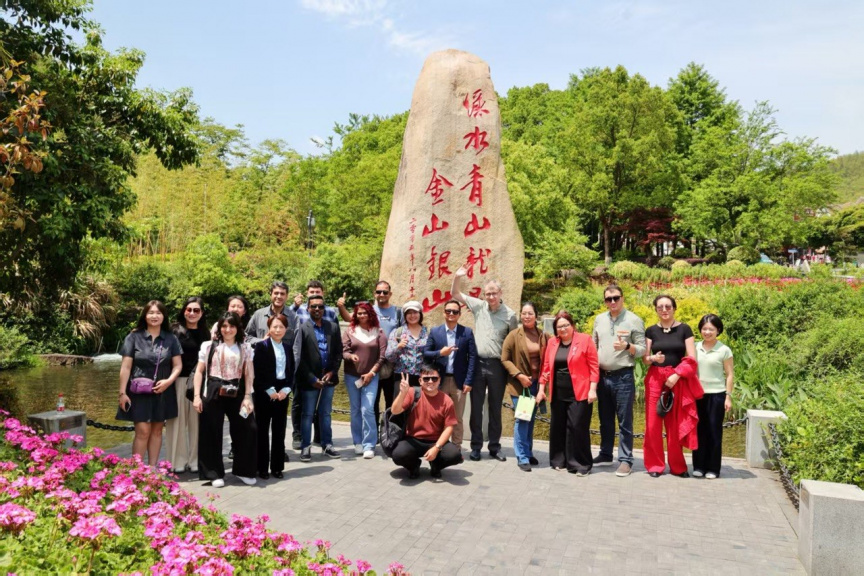
Today, as part of the SCO Media Delegation, I had the opportunity to explore Anji County—and I can honestly say, this was not just a visit. It was an experience that shifted the way I think about development, sustainability, and everyday life.
From the very beginning, I could feel that Anji is different. There is a calmness, a sense of balance, and a deep connection with nature that is hard to ignore.

Anji is known as the birthplace of the idea “lucid waters and lush mountains are invaluable assets.” And today, I didn’t just hear this concept—I saw it, I felt it, and I understood it.
This philosophy means that clean environments—clear waters, green mountains, and healthy ecosystems—are not barriers to development, but valuable assets. Instead of exploiting nature for short-term gain, Anji has chosen to protect it, and in doing so, has created long-term growth and prosperity.

It is a way of thinking that changes everything.
A warm welcome and a deeper understanding
One of the most memorable parts of the day was having lunch with the Deputy Mayor of Anji County, Mr. Shen Zhongping.

He was very welcoming and thoughtful, and he took the time to share the history of Anji—how the city developed and transformed into what it is today. Listening to him gave real meaning to everything we were seeing.
What stood out to me was not just the policies or plans—but the vision behind them.

And then came the food—and even that told a story.
Anji has its own unique food culture. During lunch, most of the dishes were made using bamboo—different types and different ages of bamboo, each bringing a different taste and texture. It was something completely new for me.

The bamboo drink was especially delightful—refreshing and unlike anything I had tried before.
And of course, Anji is also famous for its white tea, adding yet another layer to its rich natural identity.
A city built around bamboo
As the day continued, one thing became very clear to me:
Bamboo is everywhere.
Not just in the forests—but in daily life.
The houses, for example, are designed using bamboo elements, both in the interiors and exteriors. It gives the spaces a natural, warm, and sustainable feel.
But it doesn’t stop there.

From pencils to books, furniture to bags, and even musical instruments—bamboo has replaced materials that would normally harm the environment.
At first, I thought this might be symbolic.
But it’s not.
It’s real.
It’s practical.
It’s working.
And that’s when I truly understood the concept of “Bamboo as a substitute for plastic.”
Dazhuyuan Village – Where sustainability comes to life
After lunch, we visited Dazhuyuan Village, and this is where everything I had learned started to come together.
Walking through the village, surrounded by bamboo and nature, I could see how sustainability is not just talked about—it is practiced.

The village has transformed from a traditional rural area into a model of eco-tourism and green living. And yet, it has kept its identity, its culture, and its connection to nature.
It felt peaceful. Real. Honest.
And it made me realize that development doesn’t always mean change for the worse—it can mean growth that protects what already exists.

Bamboo for plastics – Seeing the future today
One of the most eye-opening visits of the day was the “Bamboo for Plastics” Comprehensive Exhibition Center.
Inside, I saw something powerful.
Not just ideas—but actual solutions already in use.

There were bamboo products for almost everything you can imagine. And there was even a shop where you could purchase these items—showing that sustainability can be part of everyday life.
This wasn’t about the future.
This is happening now.

And it made me think—why can’t we do something similar?
Innovation through education
Along the way, we also visited Shanghai Jiao Tong University, where I saw firsthand how students and researchers are driving innovation—blending technology, sustainability, and real-world solutions for the future.

Seeing this gave me hope.
Because this is where change truly begins—with young people who are willing to think differently and create something new.

Xiaoyin Half-Day Village – A moment to slow down
Our final visit was to Xiaoyin Half-Day Village, and it felt like stepping into a different pace of life.
Everything here is designed to make you slow down, breathe, and reconnect with nature.
It’s not about luxury—it’s about balance.
And after a full day of learning and observing, this place gave me a moment to reflect.

Thinking about the Maldives
Throughout the day, one thought stayed with me:
What does this mean for the Maldives?
We may not have bamboo forests, mountains, or lakes—but we have something equally valuable.
Our ocean.
Our islands.
Our natural beauty.
We are rich in palm trees and marine life.
So maybe the question is not what we don’t have—
but what we can create from what we do have.
Could palm-based materials replace plastic?
Could we innovate using our own resources?
Could we protect our ecosystem while still developing?
Anji has shown me that this is possible.
A message to Maldivian youth
This experience also made me think about young people back home.
If you love nature…
If you want to create change…
If you have the mindset to build a better future…
There are opportunities waiting for you.
Institutions like the Bamboo Industry Institute at Zhejiang A&F University (ZAFU) are working on real solutions—focusing on bamboo cultivation, engineering, and carbon technologies.

Learn something new.
Try something different.
Create something meaningful.
Ending the day
From the first visit in Anji to the last, everything today was meaningful.
And I would also like to sincerely thank our hosts—the entire experience was truly well organized and thoughtfully planned.
The day ended with checking into the Grand New Century Resort in Anji.
From my room, I could see the mountains stretching into the distance. The breeze was cool and refreshing, carrying a gentle bamboo scent through the air.
It was peaceful. Calm.
And deeply reflective.
Looking ahead
Tomorrow, we head to Beilun District in Ningbo—where more places, more ideas, and more experiences await.
This journey is far from over.
And I’m looking forward to discovering what comes next.