date_range
Thursday 15 Oct 2026


 LOCAL EDITION
close
 LOCAL EDITION


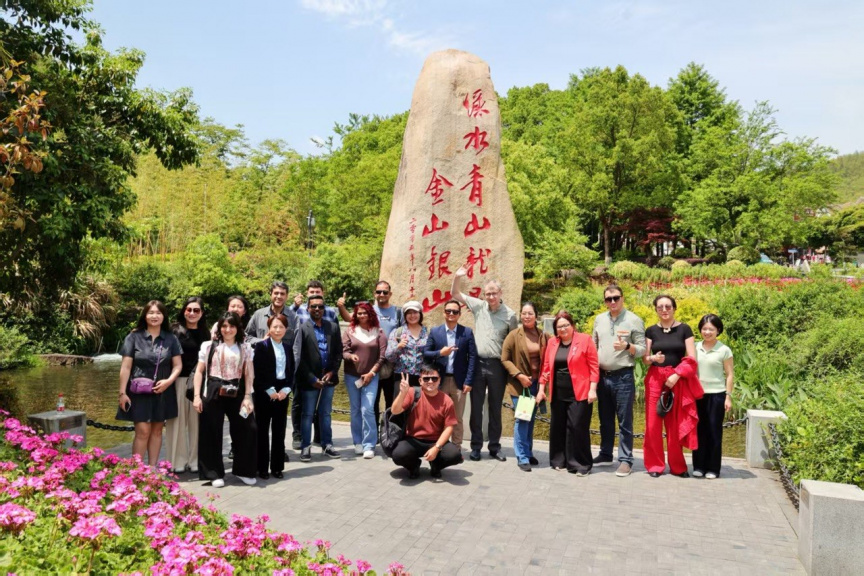
Being part of the Green and Sustainable Development Forum of the Shanghai Cooperation Organization (SCO) was more than just attending a forum — it was an experience that genuinely shifted how I understand development, sustainability, and the way our future can be shaped.
What made this journey special is that it wasn’t limited to discussions in a hall. We didn’t just hear about sustainability — we saw it, walked through it, and experienced it in real life.
It all began in Hangzhou, a city that immediately gives you a sense of balance. There’s a calmness in how everything functions — modern, yet not overwhelming. At the Hangzhou Embodied Intelligence Exhibition Center, I saw how far technology has come. Robots interacting, systems responding in real time — it felt like stepping into the future. But what stood out to me was how this innovation didn’t feel separate from sustainability. It felt like it was built to support it.

Then came Anji County — and this is where everything started to connect.
Anji is not just a place, it’s an idea. A way of living that proves development doesn’t have to come at the cost of nature. Walking through Yucun Village, it was hard to believe that this was once an area dependent on industries that harmed the environment. Today, it stands as a global example of what happens when a community chooses a different path.


In Dazhuyuan Village, I saw how something as simple as bamboo can become a powerful solution. The “Bamboo for Plastics” initiative really stayed with me — it’s practical, it’s scalable, and most importantly, it works. It made me think about how solutions don’t always have to be complex. Sometimes, they already exist around us.


And then there was Xiaoyin Half-Day Village — a place that felt like a pause. A reminder that development is not only about building more, but also about creating spaces where people can reconnect with nature and themselves.
Just when I thought I understood what sustainable development looked like, the journey took us to Ningbo — and this is where my perspective expanded even more.


At Ningbo Iron and Steel Co., Ltd., I expected to see what we usually associate with heavy industry — pollution, noise, and environmental strain. But what I saw was completely different.

Yes, it was large-scale. Yes, it was powerful. But it was also clean, organized, and surprisingly green.


Through their industrial experience program, we were able to see everything up close — from steel-making processes to environmental systems like dust removal and water treatment. It made one thing very clear to me:
industry itself is not the problem — how it is managed is what matters.


The biggest shift for me came at the Zeekr Smart Factory on Meishan Island.

This was something else entirely.

A factory, yes — but not in the way we imagine it.

Everything was connected, controlled, and efficient. More than 300 vehicles are produced daily, yet nothing felt chaotic. The use of AI, real-time data, and digital systems made the entire process feel smooth and precise.
But what really stood out was how sustainability was built into the system itself.

Waste heat is reused.
Rainwater is recycled.
Solar energy is actively used.

It’s not something added later — it’s part of how the factory works.
And then, there were the people.
Young professionals, focused and confident, working in a space that represents the future. It reminded me that sustainability is not only about systems and technology — it’s also about people who believe in doing things differently.

After experiencing all of this, the journey brought us to the opening ceremony of the forum, where everything we had seen began to make even more sense.

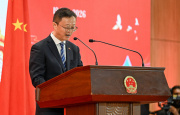
Leaders and delegates came together to discuss one of the most pressing issues of our time — how to move forward with development while protecting the environment. A strong message was shared throughout: sustainability is no longer a choice, but a necessity.
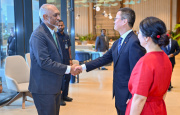
One of the most meaningful moments for me was hearing the Ambassador of Maldives, H.E. Dr. Fazeel Najeeb, speak about the close friendship between the Maldives and China, and the importance of collaboration in areas like green energy and sustainable development. His message was clear — countries like the Maldives are already facing the impacts of climate change, and this is the time for immediate action. That message stayed with me.

What also made this experience truly special was the way everything was organized by our hosts. From the very beginning, you could feel the effort and care that went into every detail. The coordination, the timing, the smooth flow of the program — everything was handled so professionally, yet with a personal touch that made us feel completely at ease.
Despite coming from different countries and backgrounds, we never felt like outsiders. Instead, we felt welcomed — almost like we were at home.

The experience of food itself became part of the journey. From Anji County to Ningbo, every meal introduced us to a different aspect of Chinese tradition. It wasn’t just about eating — it was about experiencing culture through taste, presentation, and the way it was shared with us.

After the opening ceremony, we as media professionals spent much of our time at the news center located within the exhibition venue. And honestly, that space became something more than just a working area.
It became a place where people connected.
Media professionals from different countries — including journalists, TV producers, and content creators — gathered there, talking, sharing, exchanging ideas, and building friendships. What stood out to me the most was how natural it all felt. I didn’t feel like a stranger at all, and that’s largely because of the local Chinese media professionals. They were incredibly friendly, open, and welcoming.

I even had the opportunity to give a few interviews to local media, and I truly appreciated the way they presented our conversations. The respect and genuine interest they showed — especially their kind words about the Maldives — made me feel proud.
And the news center itself was not just about work.
While we were busy with our coverage, there were moments to pause and experience something different. We got to taste traditional Chinese delicacies right there, and even more interesting — we were introduced to Chinese traditional crafts.

Not just to observe — but to try them ourselves.
Those small moments made a big difference. They turned a professional environment into something much more human, creative, and memorable.
Looking back at the entire journey — from Hangzhou to Anji to Ningbo — one thing became very clear to me:
Green and sustainable development is not just a concept. It is already happening.
It’s happening in villages that chose nature over destruction.

It’s happening in industries that are learning to reduce their impact.
It’s happening in factories that are redesigning the way production works.
And for countries like the Maldives, where climate change is not a distant issue but a daily reality, this experience felt even more important.
This journey showed me that the real question is not whether development should happen —
but how we choose to do it.
And if done right, development doesn’t have to harm the environment.
It can protect it.
It can work with it.
And it can create a future that is not only advanced — but sustainable.

One message echoed through every voice we heard — this is not a journey any one country can take alone, and that is why the Shanghai Cooperation Organization truly matters: because the future we are building must be shared, supported, and sustained — together.