date_range
Wednesday 28 Oct 2026


 LOCAL EDITION
close
 LOCAL EDITION



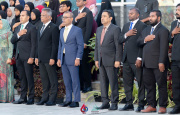
(From R-L) Finance Minister Moosa Zameer, President Dr. Mohamed Muizzu, and MACL's Managing Director Ibrahim Shareef Mohamed. (Photo/President's Office)
Is there any reason not to feel disheartened? Ibrahim Hakeem has dedicated nearly twenty-five years of service to his company. Such long-standing commitment to a profession is undoubtedly rooted in a deep passion for the work. Throughout this time, he neither voiced complaints nor questioned the value of his contributions. Yet now, he finds himself suddenly overcome with profound despair. The disparity between his decades of experience and his current salary is striking—particularly when compared to an inexperienced newcomer who has been abruptly placed into a highly paid position.
This situation reflects a broader reality across state-owned enterprises (SOEs) and government ministries in the Maldives. Ordinary employees devote their entire working lives to their roles for modest compensation. Meanwhile, with each change in administration, political appointments are distributed throughout institutions and companies. These individuals, often carrying minimal responsibility, receive substantial salaries, leaving the core workforce feeling sidelined and undervalued. What a big injustice this is.

“Just Punch In and Go Home—It Doesn’t Matter”
No sector appears immune to this issue. A review of government ministries reveals hundreds of political appointees across various levels. Data indicates that the current administration has appointed an unprecedented number of Deputy Ministers. In addition, ministries are overflowing with Senior Political Directors, Political Directors, and Assistant Political Directors. However, it remains unclear how many of these individuals produce meaningful outcomes.
“Some of these individuals do not even have designated workstations. Under such circumstances, how can productivity be even a topic? There are those who simply clock in and leave. Furthermore, during the recent campaign period, many of these appointees were seldom present in the office,” remarked a source currently serving as a Political Director.
Reports indicate that, thus far, no effective system has been established to evaluate the performance of political appointees. Nevertheless, there have been rumours that the government intends to introduce performance assessments and has warned of potential dismissals for those who underperform. This development reportedly follows a significant loss for the government in the local council elections and a referendum, along with economic pressures arising from conflicts in the Middle East, prompting the need for cost-reduction measures.
However, as with previous administrations, these injustices have been allowed to persist for over two and a half years. While ordinary employees make considerable sacrifices for their earnings, the absence of accountability among political appointees fosters a culture of indifference. This reality is evident within ministries where information is accessible.
The situation within SOEs—such as Fenaka, MACL, STELCO, and MPL, where detailed figures are often not disclosed—is even more difficult to assess. These are technically demanding environments, yet many skilled workers express frustration over systemic inequities.
“This represents a systemic failure. While we work tirelessly to keep operations running efficiently, others remain in air-conditioned offices, having a coffee and socialising,” stated an employee of a state-owned company.
“They then claim that workers are becoming complacent. But who would be motivated to go beyond expectations when their efforts receive no recognition?”

Educated Youth Left Without Opportunities
Another pressing issue is the limited opportunity for employment without political connections. Securing a position within an SOE, a ministry, or any state institution often appears unattainable without such affiliations.
A young individual, driven by a passion for aviation and having financed his studies abroad independently, now works at a pharmaceutical company. Despite applying to the airport company with strong qualifications and high expectations, he was not selected. Faced with the necessity of earning a living, he accepted the opportunities available to him.
Why should an educated young person face such a situation? The explanation is evident: institutions and companies have become tainted with political appointees, leaving little room for merit-based recruitment. Vacancies are often announced only in the lead-up to elections—one of the clearest realities highlighted by the recent council elections.

In the current state budget, MVR 17 billion has been allocated for the salaries and benefits of government employees. This figure does not even account for state-owned enterprises. A portion of this funding is derived from public taxation. No diligent taxpayer would reasonably accept that their contributions are used to fund disproportionately high salaries for individuals who do not perform meaningful work. Receiving compensation without corresponding effort reflects a lack of integrity.
No group should remain on the payroll without contributing at a level comparable to that of the general staff.
The 68 percent “No” vote in the recent referendum delivered a clear message: the public rejects the injustices observed within the government over the past two years and three months. Such practices are unacceptable. Moving forward, the priority must be to reduce political appointments and create opportunities for capable, educated youth who can contribute effectively. The system in which employment depends on personal appeals to local Members of Parliament must be dismantled. Political roles should be financed through party resources and confined to party structures. State-owned companies and public institutions must be freed from political interference.