date_range
Wednesday 28 Oct 2026


 LOCAL EDITION
close
 LOCAL EDITION


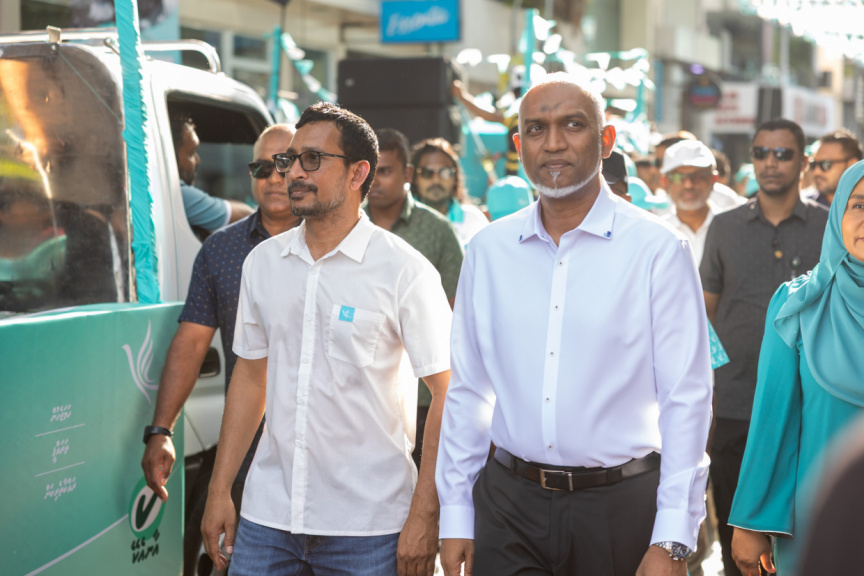
President Dr. Mohamed Muizzu at the PNC rally to wrap up its local council elections campaign on April 3, 2026. (Sun Photo/Abdulla Shathiu Mohamed)
The fact of the matter is that this is a huge embarrassment for the government. The results of Saturday's local council elections and women's development committee elections have handed the government a massive defeat. The government also lost the public referendum it initiated to gauge opinion on synchronizing the presidential and parliamentary elections by a landslide.
Leading up to this election, the government faced serious allegations it implemented in numerous economic and social measures it should not have. This included misusing state resources for campaigning, creating thousands of jobs overnight, and allegations of distributing bribe money. But despite all these alleged efforts, the people used the ballot to reject the government. The question of the hour is, what does it mean, when a government that did so many things they shouldn’t have, and distributed so many things they should just to win the elections, suffers such a heavy defeat?
Mistake upon mistake
In the leadup to the elections, the government made multiple decisions that increased the financial burden on the state. It waived off two years of rent on some 6,000 Hiyaa flats mere days before the vote. This abrupt waiving off of rent on flats funded with massive loans deal a heavily blow on state revenue, and is also an act that benefits a specific group of people.
The leadup to the elections also saw the sudden creation of thousands of jobs. Statistics show that in March alone, MTCC opened 1,185 positions with 91 vacancy announcements. Most of these MTCC jobs were temporary positions, including staff hired for six months to a year, or until the completion of specific projects. While salaries were stated to be between MVR 5,000 and MVR 15,000, the application windows for some of these jobs were notably short.
Looking at the MTCC announcements, none of these were re-advertisements of previously cancelled posts. This strengthens allegations that these jobs were created specifically to target the elections.
Beyond MTCC, institutions like RDC, Fenaka, HDC, and Customs also hired a large number of employees during this period. In this fragile economic climate, this is a burden greater than the state budget can bear. Simultaneously, numerous projects were suddenly announced in Malé and the atolls, and President Dr. Mohamed Muizzu himself, along with his ministers, conducted door-to-door visits making various promises. The millions spent by the government on the campaign are evident just by looking at the streets of Malé.
A major victory for a "dying" MDP
Early results show the government headed to a major defeat, despite running an extensive campaign backed by state property and funds. Preliminary results indicate that the opposition MDP won the mayorships of all five cities, and a majority of council seats. The MDP retaining its mayoral seats in Malé, Addu, Fuvahmulah, Thinadhoo, and Kulhudhuffushi came as a huge shock to the government.

Particularly in Malé City, where President Muizzu previously served as mayor and where government support was expected to be strongest. The people of Male’ saying ‘no’ to the government is something that requires deep reflection.
The people also rejected the proposal by the government to shorten the term of the current parliamentary assembly and hold future presidential and parliamentary elections concurrently by a landslide.
The government was accused of launching projects for show, buying votes, and distributing jobs to ensure victory. But the people used the ballot to reject the government. This shows that people are no longer falling for political traps set by administrations.
Failure to turn promises into action: Finances worsen, stalling development
President Muizzu came to power with many promises. As a result of the high hopes given to the people, the public granted the government a supermajority in the People's Majlis. However, instead of implementing reforms, the government was seen consolidation of power. Alleged attempts to influence the Supreme Court and the "tying of the hands" of Parliament members are clear examples. The government reached its mid-term with a lot of promises, but little to show for it.
The lack of results isn't just due to the state of the country's finances. The incumbent administration, too, continues to pile mistakes upon mistakes. It hasn’t implemented cost-cutting measures. The practice of distributing political jobs without regard for competence has become rampant. Finance Ministry statistics show that the largest portion of the state budget is spent on recurrent costs like salaries and benefits. Capital expenditure—spending on infrastructure projects—has declined.
Nukuranvaa ethah kameh kurevvi, evarun ves Rayyithun bunee noonekey: Naganvee kon messege eh?https://t.co/5kDqY77Cmq
— sun.mv (@sunbrk) April 4, 2026
Follow us:
Viber: https://t.co/r1ic7mirrB
Telegram: https://t.co/plOPl2zYfy#sunonline #seemv #news #sunonlineheadlines #latestnews #dhivehinews #maldivesnews pic.twitter.com/CzX1jJ1ujx
Look at recent weeks. Even as the war in the Middle East raises fuel and food prices to unprecedented levels, the government prioritized campaigning over cost-cutting. Major infrastructure projects are stalled. The President also made promises that became the subject of jokes, such as the "Rasmalé" reclamation and building an underwater glass tunnel. Despite the President claiming last year's budget was dedicated to housing and calling it the "golden year of housing," the year ended without any real results.
Those now in the top tiers of the government once criticized previous administrations for acting the same way during elections; seeing them repeat the same mistakes has increased public frustration. Experts warn that conducting such activities at a time when national debt is high and international financial institutions are calling for urgent austerity measures could plunge the country into a deep economic ditch.
The people send a clear message: Action over words
The message the people sent the government in the elections is very clear. The people will not entertain empty political talk and inconsistent spending by politicians. History has proven across all past administrations that distributing jobs, lowering rents, and using state funds for election campaigns does not guarantee votes. The people want a President who talks less and acts more—a leader who implements sound, economically viable policies.
This result demonstrates the level of political awareness among the Maldivian people. It shows that citizens prioritize long-term development over short-term gains. Therefore, it is imperative for the government to learn from this result and review its policies. As new mayors and councilors take office, the next step should be for the government to cooperate with them and determine a way to work together for national development. The people’s message is clear: they said "no" to the government. Now, it is time to reform.