date_range
Thursday 22 Oct 2026


 LOCAL EDITION
close
 LOCAL EDITION


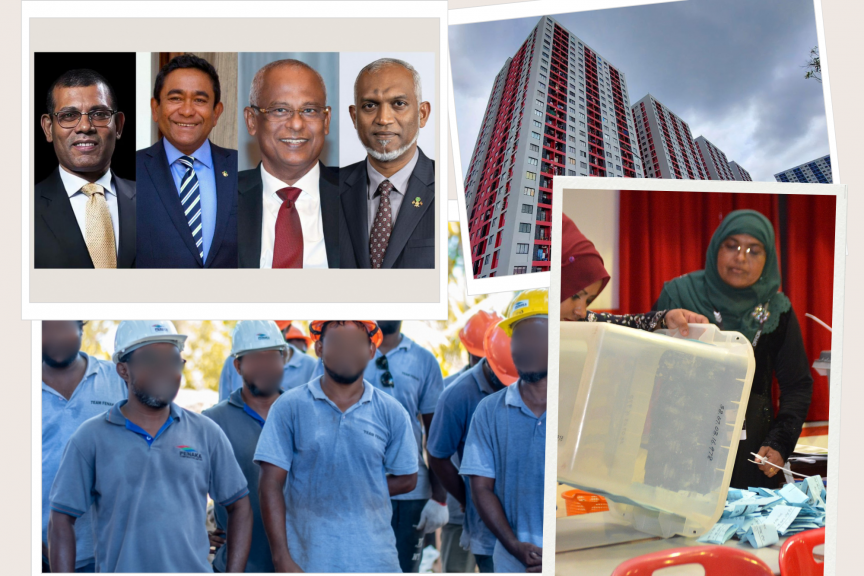
Forget for a moment the stories of corruption that occur within every Maldivian administration. The inconsistent economic and social policies alone suffice for the Maldives to serve as a "bad example" to the world. Administration after administration has been squeezing the Maldives dry for the sake of political gain, leaving the country withered and exhausted.
Let’s look briefly at some examples. During the administration of President Mohamed Nasheed, the first democratically elected president, the country suddenly began spending far beyond its income. While his administration took important financial steps like introducing taxation and attempting to run state-owned enterprises (SOEs) on a privatization model, the expenditures far outweighed the revenue. This included non-targeted subsidies and systems like Aasandha, the national health insurance scheme. The result was a skyrocketing national debt.
Looking at the subsequent administration of President Abdulla Yameen, while the massive projects funded by giant loans brought infrastructural benefits, the financial damage was not small. This is because numerous mega-projects were carried out using huge loans without a clear path to generate revenue. The fact is that income must be generated from the Sinamalé Bridge and reclaimed land for the math to work. Even then, projects like building an airport in Kulhudhuffushi—just 15 minutes away from another airport—were done purely for votes. Furthermore, corruption became commonplace, further burdening the state.

Then came the administration of President Ibrahim Mohamed Solih, where "politically motivated projects" went out of control. The state of the utility company Fenaka alone is a sufficient example. Additionally, the practice of launching projects and distributing money close to elections became a pattern. They ignored the well-researched master plan for Hulhumalé and distributed expensive land for free to specific groups, even giving away lagoons and reefs in the Malé area that hadn't even been reclaimed yet. Similarly, the 4,000 flats built by the administration were distributed at the whim of MDP MPs and government officials. Even the sudden hike in fish purchase prices—done to secure votes in the second round without regard for global market prices—increased the burden on the state.
The incumbent President Dr. Mohamed Muizzu came to power promising to fix all of this. However, his administration is becoming another bad example of distributing jobs and making inconsistent decisions timed with elections. While other administrations at least disclosed the number of jobs given, the current administration refuses to even do that. Meanwhile, the practice of state companies operating outside their mandates has reached new extremes—the state corporation mandated to develop roads is tasked with building hospitals, while state company in charge of running airports is building gyms. Add to this, the sudden waiving of rents and abrupt, massive promises. Despite claims of not engaging in "political shows," the incumbent administration does this frequently, especially when an election is on the horizon.
Whether looking at past administrations or the current one, the picture in the Maldives is one of prioritizing political interests over actual capacity. Sacrificing the economy for temporary political gain only hurts the nation, and the burden must ultimately be borne by the ordinary citizens.
Examples from around the world
There is a very clear pattern visible globally today: when governments prioritize short-term political gain over long-term economic sustainability, they push their country into a deep pit of debt. History and current events show development slowing down and, in some cases, the entire economy collapsing. For the Maldives—a small island economy vulnerable to external shocks—these global experiences are vital lessons.

Sri Lanka is the prime example of the bitter results of prioritizing politics over economics. Before its 2022 collapse, the government slashed taxes to gain public favor and took massive loans for infrastructure projects that offered no economic return. Policies like the sudden ban on chemical fertilizers ruined the agricultural industry. When the pandemic hit tourism, the economy went bankrupt because state revenue had already been depleted by political decisions. This led to shortages of fuel and food, prompting the people to take to the streets to overthrow the government.
Pakistan shows a similar scene. To maintain public support, they held back on adjusting fuel and electricity subsidies, delaying necessary economic reforms. The result was high inflation, a devalued currency, and having to repeatedly seek IMF’s help.
In Argentina, years of spending under populist policies and price controls led to an inflation rate of 178 percent in 2024. Only after stringent measures were taken earlier this year did that number drop to 33 percent, proving that strict discipline is required for results. Even the Greek debt crisis of 2010 was a result of state spending spiraling out of control, requiring years of hardship for its citizens to recover.
The danger to Maldives is not minor
While the situation in the Maldives hasn’t deteriorated to that level, economists are expressing concern over the vulnerabilities in the country’s economic structure. Specifically, the significant risk posed by the high state debt and increasing reliance on external financing. World Bank and IMF statistics show the Maldives' debt-to-GDP ratio at 110 percent, a massive burden for a small economy.

National debt is not just money the government owes; it is a financial responsibility on the shoulders of every citizen. How consecutive leaders have managed the country’s debt since the end of former President Maumoon Abdul Gayoom’s long rule is telling:
Every consecutive administration has borrowed more than its predecessor. While borrowing for development isn't inherently wrong, it is crucial to ensure that money is invested in projects that generate income. But this is not what has been happening.
This is no way to run a country: Reform it
Experience shows that expanding subsidies and running non-profitable projects may win public support in the short term, but it weakens the state's fiscal health in the long run. Once a country enters a cycle of debt, escaping it is extremely difficult. Governments face pressure not to cut spending, while the public reacts poorly to reform measures like cutting subsidies or raising taxes.
Financial experts warn that the "window of opportunity" for small economies like the Maldives is very narrow. Any external shock—a dip in tourism or a rise in global commodity prices—will quickly expose internal economic weaknesses.
"Resisting political pressure and taking firm economic measures is a necessity. But we don't see that happening, nor do we see an intention to do so," said one financial expert.
International financial institutions have repeatedly advised the Maldives to maintain fiscal discipline, establish transparency, and prioritize long-term planning. This includes prioritizing projects with direct economic benefits and managing state spending sustainably. The examples, from Sri Lanka to Argentina, are clear. The Maldives is on that same path. The debt is overwhelming, yet mistakes continue to be piled on top of mistakes. Every day that reforms are delayed is a day the future financial burden on citizens grows heavier.