date_range
Thursday 13 Aug 2026


 LOCAL EDITION
close
 LOCAL EDITION


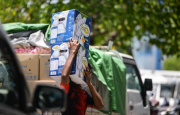
People wear masks as they drive along a road in Male' City on March 2, 2021. (Sun Photo/Fayaz Moosa)
The state has already spent 47.7 percent of the annual allocation on subsidies within the first three-and-a-half months of this year, according to the latest information released by the Finance Ministry.
The budget allocation for subsidies this year is MVR 2.89 billion.
The latest weekly fiscal report released by the Finance Ministry shows the state has already spent MVR 1.38 billion on subsidies as of April 16. This marks a 36.2 percent increase compared to the same period last year.
The total spending on grants, contributions and subsidies stands at MVR 3.64 billion. This marks 34.4 percent of the total MVR 10.6 billion annual allocation, which also goes to the public health insurance scheme, Aasandha.
The report shows that MVR 478 million out of MVR 2.02 billion has been spent on Aasandha, while MVR 65.4 million out of MVR 409 million has been spent on medical welfare.
The Parliament, in which the ruling People’s National Congress (PNC) holds a supermajority, passed a record budget of MVR 64.2 billion for this year. The total expenditure as of April 16 stands at MVR 11.99 billion, while total revenue and grants stand at MVR 13.56 billion.
Both Aasandha and subsidies are areas where the actual spending has persistently surpassed budgeted figures.
Electricity is heavily subsidized in the Maldives, and the increase in spending on subsidies is likely linked the rise in global fuel prices with the Strait of Hormuz effectively closed due to the US-Israeli war on Iran.
The PNC administration had included major reforms in its 2025 budget, including restructuring the Aasandha system, restructuring the pension scheme, reforming state-owned enterprises (SOEs), and phasing out broad subsidies in favor of targeted subsidies, aimed at saving MVR 6.6 billion.
However, these measures were not implemented, despite urgent appeals by international financial institutions to implement the reform agenda announced by the Maldives in order to alleviate risks of it defaulting on its staggering external debt obligations.
President Dr. Mohamed Muizzu announced that instead of cutting costs by rolling back subsidies and other benefits, his administration planned to cut costs by changing how projects are run and awarding government contracts to SOEs instead of private contractors.
The Maldives a staggering USD 1.1 billion in debt due this year. This includes a USD 500 million sukuk and a USD 400 currency swap that was settled in April.