date_range
Saturday 17 Oct 2026


 LOCAL EDITION
close
 LOCAL EDITION


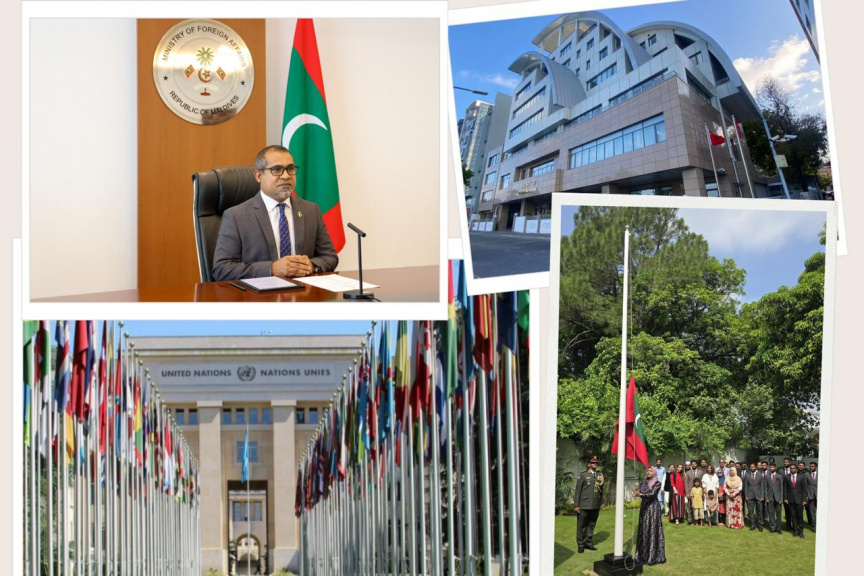
In the mornings, some feel compelled to post praise for the President or the government on social media, or to respond to critics. Between these exchanges, meetings are held and photos are shared online. Meanwhile, Maldivian taxpayers’ money is being used to fully fund certain individuals and their families in some of the world’s most expensive countries. The question arises: can a heavily indebted nation like ours truly afford this?
According to information disclosed by the Foreign Ministry, in 2024, the average monthly expenditure on Maldivian diplomatic missions abroad was MVR 32 million. Updated figures later released by the ministry indicate that by the end of last year, monthly spending had risen to MVR 54 million, amounting to MVR 648 million annually.
Of this total, MVR 2.35 million per month accounts for basic salaries of embassy and high commission staff. There are currently 82 political appointees posted at these missions, whose combined basic monthly salaries total MVR 1.85 million per month.
In addition to salaries, staff stationed abroad receive allowances according to their rank and the cost of living in the host country. These include living allowances and family allowances, which cover a spouse and up to two children, with additional benefits for children’s education.
The highest allowances are provided in countries with steep living costs, such as Japan and Switzerland. For instance, the Ambassador to Japan and Permanent Representative to Switzerland, Ahmed Mahloof, receives a living allowance exceeding MVR 52,000 per month.
At a time when the country faces severe economic challenges, such expenditure is concerning. Due to accumulated debt inherited from previous administrations, Maldives’ debt-to-GDP ratio now exceeds 100 percent. Roughly, USD 1 billion is due in loan repayments this year alone.
There are frequent shortages in the supply of essential medicines. While the country depends almost entirely on imports, the US dollar trades above MVR 20 in the black market, driving daily increases in the cost of goods. Many citizens continue to face housing difficulties, and access to quality healthcare and education remains limited, forcing people to seek services abroad.
With these points in mind, is it not excessive for a small, heavily debt-ridden nation to spend MVR 648 million annually on overseas missions, primarily as a means to provide positions to politically connected individuals? Many of these missions are staffed not by experienced diplomats but by political appointees with minimal expertise in foreign affairs.
The issue of excessive spending in the foreign sector is not unique to the current administration. During the long presidency of Maumoon Abdul Gayoom, the foreign service, managed for many years by Fathulla Jameel, served as an exemplary model, characterized by diplomatic stability and an absence of wasteful expenditure.
However, after the first multi-party election brought Mohamed Nasheed to power, political appointments in the foreign service began to increase. During Abdulla Yameen Abdul Gayyoom's administration, diplomatic appointments were served as rewards for political allies. During President Ibrahim Mohamed Solih’s administration, the practice intensified, with senior officials, party figures, their relatives, and close associates appointed to overseas posts, often lacking the necessary education or diplomatic experience.
Little has changed even under the current administration, despite sweet promises of reform. Maldives now operates 21 missions abroad, with 17 ambassadors appointed, most from outside the professional foreign service. Only a few are career diplomats.
Appointments often appear to be based on political loyalty, personal connections, or family ties rather than merit. The same applies to other senior embassy posts, many of which are filled by individuals lacking formal training or experience in diplomacy.
A senior official with over 20 years of experience at the Foreign Ministry reported that some embassies have 30 to 40 staff members, of whom only one or two are actual Foreign Ministry officials. The remainder are political appointees. Assigning inexperienced individuals to such sensitive diplomatic roles risks serious errors that could damage the country’s international standing.
Diplomacy is a delicate field, and placing unqualified individuals in key positions can cause long-term harm. There have already been controversial incidents, including diplomatic engagements that raised questions about judgment and protocol, potentially affecting Maldives’ reputation abroad.
Other small states adopt different approaches. Seychelles, for instance, relies heavily on non-resident ambassadors to reduce costs, avoiding permanent staffing in multiple countries. Mauritius prioritizes missions focused on economic and financial interests rather than maintaining a large diplomatic footprint. Singapore links its foreign policy directly to economic growth and strategic priorities, filling senior diplomatic positions with experienced professionals who have risen through the ranks.
Maldives also has a Foreign Service Act, but the challenge lies in its implementation.
It is time to assess whether the substantial expenditure on overseas missions produces tangible economic, political, or strategic benefits. After three years in office, the foreign affairs sector remains one of the areas with the least visible outcomes.
Despite participation in numerous international forums, there is limited evidence of significant foreign aid or investment gains. Even relations with key partners have occasionally shown strain.
To reduce excessive spending, the number of embassies should be reviewed. Missions in locations of limited strategic importance should be reconsidered or converted into non-resident representations. Diplomatic appointments should be reserved strictly for individuals with relevant education and professional diplomatic experience. Diplomating postings are not holidays funded by taxpayers.
For a small and indebted nation, spending nearly MVR 648 million annually without measurable returns represents a heavy burden. More concerning is the lack of visible outcomes from such substantial expenditures.
This is not a problem unique to any single government. It is a systemic issue that has grown over successive administrations, representing wasteful spending that must now be urgently addressed.
The time for serious reform is long overdue.