date_range
Saturday 07 Nov 2026


 LOCAL EDITION
close
 LOCAL EDITION


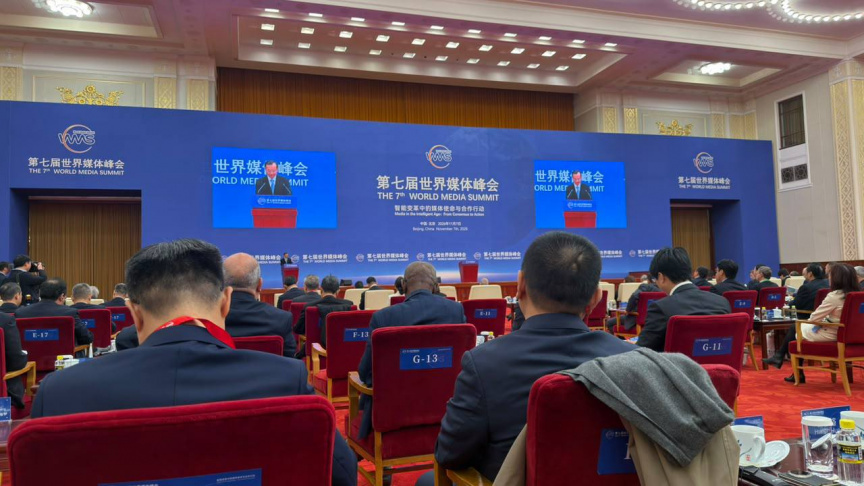
International media leaders gather in Beijing, China, for the 7th World Media Summit. (Sun Photo)
As Xinhua News Agency celebrates its 95th anniversary on Saturday, the gathering of international media leaders in Beijing for the 7th World Media Summit offers a fitting moment to reflect on the agency’s remarkable journey, its evolving role in global communication and the future of journalism in an era of profound technological transformation.
95 after its establishment in a small revolutionary town in southeastern China, Xinhua News Agency finds itself at the center of an increasingly interconnected global media landscape, bringing together journalists, editors, media executives and communication professionals from around the world to discuss the future of the industry.
The anniversary coincides with the 7th World Media Summit, hosted by Xinhua News Agency in Beijing, providing an international platform for reflection, dialogue and cooperation at a time when journalism is undergoing one of the most significant transformations in its history.
The summit has brought together more than 500 participants representing over 300 media organizations from 210 countries, creating a remarkable gathering of international media professionals and industry leaders.
The convergence of these two milestones carries particular significance. While Xinhua looks back on nearly a century of reporting and institutional development, the World Media Summit looks ahead to the challenges and opportunities shaping the next generation of journalism.
From humble beginnings to a global news network
Xinhua’s story began on November 7, 1931, when the Red China News Agency was established in Ruijin, Jiangxi Province. Operating in the difficult circumstances of its early years, the agency undertook the fundamental task of collecting, producing and disseminating information.
In January 1937, it adopted the name Xinhua News Agency, meaning New China News Agency, as its operations developed in Yan’an.
Over the decades, Xinhua evolved alongside China’s political, economic and social transformation. Following the founding of the People’s Republic of China in 1949, it became the country’s national news agency.
Its development mirrored the changing nature of communications itself. From the early days of print and radio dispatches to satellite transmission, television broadcasting, digital publishing and multimedia journalism, Xinhua steadily expanded its capacity to gather and distribute news.
Today, it operates as a major international news organization, delivering information across multiple platforms and languages and maintaining a worldwide reporting network. Its coverage encompasses politics, economics, international relations, science, technology, culture and social development.
The journey from a modest news operation in Ruijin to an international media institution reflects not only the expansion of its infrastructure but also the profound changes that have reshaped the global flow of information.
The World Media Summit: A meeting place for global journalism
The 7th World Media Summit gives the anniversary a distinctly international dimension.
By bringing together media organizations from different geographical, cultural and professional backgrounds, the gathering provides an opportunity to examine how journalism can respond to a rapidly changing world.
The summit’s agenda addresses some of the most pressing issues confronting the media industry: artificial intelligence and the transformation of global journalism, media dialogue and cooperation in addressing international challenges, technology-enabled cultural exchanges, and the future of global communication.
These discussions come at a particularly important moment.
Artificial intelligence is transforming virtually every stage of the news production process, from information gathering and data analysis to content creation, translation, editing and distribution.
News organizations are increasingly exploring how emerging technologies can improve efficiency, expand audiences and make information more accessible.
Yet technological progress also raises difficult questions about journalistic credibility, misinformation, intellectual property, algorithmic bias and the future of professional journalism.
The central challenge is therefore not simply how quickly media organizations can adopt new technologies, but how effectively they can ensure that innovation serves the public interest.
The summit’s emphasis on international dialogue and cooperation reflects the growing recognition that global media challenges cannot be addressed by individual organizations working in isolation.
Cooperation in information verification, professional training, technological development and cross-border reporting will be increasingly important in maintaining public confidence in journalism.
Journalism in an age of artificial intelligence
Perhaps no issue is more consequential to the future of Xinhua and the wider media industry than the rapid emergence of artificial intelligence.
The traditional boundaries between news gathering, production and distribution are becoming increasingly fluid. Automated systems can process enormous quantities of information, translate content across languages and help journalists identify patterns that might otherwise remain unnoticed.
For international news agencies, these developments offer significant opportunities.
An agency with a global reporting network can potentially use AI-assisted technologies to improve the speed, reach and accessibility of its reporting, connecting audiences across linguistic and geographical boundaries.
However, technology cannot replace the fundamental responsibilities of journalism.
Accuracy, verification, editorial judgment and accountability remain essential to credible news production. As AI-generated text, images and videos become increasingly sophisticated, distinguishing authentic information from manipulated content will become an even greater priority.
The future of journalism will depend on finding the right balance between technological innovation and human responsibility.
For Xinhua, reaching its 95th anniversary at this technological crossroads provides an opportunity to reflect on how a traditional news agency can continue to reinvent itself while maintaining the institutional experience and reporting capabilities developed over generations.

Building bridges through international media cooperation
Beyond technology, the World Media Summit highlights another enduring question: how can media organizations contribute to greater understanding among nations and peoples?
In an increasingly interconnected world, international events, geopolitical developments, economic shifts and social transformations have consequences that extend far beyond national borders.
Yet differences in political systems, cultural traditions, historical experiences and media environments often shape how the same events are understood and reported.
This makes communication and professional exchange particularly important.
International media cooperation can create opportunities for journalists to share experiences, develop professional partnerships, exchange news content and undertake joint reporting projects.
It can also help broaden the range of perspectives available to global audiences, particularly by strengthening the participation of media organizations from developing countries and the Global South.
The presence of hundreds of media representatives in Beijing demonstrates the continuing value of face-to-face dialogue in an era when much communication takes place through digital platforms.
The World Media Summit, first initiated in 2009, has developed into an international forum for media exchange and cooperation. Its seventh edition reinforces the importance of maintaining dialogue across different media systems as the industry navigates technological and geopolitical change.
Looking towards the next 95 years
Anniversaries are occasions to celebrate institutional achievements, but they are also opportunities to consider future responsibilities.
For Xinhua, 95 years represents a substantial institutional legacy built through successive generations of journalists, editors, photographers, broadcasters and media professionals.
But the next chapter will be written in an environment very different from the one in which the agency was founded.
The global media industry faces mounting pressures: declining public trust in some media institutions, the proliferation of misinformation, the fragmentation of audiences, the economic sustainability of journalism and the disruptive impact of emerging technologies.
At the same time, opportunities for international communication have never been greater. Digital platforms allow news to travel across borders almost instantaneously, while new technologies are opening possibilities for storytelling and audience engagement that were unimaginable just a generation ago.
The challenge for established news agencies is to adapt without losing sight of the essential purpose of journalism: informing people, documenting events, explaining complex developments and contributing to a better-informed society.
As media leaders gather in Beijing for the World Media Summit, Xinhua’s 95th anniversary becomes more than a celebration of the past. It is also a moment to consider the collective future of journalism.
From its beginnings in Ruijin in 1931 to its role as an international news organization today, Xinhua has witnessed extraordinary transformations in China and the wider world.
Its anniversary, marked by an international gathering of media professionals, offers a reminder that despite differences in geography, language and media traditions, journalism faces a number of shared responsibilities.
In an age when information moves faster than ever, the need for accuracy, credibility, dialogue and mutual understanding has become more important, not less.
As Xinhua enters its next chapter, the conversations taking place in Beijing carry a message extending beyond one institution or one anniversary: the future of journalism will be shaped not only by technological breakthroughs, but also by the commitment of media organizations to cooperation, responsibility and the enduring value of trustworthy information.
Among the international media organizations represented at the 7th World Media Summit in Beijing is Sun Siyam Media, represented by its Chief Executive Officer, Mohamed Asif. His participation reflects the Maldives-based media group’s engagement with the global media community and its interest in strengthening international media dialogue, cooperation and professional connections.
95 years after its founding, Xinhua’s story is both a reflection on how far journalism has travelled and an invitation to consider where it must go next.