date_range
Thursday 22 Oct 2026


 LOCAL EDITION
close
 LOCAL EDITION


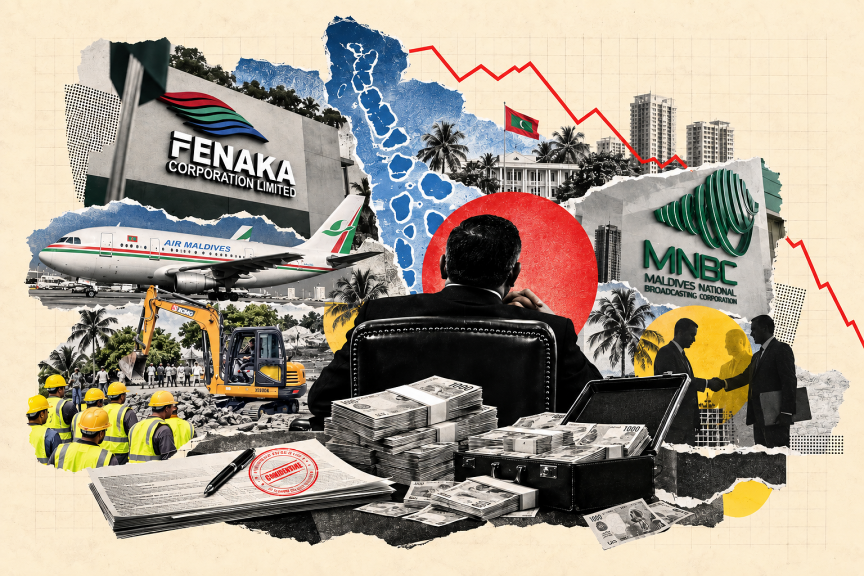
Multiple state-owned companies riddled with corruption have gone bankrupt. (Sun Graphics)
Dissolving Fenaka and Road Development Corporation (RDC), which have become painful toothaches due to corruption, is well and good. But one question remains: What happens to the people who drove these companies to this state?
Looking back at the political history of the Maldives, one of the most common issues across every administration has been massive theft and corruption committed through state-owned enterprises (SOEs). Such acts of corruption have bankrupted numerous state companies and caused the loss of billions of Rufiyaa. When companies go bankrupt, the typical solution adopted by governments is to dissolve them. However, a major question arises: Is dissolving a company a real solution to the issue, or is it a gateway for embezzlers to evade legal action?
Leaving things unmanaged and simply dissolving companies often leaves the perpetrators who committed the corruption—the core reason for the bankruptcy—free. History shows that erasing only the company's name without punishing those who embezzled state assets and funds is not a way to establish justice.
Different administrations, same game
Looking at the administration of former President Maumoon Abdul Gayoom, the FPID (Fisheries Projects Implementation Department) corruption scandal that came to light in 1990 was one of the biggest corruption cases in Maldivian history. This department, operated under STO, was accused of stealing millions of dollars. Although key figures were prosecuted in this case, they were later acquitted of the charges. Following this, FPID was dissolved, and in 1993, the Maldives Industrial Fisheries Company (MIFCO) was created to take over fisheries operations. Similarly, when the national airline, Air Maldives, went bankrupt and was dissolved in 2000, reports indicated it had suffered losses of USD 69.2 million. This too was a case wrapped in allegations of poor management and corruption.
Additionally, during Maumoon's administration, the Maldives National Shipping Limited (MNSL) went bankrupt and was dissolved. It was revealed that Vilingilivaru, which had been leased to the company in 1990 for tourism development, was sold without paying the state the money owed. Although the Civil Court ordered the payment, the money was never recovered by the state because the company went bankrupt and was dissolved. All these incidents reflect how a culture of dissolving bankrupt companies was born.
During the administration of former President Mohamed Nasheed, numerous companies were created to decentralize services. Among these, utility companies were later dissolved. While these were not necessarily seen as companies that went bankrupt directly due to corruption, they were part of a policy of creating and dissolving companies. However, the case of the Maldives National Broadcasting Corporation (MNBC) involved serious financial misconduct. Audit reports showed that out of an USD 3 million loan taken for an uplink project, only USD 127,000 was spent on the project. The remaining 85 percent was used for staff salaries and other expenses. This company was also later dissolved.
Likewise, the Maldives Entertainment Company (MECL), created during the same administration, was dissolved due to significant financial issues. Unmatched expenses and bank withdrawals, along with a lack of proper revenue record-keeping, were key audit findings. When these companies were dissolved, the state was left to shoulder their financial liabilities.
The MMPRC (Maldives Marketing and Public Relations Corporation) embezzlement scandal that occurred during the administration of former President Abdulla Yameen Abdul Gayoom was one of the biggest corruption scandals in Maldivian history. Audit reports showed that USD 79 million (nearly MVR 1.2 billion) owed to the state from leasing islands and lagoons for tourism was stolen. Of this, USD 65 million was money received as acquisition costs. While 59 islands and lagoons were leased in this scheme, a presidential commission later revealed that 37 islands and 12 lagoons were leased fraudulently. This stands as the biggest crime committed through a state enterprise. While this money has not been recovered by the state, those who profited from it continue to use these funds. Though some individuals were convicted, a vast portion of the lost money remains unrecovered.
Corruption issues remained rampant even during the administration of former President Ibrahim Mohamed Solih, who took office making allegations of theft against Yameen. Serious issues involving Fenaka Corporation and RDC came to light. A special audit by the auditor general showed that between 2021 and 2023, Fenaka signed contracts worth MVR 2.2 billion, of which MVR 1.3 billion was awarded without competitive bidding. Those accused of profiting the most were several parliamentarians holding office under the party ticket at the time and senior government officials.
Regarding RDC, it was revealed that in 2022 and 2023, MVR 161 million was transferred to various parties without proper documentation. Of this, MVR 14 million was reportedly deposited into personal accounts, including an instance where MVR 11 million was deposited into a single individual's account. After generating a profit of MVR 34 million in 2022, the company faced a loss of MVR 188 million in 2023. By 2024, that loss rose to MVR 229 million. As the financial conditions of these companies deteriorated and became a heavy burden on the state, adequate measures were not taken against those responsible.
Recently, President Dr. Mohamed Muizzu announced his decision to dissolve Fenaka and RDC, as similar allegations of corruption within state-owned companies run rampant in his own administration.
Is this enough to solve the problem?
The greatest miscarriage of justice seen across all these cases is that when companies go bankrupt, they are simply dissolved, while adequate action is never taken against those who brought them to that state. As these individuals live lavish lifestyles in the Maldives and abroad using illicit gains, it is the general public that ends up paying the price for the embezzlement. Millions of Rufiyaa from the state budget have to be spent to save these companies or clear their debts.
Dissolving a company must not serve as an "escape hatch" or a way out for embezzlers. A system lacking individual accountability only fosters a culture of state asset corruption. When companies are dissolved, their debts fall onto the state, making it unjust that tax dollars paid by citizens are used to clear those debts.
Looking at how such issues are handled globally, instead of dissolving companies, priority is given to bringing embezzlers to justice and recovering lost funds for the state. For instance, in the massive 1 Malaysia Development Berhad (1MDB) scandal, international investigations were conducted, recovering billions of dollars in assets and funds, and lengthy prison sentences were handed down to top figures involved. Under the United Nations Convention against Corruption (UNCAC), specific principles are set out for recovering lost state assets. Many countries utilize civil asset forfeiture laws, granting the power to seize assets believed to be illicitly obtained, even without a criminal conviction. Such laws ensure that corrupt actors cannot enjoy the benefits of stolen money.
In the Maldives, some efforts have been made to take action against embezzlers in the past. However, most of the time, these efforts fizzle out into nothing. In the end, cases go uninvestigated, lost state funds remain unrecovered, and embezzlers are left with every opportunity to fly high on that money.
Therefore, simply dissolving state companies upon bankruptcy is not the solution to the problem. The real solution lies in conducting forensic audits, identifying the perpetrators, bringing criminal charges against them, and recovering lost state assets. In collaboration with the international community, efforts to track down assets and funds hidden abroad must be strengthened. Corruption can only be stopped if embezzlers are certain to face the bitter consequences of their actions. State institutions must take firm steps to initiate the recovery of missing funds. Simply dissolving companies is not enough.