date_range
Wednesday 14 Oct 2026


 LOCAL EDITION
close
 LOCAL EDITION


Political discourse has intensified significantly recently with heated exchanges between former political leaders, current leaders, and individuals aspiring to attain such positions. Much of the discussion centers on whether presidential and parliamentary elections should be held concurrently.
The government maintains that they must be merged, while the opposition contends that they should remain separate.
This discourse has seen some have voiced concerns on behalf of the public. When a major change to the country’s electoral system is proposed, many citizens feel they have not been sufficiently consulted or given an adequate opportunity to express their views. During these discussions, I posed a simple question:
“Every five years, aren’t citizens giving one of two political sides the opportunity to commit theft? Is there anything more than that ordinary citizens are required to do?”
Inthihaabah goiy kiyan hunna foari vakkan huttuvumah nuhunnanee keeve?https://t.co/UdbgLF6VmN
— sun.mv (@sunbrk) March 3, 2026
Follow us:
Viber:https://t.co/r1ic7mirrB
Telegram:https://t.co/plOPl2zYfy#sunonline #seemv #news #sunonlineheadlines #latestnews #dhivehinews #maldivesnews pic.twitter.com/TmhaJEZ4pB
There are numerous reasons why this question arises, and serious consequences underpin it.
It has now been 22 years since the Constitution guaranteeing freedom of expression and the right to vote came into force. These freedoms were secured through immense sacrifice — imprisonment, hardship, and suffering. Citizens sought justice and fairness for all. They wanted public funds safeguarded from misuse. They did not want any leader to govern like a monarch under the title of President. They sought the protection of fundamental rights.
But the pressing question remains: has this vision been realized? The answer is quite clear. It has fallen far short of expectations. There is only one consistent element in all this— political theft.
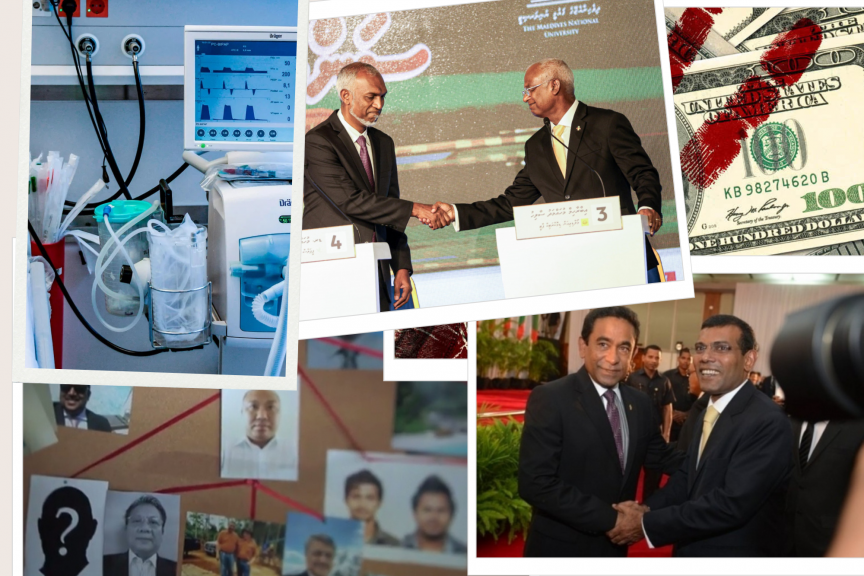
The Maldives has a population of less than 400,000 people and is internationally recognized as a luxury destination where the world’s wealthy come to relax. The nation generates billions of dollars annually. Yet, due to corruption and inadequate planning, even after years of democratic governance, a significant number of citizens still lack proper housing. Healthcare standards remain below par. For serious medical treatment, people must travel abroad. Although certificates are awarded, the education system does not meet global standards. Overall, the country’s condition remains fragile.
Rather than dedicating their time in office to reforming institutions, leaders and their close associates often appear more focused on personal enrichment.
It has been 18 years since governments formed from parties that emerged following the MDP–DRP political divide have been heading the Maldives. However, corruption within successive administrations has only increased. No single party can claim innocence. State funds continue to be siphoned off by those in power and their close acquaintances.

This is a small country, and changes are easily observed. Individuals who once lived modest lives enter politics and soon display dramatic increases in wealth. Audit reports reveal unexplained transformations. These developments can only be described as corruption and abuse of office.
Every political party campaign on promises of reform and accountability. Yet once in power, they resist relinquishing authority. The President becomes the central authority. The judiciary has been shaped in ways that raise serious concerns. When one party consolidates power, the other does the same upon assuming office.
Parliament, which costs millions each month to operate, has increasingly functioned as a body where the majority advances the agenda of the sitting President. Laws affecting the public are passed without broad consultation. Allegations of corruption involving both former and current members of parliament have become a national embarrassment.
So-called “independent institutions” were established to combat corruption, with millions spent on them monthly. Yet tangible results remain limited. The Anti-Corruption Commission (ACC), the Auditor General’s Office, the Prosecutor General’s Office, and the police have all produced results that the public finds disappointing. Even state-owned enterprises operate under concerning conditions, frequently serving political interests rather than principles of sound governance.

The principal beneficiaries of this flawed system are politicians who flourish within it. Because institutions lack genuine independence and systemic safeguards remain weak, opportunities for corruption persist. Meanwhile, the majority of citizens experience little meaningful improvement in their lives, while a small group accumulates substantial wealth.
For this reason, when politicians speak of reform, the most urgent issue to address is corruption.
Can Corruption Be Stopped? Other Countries Have Done So
The greatest impediment to the Maldives’ development is corruption embedded within the state system. Addressing it requires learning from countries with the lowest levels of corruption.
According to Transparency International’s most recent Corruption Perceptions Index, the Maldives scored just 39 points — a clear indication that sufficient efforts to combat corruption have not been undertaken.
Countries such as Finland, Singapore, New Zealand, and Norway consistently rank among the least corrupt in the world. Their success has not occurred by chance.
Singapore’s approach is frequently cited. Its anti-corruption framework is straightforward but uncompromising: zero tolerance. The Corrupt Practices Investigation Bureau (CPIB) operates under the Prime Minister’s Office yet functions independently. It possesses the authority to investigate any individual, including the Prime Minister. Political leaders do not interfere in its work.
Singapore also enforces stringent penalties. Even minor acts of corruption carry severe consequences. Misappropriated funds are recovered, and laws are applied rigorously.
In Finland, Norway, and New Zealand, low corruption levels stem not only from legal frameworks but also from a culture of transparency and accountability. Financial disclosures are public. Tax records and income information are accessible. Such transparency makes illicit enrichment difficult to conceal.
Institutions in these countries command public trust because they are insulated from political interference. Citizens report wrongdoing without fear. Access to government information is regarded as a fundamental right.
Lessons for the Maldives
Although the ACC in the Maldives holds legal authority, it has not been able to exercise its powers fully. Meaningful reform is necessary to bring about substantive change.
First, the ACC must be protected from political influence. The appointment and removal of commissioners should not rest solely with political leaders.
Second, financial declarations of senior public officials should be made publicly accessible, following models such as Finland’s. Transparency remains one of the most effective tools against corruption.
Whistleblowers must be safeguarded, and the judicial system strengthened to ensure corruption cases are resolved promptly and fairly.
At present, the Maldives remains caught in a fragile political cycle. When one party governs, the opposition accuses it of theft. When power shifts, the roles reverse. The consequence is a profound erosion of public trust in the system.
Combating corruption requires more than legislation. It demands political sincerity and genuine institutional independence. Developed nations demonstrate that reform is achievable.
If political leaders truly intend to improve the country, this is where action must begin. Whether elections are held simultaneously or separately is far less significant than whether corruption is effectively addressed.
That is the issue that should weigh most heavily on our minds.