date_range
Saturday 17 Oct 2026


 LOCAL EDITION
close
 LOCAL EDITION


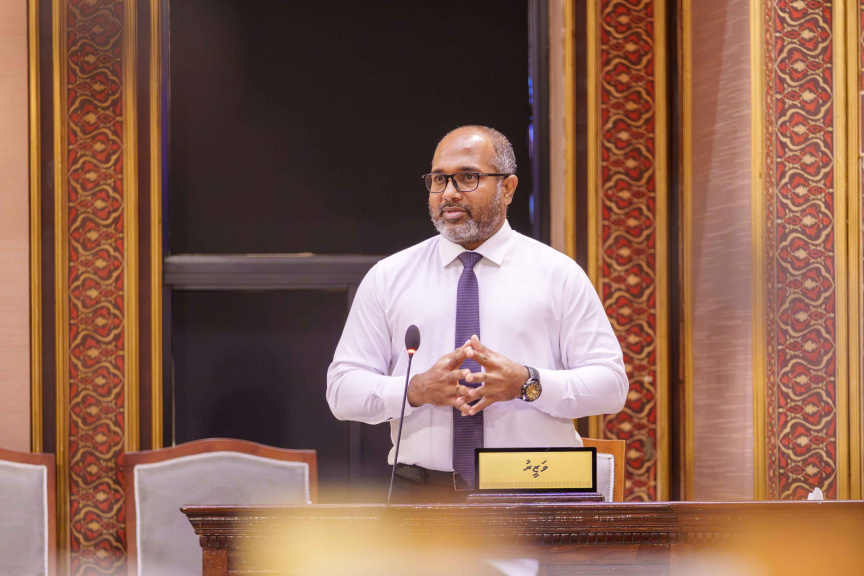
Home Minister Ali Ihusan responds to questions at the Parliament on August 11, 2026. (Photo/People's Majlis)
Home Minister Ali Ihusan told the Parliament on Tuesday that he decided to publicly shared details of the interactions an 18-year-old university student had with a state-run victim support service before committing suicide in April in order to combat what he described as “organized efforts” to discredit the police.
The young woman was found dead in her room on early April 21, at the Majudhudheen Dhanaal, the Maldives National University (MNU)’s dormitory in Male’. Allegations soon surfaced that she had contacted the police before committing suicide, but that the authorities failed to provide proper support.
At a press briefing two days later on April 23, Ihusan denied these allegations of negligence, and went on to share details of the communications the young woman had with the victim support helpline.
The decision sparked immediate backlash, with many describing it as a grave breach of confidentiality, as well the dignity and rights of the victim.
Ihusan, who was summoned to the Parliament on Tuesday, was questioned regarding this by South Galolhu MP Meekail Ahmed Naseem, a lawmaker from the main opposition Maldivian Democratic Party (MDP).
Responding to the question, Ihusan acknowledged that interactions between law enforcement officers and vulnerable individuals are protected.
But he said that the specific case had sparked disinformation among the public.
Ihusan said that public confidence in the police was crucial in order for the institution to effectively assist victims of crimes, especially those in highly vulnerable states.
“There were organized efforts being carried out on that day to damage public trust in the institution,” he said.
Ihusan suggested that he had faced an impossible situation, having a duty to both protect the private information of the victim as well as to uphold public confidence in the police.
He said that in cases such as that, the failure to disclose evidence and information is most often perceived as an attempt to cover up the truth, while disclosure of information prompts accusations of violating privacy.
There’s a very thin line between these two, he said.
Ihusan said that several countries have policies allowing the disclosure of information under similar circumstances.
He said that the enactment of the data privacy law submitted to the Parliament back in May will establish a standard for disclosure of such information.
“But on that day, I was forced to… the Maldives Police Service… We will not disclose such information regarding a Maldivian citizen in all instances where police credibility is put into question. However, I believe it is absolutely crucial to maintain the service’s credibility in such vulnerable situations, where the people are constantly reaching out and appealing for support,” he said.
Ihusan provided assurance that he will treat the disclosure of information in such situations with the utmost care.
The incident in April had marked the third such high-profile incident where authorities were accused of breaching confidentiality and violating the dignity of victims of crimes. This includes when the police had shared personal information of victims on live TV in face of allegations of negligence and misconduct in investigations into the case of a young woman who fell from the balcony of a home in Male’, and another who fell from a building to the roof of the adjacent building.