date_range
Saturday 24 Oct 2026


 LOCAL EDITION
close
 LOCAL EDITION


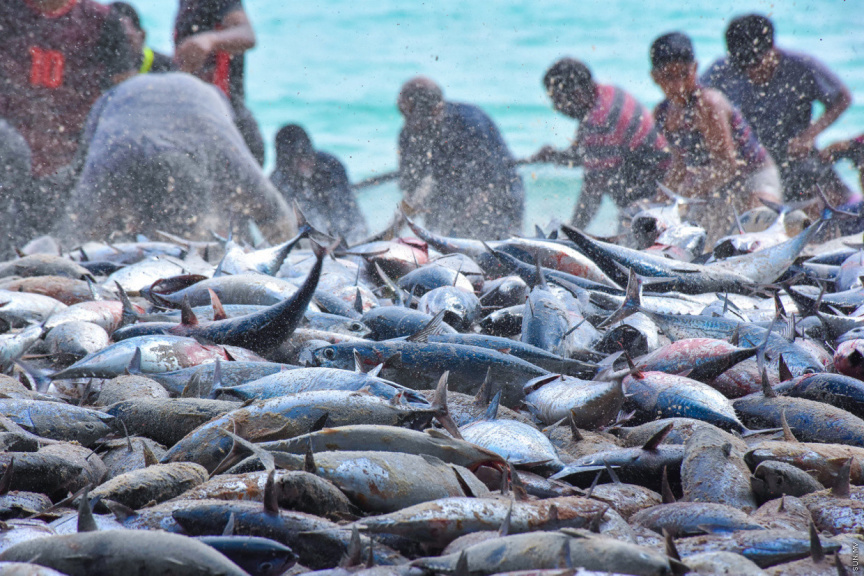
A large number of frigate tuna washes up on Th. Buruni beach with southwest monsoon. (Photo/Buruni Facebook Page)
A new scientific study has revealed that mercury exposure among Maldivians is higher than previously understood, with women of childbearing age showing levels above international safety guidelines. The findings come at a time when public confidence in food safety is already shaken by fears over cheap imports, pesticide misuse, and cold-chain failures.
The research, published in Environmental Monitoring & Contaminants Research, analysed hair samples from 159 Maldivians across the country. It is the first national baseline, meaning the first time Maldives has ever measured how much mercury is actually accumulating in people’s bodies.
For us Maldivians, this baseline matters because it finally answers a question we have been asking quietly for years: What exactly are we consuming?
The study found that mercury exposure is closely tied to the Maldives’ extremely high seafood consumption. Fish makes up 71 percent of all animal protein eaten in the country, the highest in the world.

Among women aged 18-39, the group whose mercury exposure directly affects unborn children, the average hair mercury level was 2.66 ug/g, above the WHO safety reference of 2.2 ug/g.
The highest recorded value among women was 11.0 ug/g, five times the recommended limit.
Across the general population, the average mercury level was 3.22 ug/g, with older adults showing the highest accumulation. Men also showed higher levels than women, likely due to larger food portions.
Researchers confirmed a direct link:
“A positive relationship was identified between fish consumption and mercury levels.”
This means the more fish a person eats, the more mercury builds up in their body.

Maldives is going through one of the most aggressive food-safety crackdowns in its history.
Cheap imports are being rejected at the port. Cold-storage raids are shutting down businesses. Farmers are being forced to register and retrain. The MFDA now has sweeping powers to close kitchens, confiscate goods, and fine businesses up to MVR 750,000.
And yet, despite all these measures, ordinary Maldivians still feel unsafe, because we cannot choose our food.
We cannot choose organic.
We cannot choose chemical-free.
We cannot choose guaranteed cold-chain.
We cannot choose fish that are tested for mercury.
We eat what is available.
We eat what we can afford.
We eat what reaches our shops.
This study adds a new layer to that fear. Not because fish is unsafe, but because we finally have proof that our consumption habits carry measurable risks, especially for pregnant women and unborn children.
High mercury exposure is linked to developmental delays in unborn children and can affect memory, coordination, and nerve function in adults over time.
Several NCDs common in the Maldives, from high blood pressure to kidney strain and arthritis-like inflammation, can be aggravated by long-term mercury exposure, though public messaging often focuses mainly on tobacco.

For years, public anxiety has centred on:
unregistered expatriate-run kitchens
pesticide misuse in local farms
cold-chain failures in frozen fish
mislabeled cheap imports
rumors of chemical preservatives
unsafe storage practices in shops and cafes
Now, mercury joins the list, not as a scandal, but as a scientifically measured reality of living in a country where fish is both our culture and our main food source.

Unlike pesticides or formaldehyde, mercury is not added by anyone. It is not a contamination scandal. It is not a crime. It is simply the natural consequence of eating large amounts of seafood in a small island nation, without balancing it with foods rich in selenium, fiber, and sulfur. These nutrients directly bind to mercury, reduce its absorption in the body, and help flush it out.
For Maldivians who already feel trapped between unsafe imports and unsafe local produce, the findings deepen the sense of vulnerability.
We are a nation that eats fish every day, but we are also a nation that cannot afford to stop.

With the Maldives now part of the Minamata Convention (a global treaty created to reduce mercury pollution and protect human health), the government is required to identify and protect populations at risk of mercury exposure. This study gives the country its first scientific foundation to:
issue dietary guidance for pregnant women
monitor mercury levels in fish species
improve public awareness
strengthen food-safety policy
expand testing and surveillance
The research does not call for reducing fish consumption across the population. Instead, it highlights the need for targeted protection for vulnerable groups.
For the first time, Maldives has data, and data should give us the ability to act.