date_range
Friday 09 Oct 2026


 LOCAL EDITION
close
 LOCAL EDITION


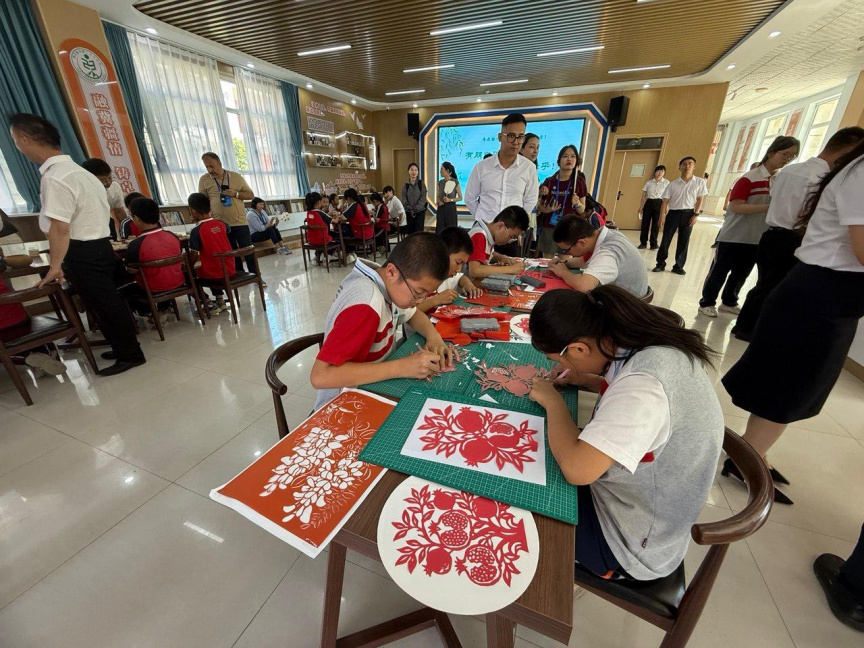
Captures from the visit to a school in China's Xinjiang. (Sun Photo/Ahmed Saail Ali)
Reporting from Xinjiang, China
Standing in a bright, modern classroom equipped with advanced technological resources, the concept of the "Silk Road" felt remarkably contemporary. My journey to this region, together with senior editors from various international media outlets, was to participate in the "Silk Road Economic Belt Joint Construction Countries Media Heads Seminar." Although the discussions have primarily focused on economics, logistics, and regional trade, a visit revealed what may be the true driving force behind China's rapid development: its public education system.
A visit to a school in this region completely challenged the outdated global perception that education is a system based solely on memorizing textbooks and passing examinations. Walking through the school corridors, it became immediately apparent that students are not confined to traditional classroom learning. Through a well-structured and comprehensive curriculum, they are encouraged—and indeed required—to move beyond conventional lessons and actively engage in specialized club activities.
In state-of-the-art laboratories, middle school students demonstrated impressive proficiency in 21st-century engineering skills. Surrounded by 3D printers producing a variety of objects, students were designing, wiring, and programming drones. This hands-on approach ensures that they develop a strong understanding of aerodynamics and coding long before entering the workforce.

Next to these modern learning spaces, other classrooms reflected an equally strong commitment to preserving cultural heritage. Students were engaged in "filigree enamel," or cloisonné, artwork. Under the guidance of instructors, young children carefully used fine tweezers and wires to outline traditional Chinese opera characters before filling them with vibrant colours. These activities—including technical work, painting, traditional dance, and singing—are not simply extracurricular pursuits or leisure activities; they are compulsory and integral components of the educational curriculum.
This system clearly demonstrates why Chinese students are widely recognized as among the brightest and most academically accomplished in the world. It is founded on the "Five Educations" framework: Morality, Intellect, Physical Fitness, Art, and Labor. By advancing these five elements collectively, a child's confidence is not determined solely by examination results. A student who may struggle in subjects such as mathematics is provided with opportunities to excel in areas such as drone engineering or the arts. Knowledge acquired from textbooks is immediately reinforced through practical application. At the same time, traditional crafts cultivate patience, precision, and a spirit of collaboration among students.

One of the most striking aspects of the visit was the notice boards displayed along the school corridors. These boards did not merely celebrate student achievements and awards; equal prominence was given to recognizing the accomplishments and honors of the teachers. When I asked the school management about this practice, their response was both simple and deep:
"A school does not belong solely to the students; it belongs equally to the teachers. If our teachers do not feel valued and celebrated for their success, they cannot become the role models our students need to achieve success themselves."
Witnessing these practices as a journalist prompted me to reflect on the education system of the Maldives. While the Maldives has made remarkable progress in achieving high literacy rates and ensuring broad access to schooling, our education system remains heavily centered on preparing students for standardized examinations such as O-Levels and A-Levels. Opportunities for practical, hands-on learning remain comparatively limited. The public school system in Xinjiang offers several valuable lessons for Maldivian policymakers and educators.
First, rather than relying predominantly on textbook-based instruction, practical laboratories should become an essential component of the curriculum. Introducing subjects such as coding, robotics, and engineering into Maldivian schools could help nurture a generation that creates innovation rather than merely consumes technology.

Second, the Maldives' rich cultural heritage—including lacquer work (liye laa jehun), traditional carpentry (kissaru vadaan), and reed mat weaving (thundu kunaa viyun)—could be revitalized through the education system. Adopting an approach similar to China's integration of cultural arts into the curriculum would help instil patience, creativity, and craftsmanship among young people.
Another significant lesson is the importance of rethinking how society values teachers. Publicly recognising teachers' achievements within schools and elevating their status within society is a low-cost, high-impact approach that has the potential to strengthen educational standards.
The enthusiasm, creativity, and confidence displayed by the students in Xinjiang demonstrate that genuine educational excellence is not achieved through memorisation alone. It is realised when a society values its teachers and empowers its students with the freedom to create, explore, and discover through hands-on experience.