date_range
Monday 12 Oct 2026


 LOCAL EDITION
close
 LOCAL EDITION


A look into the political history of the Maldives shows that there have always been individuals surrounding leaders who obscure reality and replace it with carefully crafted narratives. In the version of events they present, elections are always victories, public support is consistently overwhelming, and even electoral defeats are portrayed as achievements. This often occurs because those closest to political power are frequently motivated by business interests or other forms of personal gain.
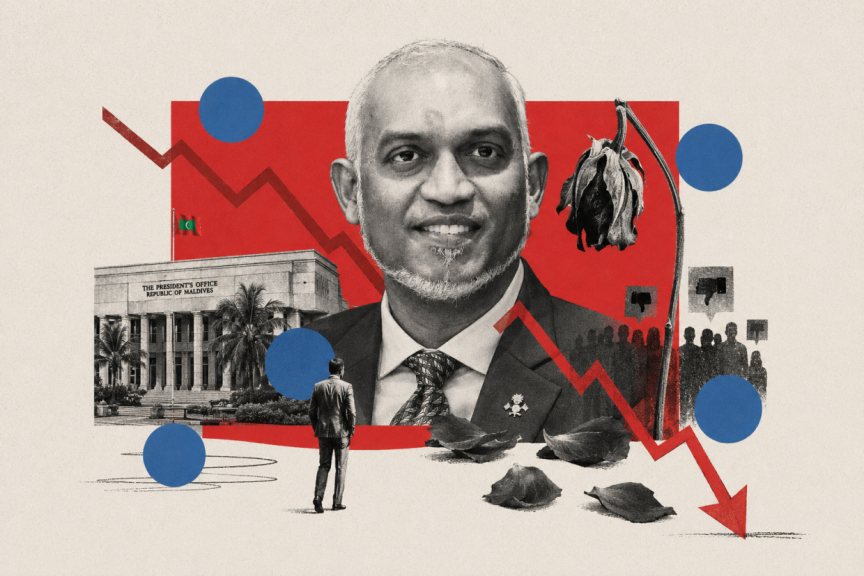
However, any meaningful assessment must begin with an honest acceptance of reality. When viewed objectively, recent election results provide clear evidence that support for President Dr. Mohamed Muizzu’s administration has declined considerably.
In the recent parliamentary by-election for the North Hithadhoo constituency, the ruling PNC, backed by all the advantages that come with governing, sought to retain a seat previously held by one of its own members. Naturally, an incumbent government has numerous tools and resources available to help secure electoral success. Despite these advantages, the PNC was unable to defend its own seat, which was ultimately won by the opposition MDP. Nevertheless, both the PNC and the government have sought to frame the outcome as a significant success. Some PNC leaders have even argued that the victorious MDP was, in reality, the true loser of the election. Such is the current political narrative.
An examination of facts
In the referendum held last April, only 30 percent of voters supported the government’s position. The administration failed to secure support equivalent even to the total number of individuals registered on the PNC membership roster. Instead, 70 percent of voters rejected the government’s stance. This can reasonably be interpreted as a direct public rejection of the government’s policies.
The trend did not stop there. In the local council elections held on the same day, the opposition MDP secured outright majorities in all cities and across most of the larger islands. Despite spending millions on campaign efforts and utilizing extensive state resources, the PNC government experienced a series of defeats. More recently, the government suffered another setback in the Addu by-election. These are not claims based on speculation or hearsay; they are facts reflected in election results. Taken together, they point clearly to a steady decline in the government's popularity.
"I spoke with several senior PNC lawmakers. They believe, and it is now the view of most members, that President Muizzu will not be able to win another presidential election. I did not come across a single member who believed that the PNC could win a presidential election with President Muizzu. Even if they speak differently on social media and during parliamentary debates, when you meet them in person, they too accept the reality," a prominent political figure who has held several senior government positions told Sun.
This raises an important question: with roughly two years and five months still remaining in the administration’s term, why has public support for the government fallen so dramatically?
The reality is that many citizens voted for President Muizzu with considerable optimism and high expectations. These expectations were driven by confidence in his educational background, his seven years as Housing Minister, and his experience as Mayor of Malé. Many believed that such experience would translate into effective leadership and tangible results. During the campaign, President Muizzu repeatedly assured the public that the country's debt burden was not a cause for concern, arguing that friendly nations were prepared to assist in resolving the issue. At the same time, he pledged that the Maldives’ housing crisis would be fully addressed by the end of his five-year term. The public accepted these assurances, as evidenced by the unprecedented parliamentary majority granted to the government alongside the presidency. Yet, the outcomes delivered so far have fallen well short of those expectations.
Although numerous projects were announced and agreements signed in the lead-up to elections, little meaningful infrastructure development has begun across the country, even as the administration approaches the midpoint of its term. Despite a pledge to keep political appointments below 700, that commitment quickly unraveled. The public watched as political activists were appointed to positions far beyond their qualifications. Meanwhile, the state wage bill expanded significantly, while ordinary citizens saw no corresponding improvement in their financial circumstances.
Public confidence has also been eroded by a pattern of policy reversals and inconsistent decision-making. Government announcements are no longer regarded with the same seriousness because it has become increasingly common for major decisions to be reversed almost immediately. The government's recent discussions on reducing cigarette prices serve as a notable example. In addition, impulsive actions and reactionary policymaking have become recurring features of this administration. Such behavior has even begun to strain relations with neighboring countries.
The need to implement reformative measures without consideration to political popularity
After decades of governance characterized by a lack of long-term direction and policies driven largely by political calculations, the nation now finds itself facing significant challenges. Given these circumstances, the government still has an alternative path available: using the remainder of its term as a period of serious national reform. This is an opportunity through which President Muizzu can establish a lasting legacy and provide a clear direction for the country. Only then can he be remembered as a leader who genuinely transformed the nation.
With political support already having diminished substantially, President Muizzu should consider setting aside ambitions for a second term and instead focus on implementing the difficult but necessary reforms required to restore the country’s finances and institutions.

As public debt continues to rise, addressing the issue will require transforming the subsidy system from a universal entitlement into a targeted programme directed only toward those who genuinely need assistance. The Aasandha national health insurance scheme has deteriorated to a level that demands urgent intervention due to inefficiency, waste, corruption, and weak management structures. Comprehensive reform is necessary.
Within the Maldives, political influence and shortcomings in the administration of justice have weakened public confidence in the judicial system. Many citizens no longer believe that ordinary people can receive fair treatment under the law. As a result, significant structural reforms are required within the judiciary as well.
Regardless of educational qualifications, obtaining employment or advancement within the state sector has become increasingly difficult without political connections. At the same time, politically connected individuals often rise to senior positions despite lacking the necessary competence. Conversely, those who refuse to comply with political pressure frequently risk losing their jobs.
Then there is the most serious issue of all: the widespread culture of theft and corruption. Many individuals enter politics with the specific aim of accumulating illicit wealth. Large numbers of people continue to benefit through project manipulation, abuse of influence, and kickback arrangements. Although governments change every five years, corruption remains deeply entrenched. Furthermore, those responsible rarely face meaningful consequences. Addressing these problems will require sincere and determined action from a genuinely committed president.
Because State-Owned Enterprises (SOEs) and independent institutions are often led by individuals selected primarily for their loyalty, the broader system struggles to function effectively. Most SOEs are burdened by severe debt, while corruption remains widespread. Billions are spent maintaining independent institutions, yet the outcomes achieved frequently fail to justify the expenditure. In many cases, institutional leaders appear to do little beyond drawing salaries while carrying out the wishes of the government of the day. The Anti-Corruption Commission (ACC) stands as one of the clearest examples of the shortcomings within supposedly independent institutions.
The country must also address the longstanding problem of excessive concentration of power in the hands of the incumbent president. The practice of centralizing authority within the presidency must be curtailed. The Maldives should continue developing a governance system in which the executive, legislature, and judiciary operate with genuine independence.
The challenges outlined above are among the most pressing issues facing the country. Yet they have remained unresolved largely because of a lack of political sincerity and a reluctance to pursue reforms that could jeopardize public support. For the current administration, however, there appears to be little political capital left to lose.
When compared with previous administrations, the administrations of former presidents Abdulla Yameen Abdul Gayyoom and Ibrahim Mohamed Solih delivered substantially more projects and initiatives than the current government. Nevertheless, both were denied a second term by voters. Given the present administration’s record and its disappointing performance in recent elections, the prospects of President Muizzu securing another term appear increasingly remote.
Therefore, if President Muizzu chooses to pursue bold and meaningful reforms during the remainder of his presidency, the nation stands to benefit significantly from such a course of action.