date_range
Friday 16 Oct 2026


 LOCAL EDITION
close
 LOCAL EDITION


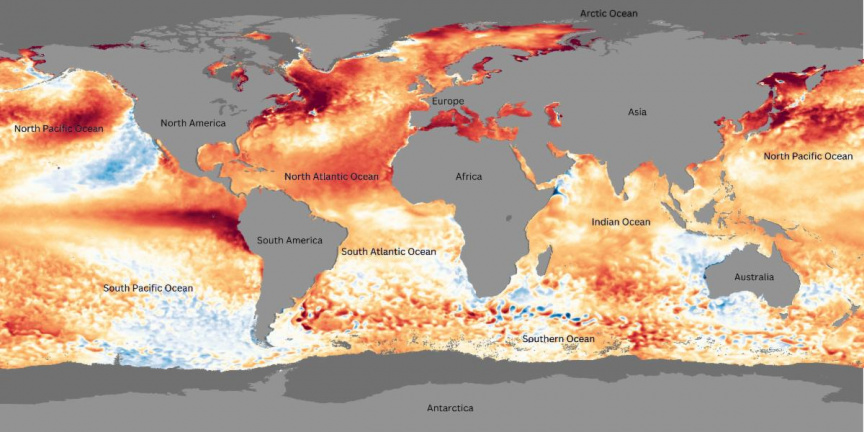
This NOAA Sea Surface Temperature Anomaly Map shows global SST anomalies with clear El Nino warming in the Pacific. (Photo/NOAA)
Climate models are signalling the possibility of a strong to “super” El Nino forming in the Pacific by November 2026, a rare event that historically triggers major weather disruptions across the tropics, including the Maldives.
According to long‑range projections from leading climate agencies, sea‑surface temperatures in the central and eastern Pacific are expected to rise sharply from mid‑2026. If the warming exceeds 2degrees celsius above normal for several months, the event would be classified as a “Super El Nino”, the strongest category of El Nino. Only three such events have been recorded in the modern era: 1982–83, 1997–98 and 2015–16.
El Nino events alter global wind patterns and weaken rainfall across the equatorial Indian Ocean. For the Maldives, past Super El Nino years have brought hotter temperatures, prolonged dry spells, and severe coral bleaching. The 1998 and 2016 events caused widespread reef mortality, with some atolls losing up to 90 percent of shallow coral cover.
Meteorological experts say a strong El Nino typically suppresses the Northeast Monsoon, increasing the risk of water shortages in islands dependent on rainwater and stressing groundwater lenses. Hotter temperatures and irregular rainfall also heighten the risk of dengue outbreaks, as seen during previous strong El Nino years.
A Super El Nino also raises global sea levels temporarily due to ocean heat expansion and shifts in wind patterns. This increases the likelihood of coastal flooding, harbour inundation and erosion during swell events in low‑lying island nations.
El Nino is part of the El Nino–Southern Oscillation (ENSO) cycle, a natural climate pattern driven by temperature changes in the Pacific Ocean. While El Nino events occur every two to seven years, Super El Ninos are rare, with only three in the past five decades. Scientists warn that a warmer global climate may amplify the impacts of future events.
Although long‑range forecasts carry uncertainty, climate agencies say the early signals are strong enough for governments in the equatorial region to begin monitoring potential impacts. The Maldives Meteorological Service is expected to issue detailed guidance as the 2026 ENSO outlook becomes clearer.