date_range
Friday 23 Oct 2026


 LOCAL EDITION
close
 LOCAL EDITION


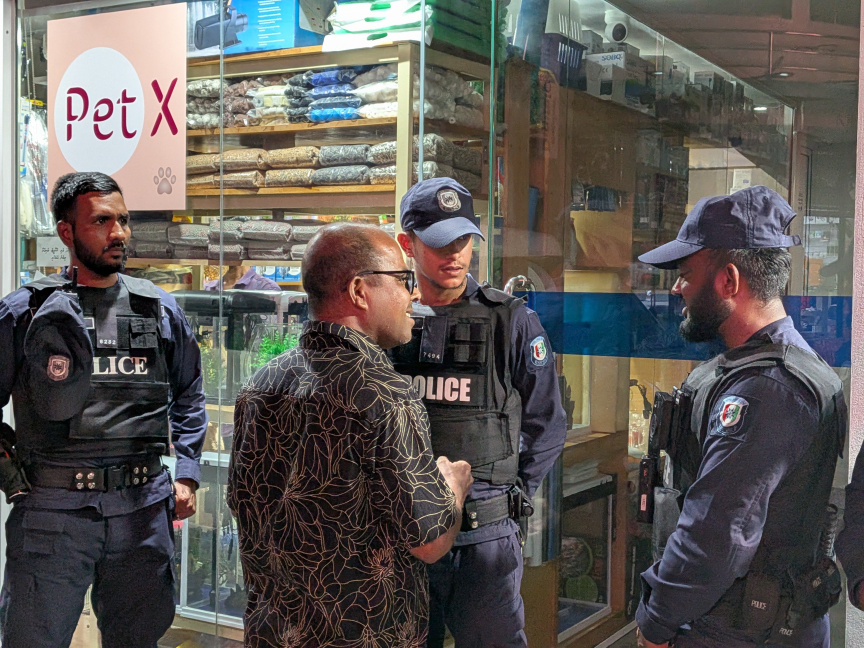
Adhadhu's CEO Hussain Fiyaz Moosa talks to police standing guard during a raid on 'Adhadhu' office on April 27, 2026. (Photo/MJA)
Adhadhu has decided not to provide passwords to any of the laptops seized from its office in connection with a documentary published by the outlet alleging misconduct by President Dr Mohamed Muizzu.
Police raided Adhadhu’s office for four hours on March 27 under a court order following the release of the documentary Aisha. After the operation, officers seized 20 devices, including laptops, hard drives and memory cards.
At the request of police, the Criminal Court later issued an order allowing investigators to access the electronic devices and data seized.
Adhadhu CEO Hussain Fiyaz Moosa was summoned to the police on Monday afternoon. After the questioning, his lawyer Ali Hussain said the outlet had decided not to hand over the passwords because doing so could expose confidential sources.
“We stated that the source cannot be disclosed. If we give the passwords, the sources will be revealed,” Ali Hussain said.
He added that providing access would allow police to identify individuals who had shared information with the outlet beyond the Aisha documentary. For that reason, he said, the decision was made not to release the passwords.

According to Ali Hussain, Fiyaz told police he would not disclose any source even if charges were brought against him. He also noted that the court order shown by police included only a search warrant, not a seizure order.
Article 28 of the Constitution states that no one shall be compelled to disclose the source of news or information disseminated or published. Under the Evidence Act, source disclosure is required only in cases involving terrorism or national security.
The order issued by Criminal Court Judge Ahmed Shafiu allows police to access the data but requires a representative from the Maldives Media and Broadcasting Commission to be present. The court also instructed police to pay special attention to privileged material and to take all necessary measures to maintain confidentiality.
In addition to Fiyaz, Adhadhu’s Managing Editor Hassan Mohamed has been summoned for questioning in connection with the Aisha documentary. Both men have been charged with criminal offences and had their passports seized.
The police search of Adhadhu’s office has been condemned by local and international journalists’ associations.