date_range
Thursday 03 Sep 2026


 LOCAL EDITION
close
 LOCAL EDITION


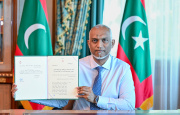
President Dr. Mohamed Muizzu speaking to the press: The President states responsible journalism vital in empowering citizens.
President Dr. Mohamed Muizzu, on Sunday, has emphasized the vital role played by responsible journalism in empowering citizens, facilitating access to information, and ensuring a transparent and accountable democratic environment.
He made the remark in an address on the occasion of World Press Freedom Day.
In his address, the President extended greetings and best wishes to media professionals across the Maldives, with particular recognition of the dedication and service demonstrated by journalists.
President Muizzu underscored the role of the media as the fourth estate, serving as a vital link among the branches of government established under the Constitution. He observed that freedom of expression is held in high regard in Islam, while stressing that it is accompanied by well-defined ethical limits and responsibilities. In this context, he highlighted the importance of upholding moral standards, safeguarding societal interests, preserving peace and security, and protecting human dignity in the exercise of free speech.
The President stated that ensuring a safe and enabling environment for journalists has been a priority of the administration from the outset, reaffirming his commitment to upholding all constitutional rights afforded to the press. He noted that ongoing global discourse reflects the evolving relationship between journalism, technology, civil liberties, and human rights. He added that efforts to develop information ecosystems under the Maldives 2.0 initiative are expected to foster an even more supportive environment for journalists.
Emphasising the need to strengthen journalism as a profession capable of sustaining dignified and stable livelihoods, he noted that the government is working to address structural challenges within the media sector, including issues of operational viability in the context of a small population. He also highlighted initiatives to support the development of a skilled and academically grounded generation of media professionals able to keep pace with a rapidly changing global landscape.
He further asserted that the current administration has given unprecedented attention to the press and affirmed that commitments made to the media are being honored, outlining ongoing government initiatives aimed at advancing media development.
Despite government assurances regarding the protection of press freedom, the Maldives has fallen to 108th place in the latest World Press Freedom Index published by Reporters Without Borders (RSF). This represents a decline of four positions from its ranking of 104th last year. According to the RSF report, the country’s overall score decreased from 52.46 to 49.23. Notable declines were recorded across several indicators, with the political ranking dropping from 123 to 129, the economic ranking from 118 to 157, the legal ranking from 103 to 126, and the security ranking from 56 to 77.
A key factor contributing to this deterioration is the governnment-backed Media and Broadcasting Regulation Bill, enacted in September of last year, which has been heavily scrutinized for granting the government significant control over the media, and has posed significant challenges for media organizations. International bodies have expressed concern that the powers conferred upon the regulatory commission under this legislation—particularly the authority to impose fines and block websites—constitute a serious impediment to press freedom. Moreover, recent measures against the news outlet "Adhadhu," following the release of a documentary concerning the President, included police raids on its newsroom, the seizure of equipment, and the imposition of travel bans on senior editorial members.
Notably, the Maldives Journalist Association (MJA) has also raised alarm over an increase in intimidation tactics targeting journalists, including death threats.