date_range
Tuesday 06 Oct 2026


 LOCAL EDITION
close
 LOCAL EDITION


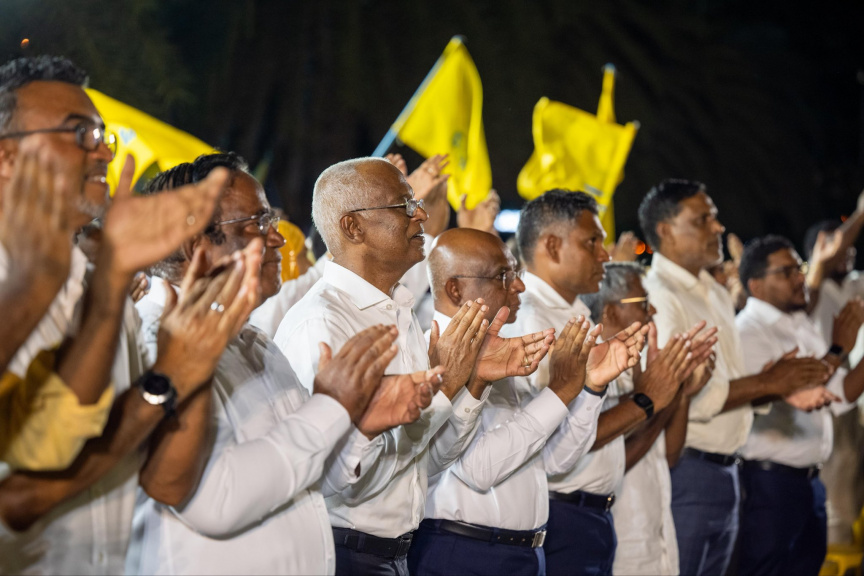
MDP leaders attend a election victory rally on April 7, 2026: MDP has slammed the Supreme Court ruling on Anti-Defection laws, citing it fails to address the legal arguments raised in the case. (Photo/MDP)
Main opposition Maldivian Democratic Party (MDP) states the Supreme Court’s decision on the constitutional amendment concerning anti-defection laws—which stipulates parliamentarians will lose their seats if they change parties—does not address the legal arguments presented in the case.
The constitutional amendment in question was submitted, passed and ratified in quick succession in November 2024. It added three more circumstances where parliamentarians will lose their seat. They are:
Former Kendhoo MP Ali Hussain, an attorney-at-law, filed a constitutional case with the top court on November 24, 2024, seeking to have the provisions annulled. MDP intervened in the case.
The first hearing in the case was held on February 17, 2025. On the day of the second hearing, the Judicial Service Commission (JSC) suspended three Supreme Court justices – Dr. Azmiralda Zahir, Mahaz Ali Zahir and Husnu Al-Suood – citing an ongoing criminal investigation against them by the Anti-Corruption Commission (ACC). Suood resigned from the top court in protest of JSC’s decision, as Azmiralda and Mahaz were dismissed by the Parliament as they argued that the allegations against them are baseless and that the investigations by the JSC were tainted by the denial of due process to them.
The second hearing was ultimately held over a year later, on April 14, after Supreme Court bench was reconstituted.
In its ruling on Wednesday, Chief Justice Abdul Ghanee Mohamed said there were no legal grounds to overturn contentious anti-defection clauses and their application to the incumbent 20th parliamentary assembly.
The sole dissenting voice was that of Justice Aisha Shujoon, who opined that the amendment should be annulled as the change was made outside the procedures set down under Article 262 (b) of the Constitution, and poses an obstruction to fulfilling the duties and responsibilities of members of Parliament set down under Article 75 of the Constitution.
The remaining five justices concurred with the Chief Justice, resulting in a 6–1 majority ruling upholding the amendment.
In a statement following the ruling, MDP said Justice Shujune’s dissent directly addressed the constitutional issues raised, while the majority ruling failed to engage with the central legal questions.
On the contrary, MDP said the majority opinion failed to address the core question in contention in the case: whether this particular amendment violated the basic structure and foundational elements of the Constitution of the Maldives.
The party further said the majority opinion was internally inconsistent, noting that while it accepted the State’s argument that the Sixth Amendment was urgently intended to apply to the current parliamentary assembly, it also ignored the State’s position that key provisions of Section 73 cannot yet be implemented because the necessary legislation has not been enacted. The party argued this contradiction undermines the justification for the amendment’s urgent passage.