date_range
Tuesday 25 Aug 2026


 LOCAL EDITION
close
 LOCAL EDITION



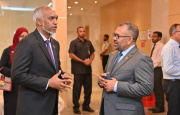
Finance Minister Moosa Zameer (L) and President Dr. Mohamed Muizzu (R). (Photo/President's Office)
Finance Ministry has instructed the Privatization and Corporatization Board (PCB) to cut the number of employees at state-owned enterprises (SOEs) by 33 percent.
The PCB had issued a circular earlier in April instructing SOEs and its subsidiaries to cut costs in light of the economic shock from the US-Israeli war on Iran.
These measures included controlling salaries and allowances, suspend promotions unless absolutely necessary, and a ban on new hirings. SOEs were also instructed to limit overtime pay, cancel unnecessary events, and minimize travel and other optional expenses.
In a statement on Saturday, the ministry said it sent a letter to PCB’s president Mohamed Anas on Friday instructing the implementation of additional measures to improve the efficiency of SOEs, improve human resources management, and promote financial sustainability.
“As part of this, it was instructed to cut operational costs of SOEs, and to reduce employees by 33 percent as part of efforts to improve cost management,” reads the statement.
The Finance Ministry said it also instructed for SOEs to improve the recruitment process by strengthening the merit-based policy and ensuring recruitment is carried out based on this policy.
This decision was made to ensure only the most appropriate employees are hired, and to ensure maximum efficiency in the work of SOEs, said the ministry.
The ministry described these measures as important and necessary steps to ensure the long-term sustainability of the operations of SOEs, and to shape the work of SOEs in line with the state’s financial and operational policies.
The ministry said it instructed the PCB to inform SOEs of the measures, and monitor its implementation.

The Finance Ministry said that the new measures add to previous measures instructed by the ministry for SOEs to cut costs, maintain strong finance management policies, and improve financial management.
Multiple countries had implemented austerity measures as the closure of the Strait of Hormuz due to the Middle East war sent fuel prices soaring and disrupted global travel. These measures included switching to work from home, closing schools, and other energy conservation measures.
In the Maldives, the war resulted in a rise in fuel prices, and disrupted tourist arrivals – affecting the country’s main economic driver. This promoted economic analysists to urge the government to implement urgent austerity measures to mitigate the impact of the war.
However, instead of cutting costs, SOEs were seen hiring new employees ahead of key elections on April 4, with Maldives Transport and Contracting and Company (MTCC) alone seen recruiting 1,185 new staff in March.
This prompted criticism against the government.
The government also lost the majority to seats in the local council elections on April 4 to the main opposition Maldivian Democratic Party (MDP), and voters also rejected a proposal by the government to synchronize presidential and parliamentary elections.