date_range
Monday 05 Oct 2026


 LOCAL EDITION
close
 LOCAL EDITION


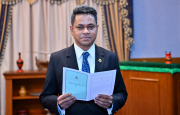
Justice Aisha Shujoon is appointed to the Supreme Court on September 4, 2019. (Photo/President's Office)
The Human Rights Commission of the Maldives (HRCM) on Thursday condemned the insulting remarks made about Supreme Court Justice Aisha Shujoon Mohamed during a public meeting earlier this month, calling the comments a barrier to eliminating discrimination against women.
The remarks were made on December 7 during a community meeting held at Kalaafaanu School for residents of Henveiru. Speaking on live television, and in the presence of President Dr. Mohamed Muizzu, an elderly man claimed that Justice Shujoon should not serve on the Supreme Court and criticised her attire.
Two weeks later, HRCM issued a statement expressing concern, describing the comments as an affront to the dignity of women and disrespectful to the office of a Supreme Court judge.
The Commission noted that every individual has the right to protect their name and reputation, a right guaranteed under Islamic Sharia, the Constitution, and international human rights treaties. It stressed that freedom of expression does not permit speech that harms the reputation of others, and urged the public to express opinions respectfully.
HRCM further stated that insulting a member of the judiciary undermines the dignity of the entire judicial system.

“The Commission calls for constructive expression of opinion, free from gender‑based discrimination. As a party to the Convention on the Elimination of All Forms of Discrimination against Women (CEDAW), such practices are also in violation of that Convention,” the statement said.
The Commission added that the use of sexually insulting language against capable and academically accomplished women like Justice Shujoon hinders the advancement of women’s rights. Such attacks, it warned, may discourage women from entering national service and instill fear among those already serving.
Justice Shujoon, an academic with extensive experience in the judiciary, was appointed to the Supreme Court during the previous administration. She and Justice Azmiralda Zahir became the first women to serve on the Supreme Court. At the time, similar criticisms were frequently voiced by activists of the current government, then in opposition.