date_range
Saturday 07 Nov 2026


 LOCAL EDITION
close
 LOCAL EDITION


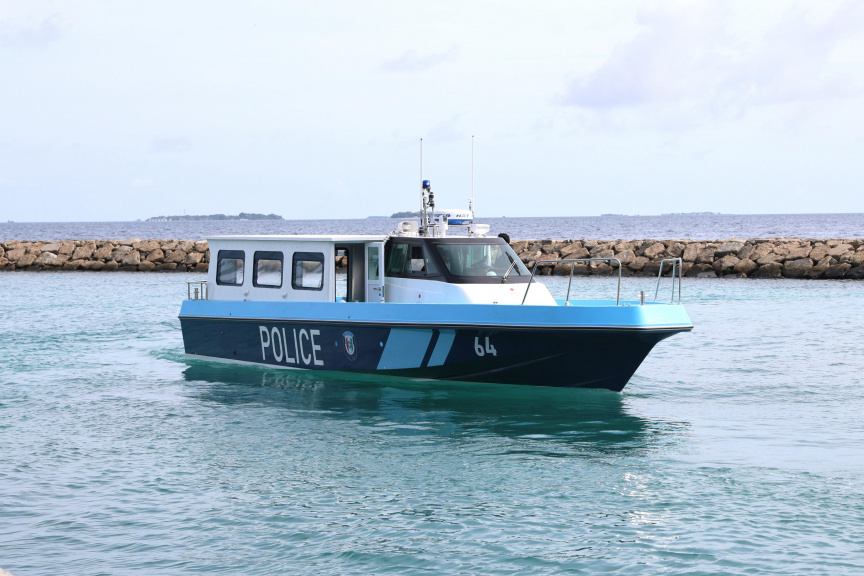
A police speedboat: Supreme Court upholds dismissal of police officer for financial misconduct in speedboat repair case. (Photo/Maldives Police Service)
The Supreme Court has upheld the Police Disciplinary Board’s decision to dismiss Adam Iyaz, former Head of Marine Police and Chief Inspector of Police, over violations of the Public Finance Regulation relating to the repair and towing of a police vessel.
The case stems from Iyaz’s dismissal in 2018 following allegations of financial misconduct involving the transportation of the vessel “Police 20” to Sri Lanka for repairs and its subsequent return to Malé. The vessel had run aground on a reef in Meemu Atoll in September 2015. The alleged violations included releasing 6,500 litres of fuel to a tugboat without authorisation from the Finance Department and personally issuing letters to Allied Insurance to facilitate payments to private companies.
Iyaz initially challenged his dismissal at the Civil Court, seeking reinstatement on the grounds that his termination was unlawful. However, the court ruled in favour of the State, a decision subsequently upheld by the High Court on appeal.
In his appeal to the Supreme Court, Iyaz raised several procedural concerns. He argued that the Civil Court had failed to summon witnesses he had proposed to demonstrate shortcomings in the Disciplinary Board’s investigation. He contended that the court’s failure to explain this omission in its final report amounted to a breach of judicial procedure. He also noted that a decision by the National Integrity Commission (NIC), which had found his dismissal to be inconsistent with established regulations, had not been followed. In addition, he highlighted that the Anti-Corruption Commission (ACC) had found no evidence of corruption in its investigation into the matter.
In its unanimous verdict, the Supreme Court acknowledged that judicial precedents require courts to provide reasons for disregarding proposed evidence. However, it stated that a lower court’s judgment should not be overturned unless the omission could have affected the outcome of the case.
The Court determined that even if the proposed witnesses had been summoned, documentary evidence clearly established that Iyaz had violated the Public Finance Regulation. The ruling emphasised that he had failed to follow the prescribed procedures for claiming insurance compensation. The Court also noted that, under established Supreme Court precedents, the standard of proof required to dismiss police officers is less stringent than that applied in general employment cases.
Addressing the other arguments, the Court clarified that since Iyaz had been dismissed before the NIC issued its decision, the commission’s directives were not legally binding on the institution under the NIC Act. It also stated that the ACC’s findings could not be taken into consideration, as they had been submitted after the Supreme Court hearings had concluded.
Concluding that there were no legal or judicial grounds to overturn the High Court’s ruling, the Supreme Court upheld the lower court’s decision, confirming the legality of Iyaz’s dismissal.